
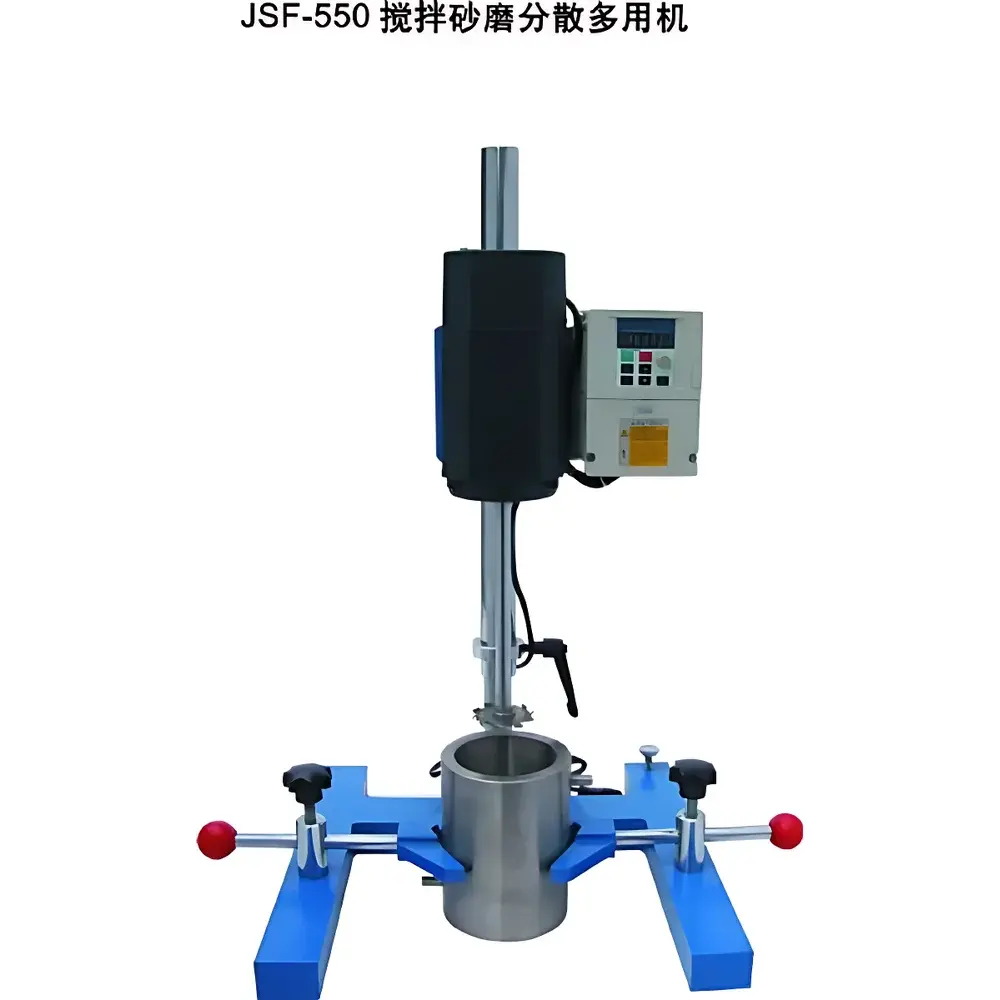
JFS-550 Multi-Function Lab Homogenizer with Stirring, Bead Milling & Dispersion Capabilities
| Origin | Shanghai, China |
|---|---|
| Manufacturer Type | Authorized Distributor |
| Product Origin | Domestic (China) |
| Model | JFS-550 |
| Price | Upon Request |
| Motor | 550 W, 220 V / 50 Hz |
| Speed Range | 0–10,000 rpm |
| Dispersion Blade Diameters | Φ50 mm, Φ60 mm |
| Bead Milling Disc Diameters | Φ45 mm, Φ60 mm |
| Chamber Volume | 1.2 L |
| Vertical Travel | 280 mm |
| Dimensions (L×W×H) | 450 × 420 × 550 mm |
| Net Weight | 36 kg |
Overview
The JFS-550 Multi-Function Lab Homogenizer is an integrated benchtop unit engineered for precision mixing, wet bead milling, and high-shear dispersion in research and quality control laboratories. It operates on the principle of mechanical energy transfer via rotating impellers—utilizing interchangeable rotor-stator configurations to achieve controlled particle size reduction (via bead-assisted attrition), uniform suspension homogenization (via high-speed dispersion), and macro-scale blending (via axial or radial stirring). Unlike single-mode homogenizers, the JFS-550 supports three distinct operational modes within one compact architecture: (1) low-shear stirring for gentle blending of viscous pastes or suspensions; (2) medium-to-high shear dispersion using serrated or sawtooth blades to deagglomerate pigments, nanomaterials, or polymer fillers; and (3) wet grinding via replaceable bead-milling discs that generate turbulent flow fields between rotating and stationary surfaces, enabling sub-micron particle size distribution control in aqueous or organic media. Its design conforms to standard laboratory safety practices—including IP20-rated electrical enclosures, thermal overload protection, and emergency stop integration—and is suitable for use under ISO/IEC 17025-accredited testing environments where method reproducibility and equipment traceability are required.
Key Features
- Brushless frequency-controlled squirrel-cage motor delivering stable torque across the full 0–10,000 rpm speed range, with <±1% speed regulation accuracy at setpoint
- Integrated digital frequency converter mounted directly on the chassis, featuring a backlit LCD display showing real-time shaft rotational speed (rpm) without external instrumentation
- Modular tooling system supporting rapid interchange of three functional head types: stirring paddles (for low-viscosity blending), dispersion blades (Φ50 mm and Φ60 mm diameters), and bead-milling discs (Φ45 mm and Φ60 mm) optimized for zirconia or stainless-steel grinding media
- Motorized vertical lift mechanism with 280 mm travel stroke, enabling precise adjustment of impeller immersion depth relative to sample volume—critical for maintaining consistent shear rate profiles during scale-down experiments
- Stainless steel housing (AISI 304) with reinforced base plate and anti-vibration rubber feet; total mass of 36 kg ensures operational stability during high-rpm dispersion cycles
- Benchtop footprint of 450 × 420 mm accommodates standard fume hoods and laminar flow workstations; height-adjustable column allows compatibility with vessels ranging from 500 mL beakers to 1.2 L jacketed reactors
Sample Compatibility & Compliance
The JFS-550 accommodates samples with viscosities up to 10,000 mPa·s (measured at 25 °C) and solids loading up to 60 wt% in liquid phases. It is routinely employed in formulation development for coatings, inks, battery slurries, pharmaceutical suspensions, and cosmetic emulsions. All wetted parts—including blade hubs, disc mounts, and chamber adapters—are constructed from corrosion-resistant materials compliant with USP Class VI and FDA 21 CFR Part 110 guidelines for incidental food contact. While not certified as GMP-compliant out-of-the-box, the system supports GLP documentation workflows through manual logbook entries and can be validated per ASTM D2196 (viscosity measurement) and ISO 13320 (laser diffraction particle sizing) when coupled with external analytical instrumentation. Electrical compliance meets IEC 61000-6-3 (EMC emissions) and IEC 61000-6-2 (immunity) standards.
Software & Data Management
The JFS-550 operates as a standalone instrument without proprietary software dependency. Speed settings are manually configured via front-panel keypad input, and all operational parameters—including runtime, target rpm, and tooling configuration—are recorded manually in laboratory notebooks per GLP requirements. For audit readiness, users may integrate optional external data loggers (e.g., Omega OM-DAQPRO-5300) via analog 0–10 V output signals derived from the frequency converter’s internal tachometer feedback loop. This enables time-stamped RPM logging compatible with electronic lab notebook (ELN) platforms such as LabArchives or Benchling. No cloud connectivity or firmware updates are provided; device firmware remains static to ensure long-term method equivalence in regulated environments.
Applications
- Preparation of stable pigment dispersions for UV-curable inkjet inks (targeting D50 < 200 nm after 30 min milling)
- Rapid deagglomeration of nano-TiO₂ or carbon black in solvent-based resin systems prior to rheological characterization
- Homogenization of lithium iron phosphate (LFP) cathode slurries for solid-state battery R&D, ensuring uniform conductive additive distribution
- Batch-wise reconstitution of lyophilized biopolymer powders into homogeneous hydrogels for texture analysis
- Scale-down simulation of industrial colloid mills for process parameter mapping (e.g., energy input vs. particle size reduction efficiency)
FAQ
What types of grinding media are compatible with the JFS-550 bead-milling function?
Zirconium oxide (ZrO₂), yttria-stabilized zirconia (YSZ), and stainless-steel beads ranging from 0.3 mm to 2.0 mm diameter are mechanically compatible. Media charge ratio should be maintained between 1:1 and 2:1 (media:sample volume) for optimal attrition kinetics.
Can the JFS-550 be used under inert atmosphere conditions?
Yes—when paired with sealed reactor vessels equipped with gas inlet/outlet ports and magnetic stirrer-compatible lids, the unit supports nitrogen or argon purging during milling of oxygen-sensitive materials such as organometallic catalysts.
Is calibration documentation available for the speed display?
The built-in tachometer is factory-calibrated against NIST-traceable optical tachometry. A calibration certificate (including uncertainty budget per ISO/IEC 17025) can be issued upon request at time of purchase.
Does the system support continuous operation at maximum speed?
Continuous operation at 10,000 rpm is rated for ≤30 minutes per cycle, followed by a minimum 15-minute cooldown period to prevent thermal drift in motor winding resistance and bearing lubricant viscosity.
How is maintenance performed on the motor and drive train?
The brushless motor requires no scheduled commutator servicing. Annual inspection includes torque verification of blade mounting screws, visual assessment of disc surface wear, and lubrication of the lift column’s linear guide rails using ISO VG 68 synthetic grease.



