
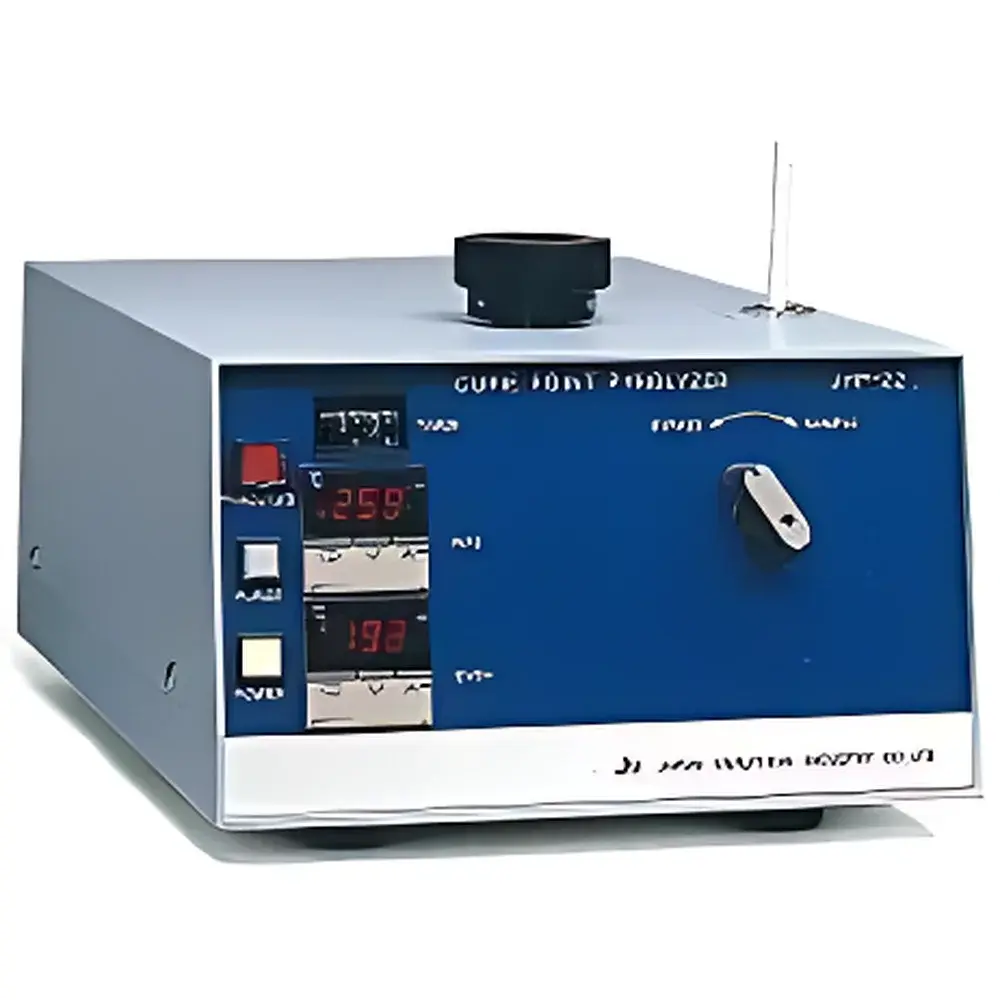
JHP-22 Curie-Point Pyrolyzer
| Origin | Japan |
|---|---|
| Manufacturer Type | Authorized Distributor |
| Origin Category | Imported |
| Model | JHP-22 |
| Instrument Type | Curie-Point Pyrolyzer |
| Heating Method | High-Frequency Induction with Curie-Point Ferromagnetic Foil |
| Sample Tube | Quartz, 4.5 mm ID (Pyrolysis Chamber) |
| Furnace Temperature Range | Ambient to 200 °C |
| Pyrolysis Duration | 1–99 s |
| Transfer Line Temperature Range | Ambient to 300 °C, Length: 0.7 m |
| RF Power Output | 48 W |
| Flow Path Switching | Solenoid Valve |
| Dimensions (W×H×D) | 305 × 190 × 465 mm |
| Weight | 18 kg |
| Power Supply | AC 100 V, 7 A |
| GC Compatibility | Universal GC Interface (Excluding Proprietary Direct-Coupled Systems) |
| Optional Curie Temperatures | 1040, 920, 764, 740, 670, 650, 590, 500, 485, 445, 423, 386, 358, 333, 315, 280, 255, 235, 220, 170, 160 °C |
Overview
The JHP-22 Curie-Point Pyrolyzer is a compact, high-precision thermal desorption interface engineered for seamless integration with gas chromatography (GC) systems. It employs ferromagnetic Curie-point heating—a physically deterministic method wherein temperature is intrinsically defined by the magnetic phase transition of precisely alloyed metal foils. When exposed to high-frequency electromagnetic fields, the foil rapidly heats to its designated Curie temperature and self-regulates at that point without external feedback control, ensuring exceptional thermal reproducibility (±0.5 °C typical) and minimal thermal overshoot. This principle eliminates reliance on conventional resistive heaters or thermocouple-based PID loops, thereby reducing drift, hysteresis, and calibration dependency. Designed for routine polymer characterization, forensic residue analysis, microplastic identification, and pyrolysis-GC/MS of thermally labile biomaterials, the JHP-22 delivers rapid, repeatable, and contamination-minimized thermal fragmentation under inert or carrier-gas-free conditions.
Key Features
- Curie-point induction heating with 21 pre-calibrated temperature options (160–1040 °C), enabling precise selection of cleavage thresholds aligned with specific bond dissociation energies.
- Integrated bypass flow path allows direct injection of volatile analytes—without pyrolysis—for concurrent analysis of intact low-molecular-weight species alongside thermally fragmented products.
- Quartz sample tube (4.5 mm ID) housed within a thermostatically controlled furnace (ambient to 200 °C), minimizing cold spots and preventing premature condensation of semi-volatiles during transfer.
- Electropolished and chemically passivated flow path surfaces—including the 0.7 m heated transfer line (ambient to 300 °C)—reduce active site adsorption and suppress background artifacts in trace-level applications.
- Tool-free quartz tube replacement and modular electromagnetic valve actuation enable full system maintenance in under 90 seconds—critical for high-throughput QC laboratories.
- Compact footprint (305 × 190 × 465 mm) and lightweight construction (18 kg) facilitate benchtop deployment in space-constrained GC labs or mobile analytical units.
Sample Compatibility & Compliance
The JHP-22 accommodates solid, powdered, or thin-film samples up to 2 mg in mass, including synthetic polymers (e.g., PVC, PET, polyolefins), natural biopolymers (cellulose, lignin, chitin), elastomers, coatings, adhesives, and environmental particulates. Its carrier-gas-independent operation permits pyrolysis under static vacuum or inert purge, supporting ASTM D7217–22 (Standard Test Method for Determination of Polymer Composition by Pyrolysis-GC) and ISO 17205:2021 (Plastics — Identification by Pyrolysis–Gas Chromatography). The system’s passive thermal stability and absence of mechanical moving parts within the hot zone meet GLP audit requirements for instrument qualification (IQ/OQ/PQ), and its solenoid-controlled flow routing supports 21 CFR Part 11–compliant electronic record integrity when paired with validated GC data systems.
Software & Data Management
While the JHP-22 operates as a hardware-integrated peripheral without embedded firmware or touchscreen interface, it is fully controllable via standard GC vendor software (Agilent OpenLab, Thermo Chromeleon, Shimadzu GCsolution) through TTL-triggered event synchronization. Pyrolysis timing (1–99 s), transfer line ramp profiles, and valve switching sequences are programmable as discrete GC method steps. All operational parameters—including selected Curie temperature, dwell time, and furnace setpoint—are logged as ASCII metadata tags in the resulting chromatographic data file (.cdf or .u2), ensuring full traceability for regulatory submissions. Optional RS-232 or USB-to-TTL adapters enable third-party script automation (Python/LabVIEW) for unattended batch processing across multi-day stability studies.
Applications
- Quantitative polymer blend identification in recycling streams using characteristic fragment ion ratios (e.g., styrene/butadiene for SBR; acrylonitrile/styrene for ABS).
- Forensic analysis of paint chips, fire debris, or illicit drug matrices where thermal degradation patterns serve as molecular fingerprints.
- Microplastic detection in environmental water and soil extracts—paired with GC×GC–TOFMS for enhanced peak capacity and spectral deconvolution.
- Thermal stability assessment of pharmaceutical excipients and packaging materials per ICH Q1A(R2) guidelines.
- Rapid screening of cured epoxy resins and composite matrix degradation pathways in aerospace QA/QC workflows.
FAQ
Does the JHP-22 require carrier gas to initiate pyrolysis?
No. The Curie-point induction mechanism operates independently of gas flow; pyrolysis occurs in static atmosphere or under vacuum.
Can the same Curie-point foil be reused across multiple analyses?
Yes—foils are single-use consumables only when maximum thermal precision is required; for routine screening, foils may be reused up to five times if no visible oxidation or warping is observed.
Is the quartz sample tube compatible with aggressive halogenated solvents?
Yes, fused quartz exhibits excellent resistance to HF, HCl, and chlorinated hydrocarbons below 200 °C; however, prolonged exposure to hot aqueous NaOH should be avoided.
How is temperature calibration verified?
Calibration is performed using NIST-traceable Curie standards (e.g., nickel foil: 354 °C ± 0.3 °C); users receive a factory calibration certificate with foil lot traceability and uncertainty budget.
What GC inlet configurations are supported?
All split/splitless, PTV, and cool-on-column inlets; direct coupling requires a custom GC transfer union (included with purchase) and alignment verification per manufacturer specifications.




