
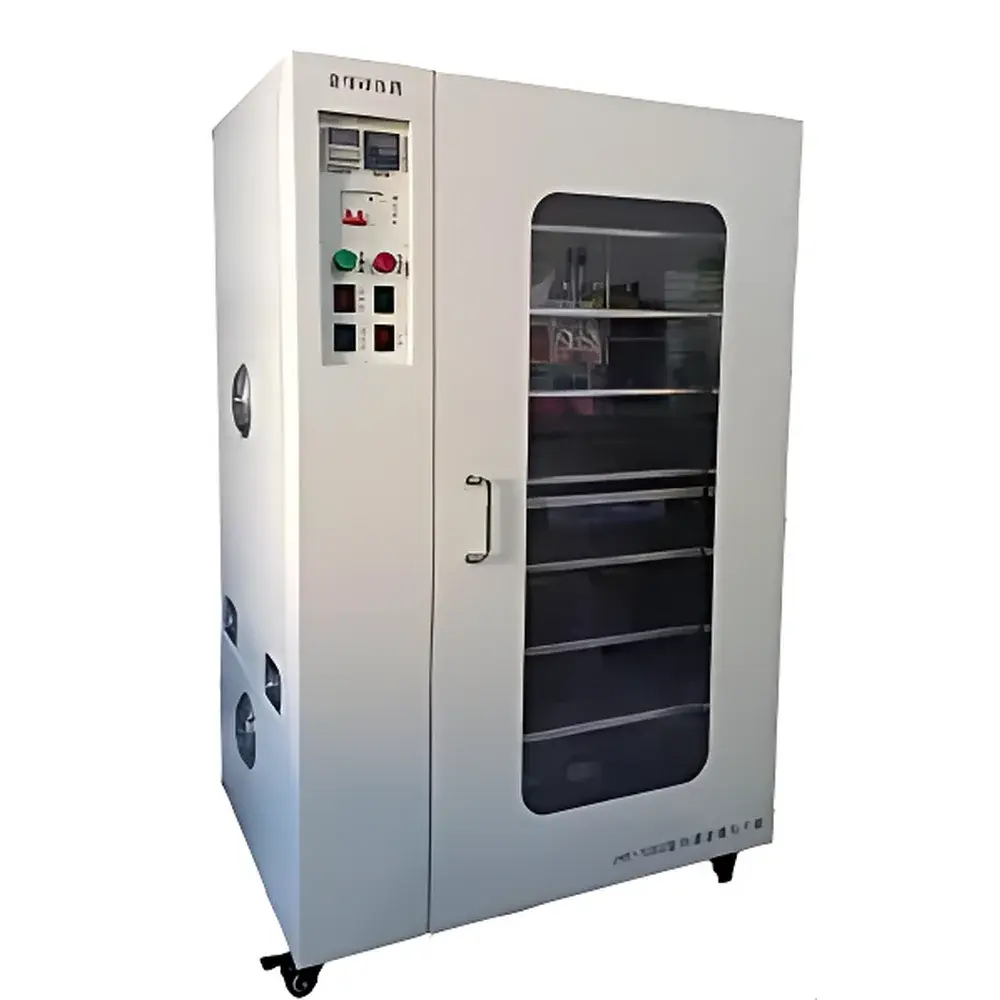
JHX-3000 Rapid Cuttings Drying Oven
| Brand | Jinhengxiang (JHX) |
|---|---|
| Origin | Beijing, China |
| Model | JHX-3000 |
| Max Operating Temperature | 80 °C |
| Chamber Capacity | 42 sample trays (7 tiers × 6 trays/tier) |
| Ventilation System | S-path recirculating airflow with independent fan control |
| Tray Design | Perforated stainless steel mesh base |
| Interior Lighting | Integrated LED illumination |
| Viewing Window | Tempered glass observation window with seal |
| Safety Features | Leakage current protection circuit breaker |
| Control Interface | Dual independent switches (heating / ventilation), mechanical timer, dedicated drying tools included |
| Construction | Fully stainless steel chamber and housing |
| Compliance | Designed for on-site wellsite and laboratory use in petroleum logging workflows |
Overview
The JHX-3000 Rapid Cuttings Drying Oven is an engineered thermal conditioning system specifically developed for the preparation of geological cuttings samples in petroleum exploration and drilling operations. Unlike conventional ovens that rely on static convection or high-temperature exposure—often inducing thermal alteration, hydrocarbon loss, or mineral phase changes—the JHX-3000 employs a low-temperature, high-airflow methodology grounded in controlled convective desiccation. Operating at a maximum temperature of 80 °C, it maintains sample integrity by minimizing volatile organic compound (VOC) evaporation while accelerating moisture removal through optimized air velocity and path geometry. Its S-path recirculating airflow design ensures uniform thermal distribution across all tray levels without hot spots, supporting reproducible drying kinetics essential for subsequent geochemical analysis (e.g., XRD, GC-MS, elemental analysis) and lithological interpretation.
Key Features
- Stainless steel construction throughout—chamber, shelving, and exterior housing—for corrosion resistance in high-humidity, hydrocarbon-laden environments typical of mud logging units and field laboratories.
- Seven-tier vertical configuration accommodating up to 42 standardized cuttings trays (6 per tier), enabling batch processing aligned with standard API RP 13B-1 and ISO 10426-1 sample handling protocols.
- Perforated stainless steel mesh trays ensure unimpeded airflow from below, promoting even surface drying and preventing sample aggregation or channeling effects common with solid-bottom trays.
- Independent dual-control system: heating element and centrifugal blower operate via separate toggle switches, allowing ventilation-only operation for ambient-temperature air exchange or cooling cycles.
- Mechanical timer (0–99 min) provides repeatable cycle definition; no software dependency ensures reliability in remote or electrically unstable wellsite conditions.
- Integrated LED lighting and large sealed tempered glass viewport support real-time visual monitoring without opening the chamber—critical for maintaining thermal consistency and avoiding cross-contamination.
- Ground-fault circuit interrupter (GFCI)-rated leakage protection complies with IEC 61000-4-5 surge immunity standards and meets basic electrical safety requirements for mobile lab deployment.
Sample Compatibility & Compliance
The JHX-3000 accommodates standard 100 mm × 150 mm cuttings trays used across major service companies (e.g., Schlumberger, Halliburton, Baker Hughes) and national oilfield laboratories. It supports wet, slurry, and partially consolidated cuttings from rotary, directional, and LWD/MWD drilling operations. While not certified to UL/CSA or ATEX standards, its design aligns with recommended practices outlined in API RP 13B-1 (Drilling Fluids Testing Procedures) and CNPC Q/SH 0128–2007 (Petroleum Logging Sample Preparation Specifications). The absence of internal electronics or digital controllers eliminates electromagnetic interference concerns during concurrent downhole tool calibration.
Software & Data Management
The JHX-3000 is a hardware-only, analog-controlled instrument with no embedded firmware, network interface, or data logging capability. This architecture ensures operational continuity in environments where cybersecurity protocols restrict connected devices, and eliminates validation overhead associated with FDA 21 CFR Part 11 or GLP audit trails. Process parameters (time, temperature selection, airflow mode) are recorded manually in field logs or integrated into existing LIMS workflows via external documentation. No software installation, licensing, or firmware updates are required.
Applications
- Preliminary drying of drill cuttings prior to X-ray diffraction (XRD) or thin-section preparation—preserving clay mineral hydration states.
- Pre-analytical stabilization of samples destined for total organic carbon (TOC) or Rock-Eval pyrolysis, where excessive heat degrades kerogen signatures.
- Routine moisture content benchmarking in accordance with ASTM D2234/D2234M (Standard Practice for Collection of a Gross Sample of Coal or Coke).
- On-the-fly sample conditioning during continuous logging operations where turnaround time between depth intervals is constrained.
- Supporting QA/QC workflows in accredited petroleum testing labs operating under ISO/IEC 17025:2017, where equipment traceability and procedural repeatability are documented externally.
FAQ
What is the maximum safe operating temperature for sensitive cuttings samples?
The JHX-3000 is calibrated to a hard limit of 80 °C, selected to remain below the onset temperature of common bitumen softening (~85–90 °C) and smectite dehydration (~100 °C), preserving diagnostic mineralogical and organic features.
Can the oven be used for drying non-petroleum geological samples?
Yes—its airflow-first, low-heat approach is suitable for paleontological matrix, soil cores, and sedimentary particulates where thermal degradation must be avoided; however, compatibility with volatile-rich samples (e.g., coal, oil shale) should be verified per project-specific SOPs.
Is calibration certification provided with the unit?
No factory calibration certificate is included; users are advised to perform initial temperature uniformity mapping using NIST-traceable thermocouples per ASTM E220 and document results as part of their equipment qualification protocol.
Does the unit require external exhaust ducting?
No—its sealed recirculation system operates without venting; optional passive exhaust may be added via rear port if local HSE policies mandate removal of airborne hydrocarbons.
What maintenance is required for long-term field deployment?
Bi-weekly cleaning of tray mesh apertures and fan inlet grille with non-abrasive stainless steel cleaner; annual inspection of GFCI functionality and door gasket integrity per manufacturer’s maintenance checklist.






