
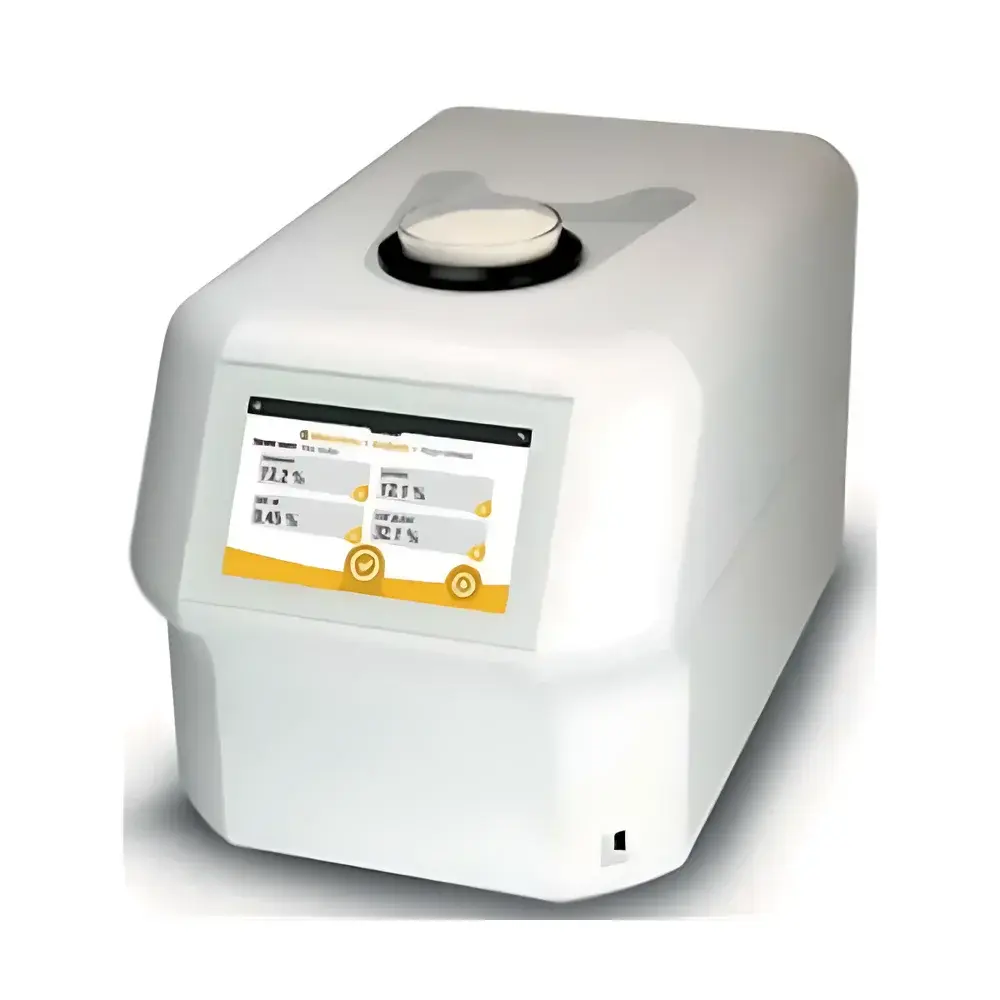
JHX SpectraAlyzer FLOUR Full-Flour Quality Analyzer
| Brand | JHX |
|---|---|
| Origin | Germany |
| Model | FLOUR |
| Measurement Principle | Near-Infrared (NIR) Reflectance Spectroscopy |
| Analysis Time | ≤45 s per sample |
| Parameters Measured | Moisture, Protein, Gluten, Starch, Ash, Color (L*a*b* or CIE XYZ) |
| Sample Handling | Non-destructive, Reagent-free, No Manual Adjustment Required |
| Calibration | Pre-loaded Factory Calibrations + User-Adjustable Multivariate Models |
| Environmental Rating | IP54-rated Enclosure |
| Operating Temperature Range | 10–40 °C |
| Software Compliance | Supports Audit Trail, User Access Levels, Electronic Signatures per FDA 21 CFR Part 11 |
| Data Export | CSV, XML, SQL via Ethernet/USB |
| Regulatory Alignment | Compliant with ISO 712 (moisture), ISO 20483 (protein), ICC Standard No. 169 (gluten), and AACC Method 44-15A (starch) |
Overview
The JHX SpectraAlyzer FLOUR is a benchtop near-infrared (NIR) reflectance spectrometer engineered for rapid, non-destructive, and reagent-free quantitative analysis of wheat flour, durum semolina, rice flour, corn starch, potato starch, and other cereal-based powders. Operating on the principle of diffuse reflectance spectroscopy in the 900–2500 nm spectral range, the instrument captures characteristic absorption bands associated with O–H (moisture), N–H (protein), C–H (starch), and aromatic side-chain vibrations (ash and color). Unlike wet chemistry or Kjeldahl-based methods, SpectraAlyzer FLOUR delivers calibrated compositional data without sample digestion, solvent use, or operator-dependent preparation—enabling consistent measurement across shifts, operators, and production lines. Its optical architecture features dual-beam referencing with temperature-stabilized tungsten-halogen and deuterium light sources, coupled to a high-resolution grating spectrometer and InGaAs detector array. This design ensures long-term photometric stability under ambient factory conditions, including thermal drift up to ±2 °C/h and mechanical vibration typical of milling environments.
Key Features
- Full-spectrum NIR analysis in ≤45 seconds per sample—no grinding, sieving, or conditioning required
- Factory-calibrated multivariate regression models for moisture (0.5–18.0 % w/w), protein (6–16 % w/w), gluten (2–12 % w/w), starch (55–85 % w/w), ash (0.3–1.2 % w/w), and CIE L*a*b* color coordinates
- Self-diagnostic optical path monitoring with real-time signal-to-noise ratio (SNR) reporting and automatic lamp intensity compensation
- IP54-rated aluminum housing with anti-static powder coating, shock-absorbing feet, and sealed optical chamber resistant to flour dust ingress
- Integrated touchscreen interface with intuitive workflow navigation—designed for operation by QC technicians without spectroscopy training
- Modular software architecture supporting method validation, calibration transfer between instruments, and partial least squares (PLS) model optimization
Sample Compatibility & Compliance
The SpectraAlyzer FLOUR accepts bulk flour samples (20–50 g) in standard petri dishes or stainless-steel sample cups. It accommodates variations in particle size distribution (D50 = 40–120 µm), bulk density (0.45–0.65 g/cm³), and flowability without manual compaction or leveling. Validation studies confirm compliance with ISO 712:2022 (cereal and cereal products — determination of moisture content — reference method), ISO 20483:2022 (cereals and pulses — determination of nitrogen content — reference method), and AACC International Approved Method 44-15A (starch content in flour). All calibrations are traceable to NIST SRM 1567b (wheat flour) and CRM 80101 (potato starch). The system supports GLP/GMP documentation requirements through configurable audit trails, electronic signature enforcement, and role-based user permissions aligned with FDA 21 CFR Part 11.
Software & Data Management
SpectraSoft FLOUR v4.2 provides full lifecycle management of analytical data—from acquisition and calibration development to report generation and database integration. The software includes built-in tools for outlier detection (Mahalanobis distance), spectral preprocessing (Savitzky-Golay smoothing, multiplicative scatter correction), and PLS regression diagnostics (RMSEC, RMSEP, R², VIP scores). Raw spectra and processed results are stored in an embedded SQLite database with optional synchronization to enterprise SQL Server or cloud-hosted instances via TLS-encrypted HTTPS. Batch reports comply with ISO/IEC 17025 formatting standards and export directly to LIMS platforms using ASTM E1384-compliant XML schemas. All user actions—including calibration updates, result edits, and method changes—are timestamped, attributed, and immutable within the audit trail.
Applications
- Real-time quality control at mill discharge points to verify compliance with contractual specifications (e.g., protein ≥12.5 %, ash ≤0.55 %)
- Blending optimization for specialty flours (high-gluten bread flour, low-protein cake flour, gluten-free blends)
- Routine verification of incoming wheat lots against supplier certificates of analysis
- Starch modification monitoring during acid hydrolysis or enzymatic treatment processes
- Color consistency tracking across harvest years and cultivars—critical for premium pasta and noodle applications
- Supporting HACCP critical control point documentation for moisture-related microbial risk mitigation
FAQ
Does the SpectraAlyzer FLOUR require daily recalibration?
No—factory calibrations remain stable for ≥6 months under normal operating conditions. Daily performance verification is performed automatically using an internal ceramic reference tile; only quarterly validation against certified reference materials is recommended.
Can the instrument analyze whole grain or bran-enriched flours?
Yes—models are validated for flours containing up to 15 % bran particles (≤250 µm), though optimal accuracy is achieved with standardized milling protocols per ICC Standard No. 111.
Is spectral data export supported for third-party chemometrics software?
Yes—raw absorbance spectra (CSV format) and PLS model coefficients (XML) are fully exportable for offline modeling in Unscrambler, MATLAB, or Python-based scikit-learn workflows.
What maintenance is required beyond routine cleaning?
Annual optical alignment verification and detector dark-current characterization are the only scheduled service interventions; no consumables or lamp replacements are needed within the first 5 years of operation.
How does the system handle ambient lighting interference?
The optical enclosure is light-tight, and the measurement cycle employs synchronized pulsed illumination with lock-in amplification—eliminating influence from ambient fluorescent, LED, or daylight sources.



