
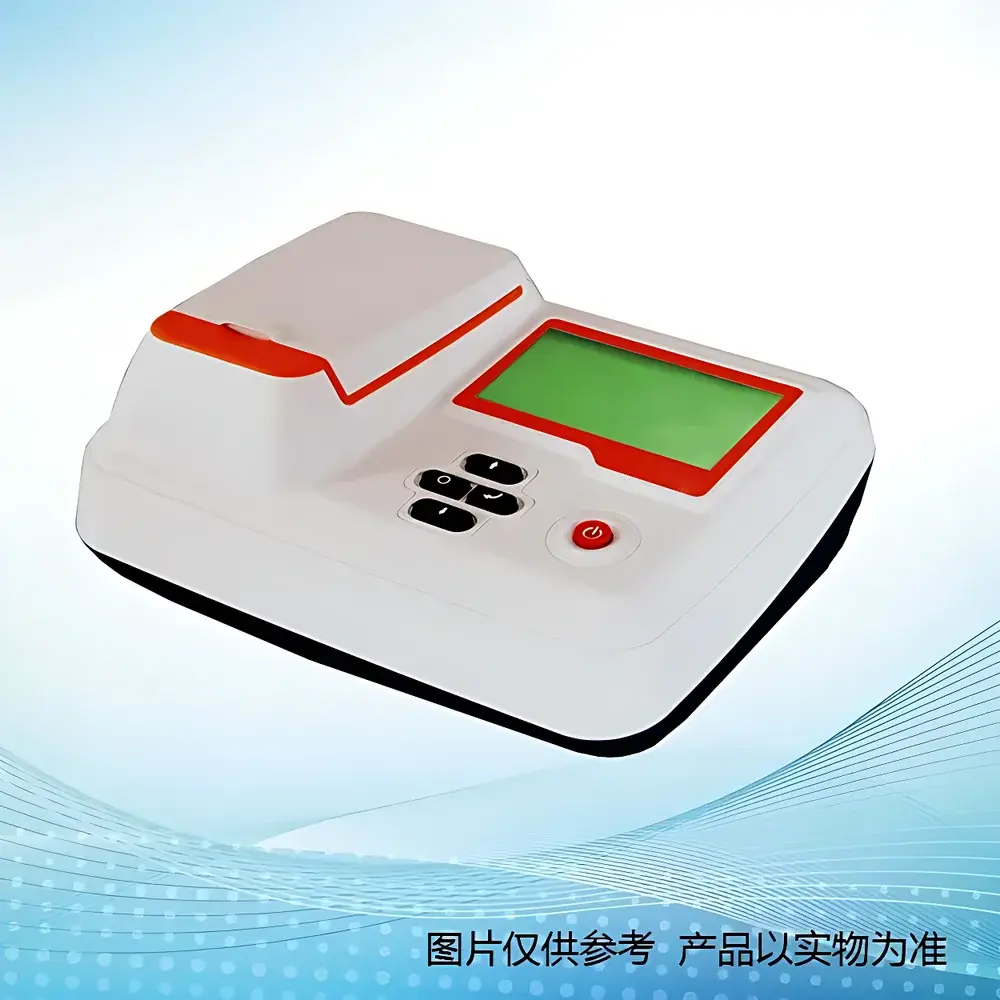
Jiada Xiaotian’e GDYK-102S On-Site Hydrogen Sulfide Gas Analyzer
| Brand | Jiada Xiaotian'e |
|---|---|
| Origin | Jilin, China |
| Manufacturer Type | Direct Manufacturer |
| Country of Origin | China |
| Model | GDYK-102S |
| Light Source | High-Brightness LED |
| Wavelength | 635 nm |
| Detection Limit | 0.005 mg/m³ |
| Measurement Range | 0.000–0.100 mg/m³ (40 L sampling volume) or 0.000–0.800 mg/m³ (5 L sampling volume) |
| Accuracy | ±5% |
| Power Supply | AC 220 V ±22 V, 50 Hz ±1 Hz |
| Dimensions | 310 × 225 × 125 mm |
| Weight | 1.7 kg |
Overview
The Jiada Xiaotian’e GDYK-102S On-Site Hydrogen Sulfide Gas Analyzer is a portable, colorimetric-based field instrument engineered for rapid, quantitative determination of hydrogen sulfide (H₂S) in ambient and indoor air environments. It operates on the principle of solid-phase colorimetric reaction: sampled air is drawn through a pre-coated detection tube or reagent strip, where H₂S reacts selectively with lead acetate or analogous metal salt reagents to form a stable, chromogenic complex (e.g., lead sulfide). The intensity of the resulting color change—measured optically at 635 nm using a high-stability LED light source and integrated photodetector—is linearly proportional to H₂S concentration within defined dynamic ranges. This methodology avoids the complexity and calibration drift associated with electrochemical or semiconductor sensors, delivering robust performance under variable temperature and humidity conditions typical of outdoor environmental monitoring or occupational hygiene assessments.
Key Features
- Optimized optical path design with 635 nm high-brightness LED ensures consistent excitation and minimizes spectral interference from ambient light or particulate scattering.
- Dual-range measurement capability: configurable sampling volumes (5 L or 40 L) enable flexible deployment—from spot-checking confined spaces (e.g., sewage pump stations, biogas facilities) to broader ambient air surveys—without hardware modification.
- Integrated rechargeable lithium-ion battery (7.4 V, 900 mAh) supports continuous operation for ≥4 hours per charge, supplemented by universal AC input (220 V ±10%, 50 Hz), ensuring operational continuity across field and lab settings.
- Compact ergonomic housing (310 × 225 × 125 mm; 1.7 kg) features IP54-rated ingress protection, impact-resistant ABS casing, and tactile membrane keypad for reliable use in dusty or humid environments.
- Factory-calibrated optical baseline and zero-reference stability verified per ISO 17025-accredited procedures; no user-performed optical recalibration required during standard service intervals.
Sample Compatibility & Compliance
The GDYK-102S is validated for direct analysis of undiluted ambient and indoor air matrices without pre-filtration (except when particulate load exceeds 100 µg/m³, in which case a 0.3 µm PTFE filter is recommended). It complies with methodological principles aligned with EPA Method IO-4.2 (colorimetric H₂S analysis) and Chinese Standard HJ 501–2009 (Environmental Air Quality — Determination of Hydrogen Sulfide — Methylene Blue Spectrophotometric Method), adapted for field use via dry-reagent solid-phase chemistry. While not certified for explosion-proof use (ATEX/IECEx), its non-sparking electronics and low-power architecture make it suitable for Class II, Division 2 hazardous locations when operated per site-specific risk assessment protocols. Data output meets GLP documentation requirements for field-deployed environmental instruments.
Software & Data Management
The device stores up to 500 measurement records internally, each timestamped and tagged with sampling volume, operator ID (manually entered), and environmental notes. Data export is supported via USB-C interface to Windows-compatible desktop software (GDYK-DataLink v2.1), which generates audit-trail-compliant reports including raw absorbance values, calculated concentrations, uncertainty estimates (±5% expanded uncertainty, k=2), and compliance flags against WHO air quality guidelines (10 µg/m³ 24-h mean) and OSHA PEL-TWA (10 ppm ≈ 14 mg/m³). Software enforces 21 CFR Part 11–compatible electronic signatures and version-controlled firmware updates.
Applications
- Real-time H₂S screening at wastewater treatment plants, landfill gas collection points, and agricultural digesters.
- Indoor air quality (IAQ) assessment in industrial buildings, laboratories, and remediation sites following H₂S release incidents.
- Regulatory compliance monitoring for municipal environmental protection bureaus conducting routine ambient air network sampling.
- Occupational exposure assessment in oil & gas upstream operations, pulp & paper mills, and sulfur recovery units—supporting exposure banding per ACGIH TLV® framework.
- Educational use in environmental science curricula for hands-on training in trace gas quantification and field method validation.
FAQ
What is the recommended calibration frequency for the GDYK-102S?
Annual factory recalibration is recommended; field verification using NIST-traceable H₂S permeation tubes (e.g., 0.05 mg/m³ and 0.5 mg/m³) should be performed before each daily sampling campaign.
Can the GDYK-102S measure H₂S in humid or rainy conditions?
Yes—the optical detection module is sealed and thermally stabilized; however, prolonged exposure to condensation on the sampling inlet may affect flow rate accuracy. Use of the optional hydrophobic inlet filter is advised in RH >90% environments.
Is the instrument compatible with third-party data logging platforms?
Raw serial output (ASCII protocol, 9600 baud) is available via USB-C virtual COM port, enabling integration with LabVIEW, Python-based SCADA systems, or custom IoT gateways.
Does the GDYK-102S require consumables beyond the detection tubes?
Only pre-packaged, lot-numbered H₂S detection tubes (catalog #GDYK-TUBE-H2S-635) are required; no solvents, gases, or reagent solutions are needed.
How is measurement uncertainty quantified for regulatory reporting?
Total expanded uncertainty (k = 2) is ±5%, derived from repeatability (n = 6, CV ≤ 3.2%), linearity deviation (<2.1% F.S.), and photometric stability (drift <0.8% over 8 h), as documented in the Certificate of Conformance shipped with each unit.
Related Products







