
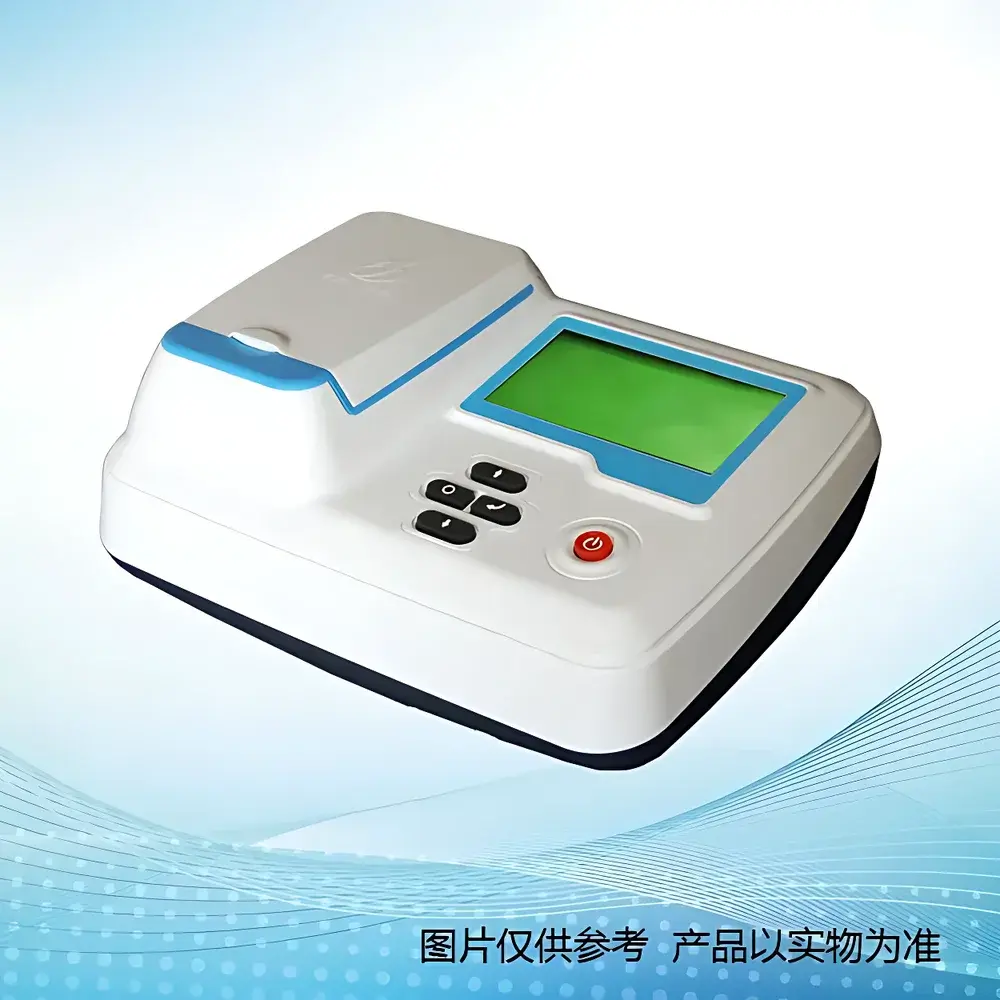
Jiada Xiaotian’e GDYK-211M Formaldehyde, BTEX & TVOC Indoor Air Analyzer
| Brand | Jiada Xiaotian'e |
|---|---|
| Origin | Jilin, China |
| Manufacturer Type | Direct Manufacturer |
| Country of Origin | China |
| Model | GDYK-211M |
| Detection Principle | Colorimetric Method |
| Measurement Range | Formaldehyde: 0.00–1.00 mg/m³ |
| BTEX (Benzene, Toluene, Ethylbenzene, Xylenes) | 0.00–1.00 mg/m³ |
| TVOC | 0.00–4.00 mg/m³ |
| Detection Limit | Formaldehyde: 0.01 mg/m³ |
| BTEX | 0.05 mg/m³ |
| TVOC | 0.05 mg/m³ |
| Accuracy | ±5% |
| Power Supply | 9 V alkaline battery (≥40 h continuous operation) |
| Auto-power-off | After 10 min inactivity |
| Dimensions & Weight | Compact, handheld design (<200 g) |
Overview
The Jiada Xiaotian’e GDYK-211M Formaldehyde, BTEX & TVOC Indoor Air Analyzer is a portable, field-deployable colorimetric instrument engineered for rapid, on-site quantification of three critical indoor air contaminants: formaldehyde, benzene and related aromatic hydrocarbons (BTEX), and total volatile organic compounds (TVOC). Based on standardized chromogenic reactions—aligned with GB/T 18204.2–2014 (formaldehyde), GB/T 18204.26–2014 (BTEX), and GB/T 18883–2002 (TVOC)—the analyzer delivers quantitative results without requiring laboratory infrastructure. Its operational principle relies on selective chemical derivatization: airborne analytes are collected via passive or active sampling onto reagent-impregnated substrates, followed by controlled thermal or ambient-time development to yield stable, intensity-proportional color complexes. Absorbance is measured at defined wavelengths using an integrated solid-state photometer, and concentration is calculated via pre-calibrated polynomial algorithms stored in firmware. Designed for routine screening in residential, commercial, and post-renovation environments, the GDYK-211M supports preliminary exposure assessment and compliance verification against national indoor air quality guidelines.
Key Features
- Triple-analyte capability: Simultaneous or sequential measurement of formaldehyde, BTEX (benzene, toluene, ethylbenzene, xylenes), and TVOC within a single platform
- Colorimetric detection with trace-level sensitivity: Detection limits of 0.01 mg/m³ for formaldehyde and 0.05 mg/m³ for both BTEX and TVOC—meeting threshold requirements for occupational and residential exposure screening
- Low-consumption reagent cartridge system: Pre-dosed, sealed chemical kits minimize operator handling, reduce reagent waste, and eliminate cross-contamination risks between samples
- Battery-operated architecture: Powered by a single 9 V alkaline cell; energy-efficient pulsed LED illumination and microcontroller sleep modes enable ≥40 hours of cumulative operation
- Auto-power management: System enters low-power standby after 10 minutes of inactivity and fully powers down to preserve battery life
- Ergonomic handheld form factor: Dimensions optimized for one-handed operation; net weight <200 g ensures portability during building walkthroughs, real estate inspections, or HVAC commissioning
Sample Compatibility & Compliance
The GDYK-211M is validated for use with standard 10 L–30 L air volumes drawn through supplied sampling tubes or passive diffusion badges, compatible with both active (pump-assisted) and passive collection protocols. All reagent formulations and calibration curves adhere to Chinese national standards (GB/T series) for indoor air monitoring. While not certified to ISO 16000 or ASTM D5197/D6196 for regulatory reporting, the instrument satisfies technical prerequisites for preliminary assessment under ISO 16000-22 (indoor air—determination of formaldehyde) and supports documentation workflows aligned with GLP principles—including timestamped result storage, batch-controlled reagent tracking, and user-defined sample ID entry. It is intended for qualitative/semi-quantitative screening—not definitive regulatory compliance testing—and should be supplemented with GC-MS or TD-GC-FID analysis when legal or health-based action levels are approached.
Software & Data Management
Data acquisition and reporting are managed via embedded firmware with non-volatile memory capable of storing up to 200 test records, each containing analyte concentration, sampling duration, date/time stamp, operator ID, and reagent lot number. Results export via USB-C interface to CSV-compatible spreadsheets for integration into facility management systems or QA/QC databases. Firmware supports configurable units (mg/m³ only), adjustable averaging windows (1–5 readings), and pass/fail threshold alerts based on GB 50325–2020 Class I/II limits. Audit trail functionality includes immutable logging of all configuration changes and calibration events—supporting basic traceability requirements under internal quality management systems.
Applications
- Routine indoor air quality (IAQ) audits in newly constructed or renovated offices, schools, and residential units
- Pre-occupancy verification testing prior to tenant move-in or LEED certification submissions
- Post-mitigation validation following formaldehyde abatement treatments or VOC source removal
- Real estate due diligence assessments and environmental disclosure reporting
- Occupational hygiene surveys in furniture manufacturing, printing, and coating facilities where solvent exposure is suspected
- Educational demonstrations of IAQ principles in environmental science and industrial hygiene curricula
FAQ
What sampling method does the GDYK-211M require?
It supports both active sampling (using an external diaphragm pump at 0.5–1.0 L/min) and passive diffusion sampling—depending on the selected reagent kit and target analyte.
Can the instrument differentiate individual BTEX compounds?
No. It provides a summed BTEX concentration based on collective reactivity with the aromatic amine-based chromogen; compound-specific resolution requires gas chromatography.
Is calibration traceable to NIST or equivalent standards?
Calibration is performed using aqueous and gaseous reference standards prepared per GB/T 5750.3, with verification against certified reference materials from CNAS-accredited providers; full NIST traceability is not claimed.
How often must the optical path be cleaned or recalibrated?
The LED-photodiode optical module is factory-aligned and sealed; no user-serviceable recalibration is required. Routine cleaning of the sample chamber window with lint-free ethanol swabs is recommended after every 50 tests.
Does the device comply with FDA 21 CFR Part 11 or EU Annex 11?
No. It lacks electronic signature capability, role-based access control, or audit trail encryption—features required for regulated GxP environments.
Related Products







