
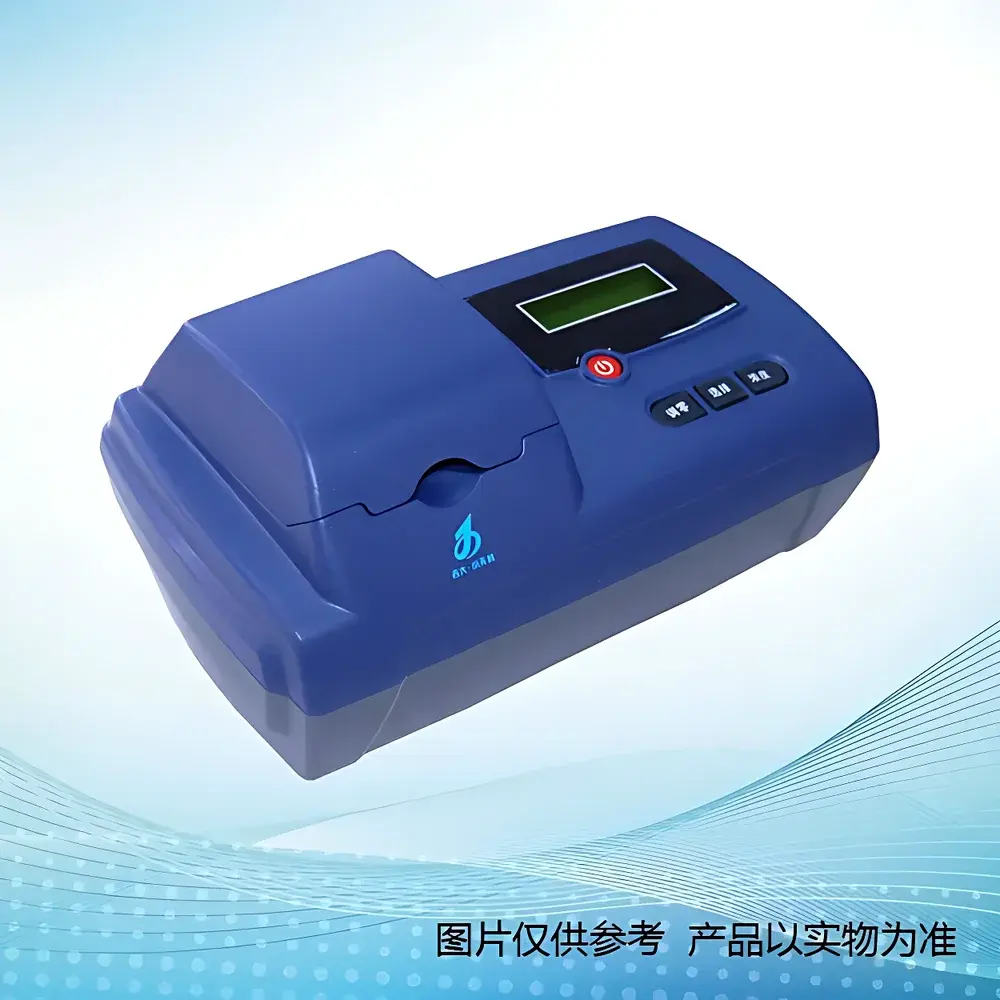
Jiada Xiaotian’e GDYS-101SN3 Portable Residual Chlorine Analyzer
| Brand | Jiada Xiaotian'e |
|---|---|
| Origin | Jilin, China |
| Manufacturer Type | Direct Manufacturer |
| Instrument Type | Portable |
| Model | GDYS-101SN3 |
| Measurement Parameter | Free Residual Chlorine |
| Measurement Range | 0.00–2.50 mg/L |
| Accuracy | ±5% |
| Detection Limit | 0.01 mg/L |
| Light Source | High-Brightness LED |
| Wavelength | 520 nm |
| Power Supply | DC 9 V |
| Dimensions | 190 × 110 × 95 mm |
| Weight | 0.4 kg |
Overview
The Jiada Xiaotian’e GDYS-101SN3 Portable Residual Chlorine Analyzer is a compact, field-deployable photometric instrument engineered for rapid, on-site quantification of free residual chlorine in disinfected drinking water and source water. It operates on the principle of colorimetric analysis using the N,N-diethyl-p-phenylenediamine (DPD) method—standardized in ISO 7393-2, APHA Standard Methods 4500-Cl G, and EPA Method 334.0—where residual chlorine oxidizes DPD reagent to form a stable magenta-colored complex. Absorbance at 520 nm is measured via a high-stability LED light source and precision photodetector, enabling direct concentration calculation based on pre-calibrated response curves. Designed for routine compliance verification and emergency response scenarios, the GDYS-101SN3 delivers laboratory-grade repeatability (RSD < 3.5% at 1.0 mg/L) in a rugged, battery-operated format suitable for municipal water utilities, environmental inspection agencies, and public health laboratories.
Key Features
- Integrated 520 nm high-brightness LED optical system with temperature-compensated photodiode detection, minimizing drift across ambient conditions (10–35 °C)
- Pre-programmed calibration curve compliant with DPD Method performance criteria per ISO 7393-2 Annex A
- Auto-zero function and dual-point calibration capability (0.00 and 1.00 mg/L reference points) to maintain traceability
- Low-power DC 9 V operation (6 × AA batteries, >8 hours continuous use), supporting extended field deployment without external power
- Ergonomic handheld housing (190 × 110 × 95 mm; 0.4 kg) with IP54-rated enclosure for dust and splash resistance
- Backlit LCD display with intuitive menu navigation and real-time measurement status indicators
Sample Compatibility & Compliance
The GDYS-101SN3 is validated for use with clarified, non-turbid drinking water samples meeting turbidity ≤ 1 NTU (per ISO 7027). It accommodates standard 10 mL glass or plastic cuvettes and supports DPD powder reagent tablets (Class I, certified for residual chlorine assay). All measurement protocols align with national regulatory frameworks including China’s GB/T 5750.11–2023 and international benchmarks such as WHO Guidelines for Drinking-water Quality (4th ed.) and EU Council Directive 98/83/EC. The instrument’s ±5% accuracy and 0.01 mg/L detection limit satisfy minimum performance requirements for Class II water quality monitoring under ISO/IEC 17025-accredited laboratories performing routine disinfectant residual verification.
Software & Data Management
While the GDYS-101SN3 operates as a standalone analyzer without onboard data logging or USB connectivity, its measurement protocol is fully compatible with external GLP-compliant documentation workflows. Users may record results manually into LIMS-integrated spreadsheets or electronic lab notebooks (ELN) that enforce audit trails, user authentication, and version-controlled SOPs. When deployed within QA/QC programs subject to FDA 21 CFR Part 11 or ISO/IEC 17025, the device supports full traceability through documented calibration logs, reagent lot tracking, and environmental condition annotations (temperature, humidity, operator ID). Optional third-party barcode scanners can be integrated to automate sample ID entry during high-throughput field surveys.
Applications
- Routine verification of residual chlorine levels at water treatment plant effluent points and distribution system hydrants
- Field validation of disinfection efficacy following pipe rehabilitation or system flushing events
- Emergency response monitoring during natural disasters or infrastructure failures affecting water safety
- Compliance auditing by provincial environmental protection bureaus and municipal health inspection centers
- Training and capacity-building for community-level water operators in rural and peri-urban settings
- Supporting WHO Water Safety Plan (WSP) implementation through point-of-use residual monitoring
FAQ
What sample preparation is required prior to analysis?
Samples must be filtered (≤ 1.0 µm membrane) if turbidity exceeds 1 NTU. No acidification or dilution is needed within the 0.00–2.50 mg/L range. Temperature equilibration to 20–25 °C is recommended for optimal DPD reaction kinetics.
Is the instrument suitable for measuring combined chlorine (chloramines)?
No—the GDYS-101SN3 is optimized exclusively for free residual chlorine detection via the DPD-1 reaction. Combined chlorine requires sequential DPD-3 addition and is outside the scope of this model’s calibration and firmware.
How often must the instrument be calibrated?
A full two-point calibration is recommended before each daily usage session or after every 20 measurements, whichever occurs first. Zero calibration should be performed immediately before sample analysis.
Can reagents from other manufacturers be used?
Only DPD reagent tablets certified to meet GB/T 5750.11–2023 purity and stability specifications are validated for use. Substitution may compromise accuracy and invalidate compliance reporting.
Does the device comply with ISO/IEC 17025 requirements?
The instrument itself is not accredited, but its measurement process—including operator training, calibration frequency, reagent control, and environmental monitoring—can be fully embedded within an ISO/IEC 17025-compliant quality management system when documented per Clause 7.2 and 7.7.







