
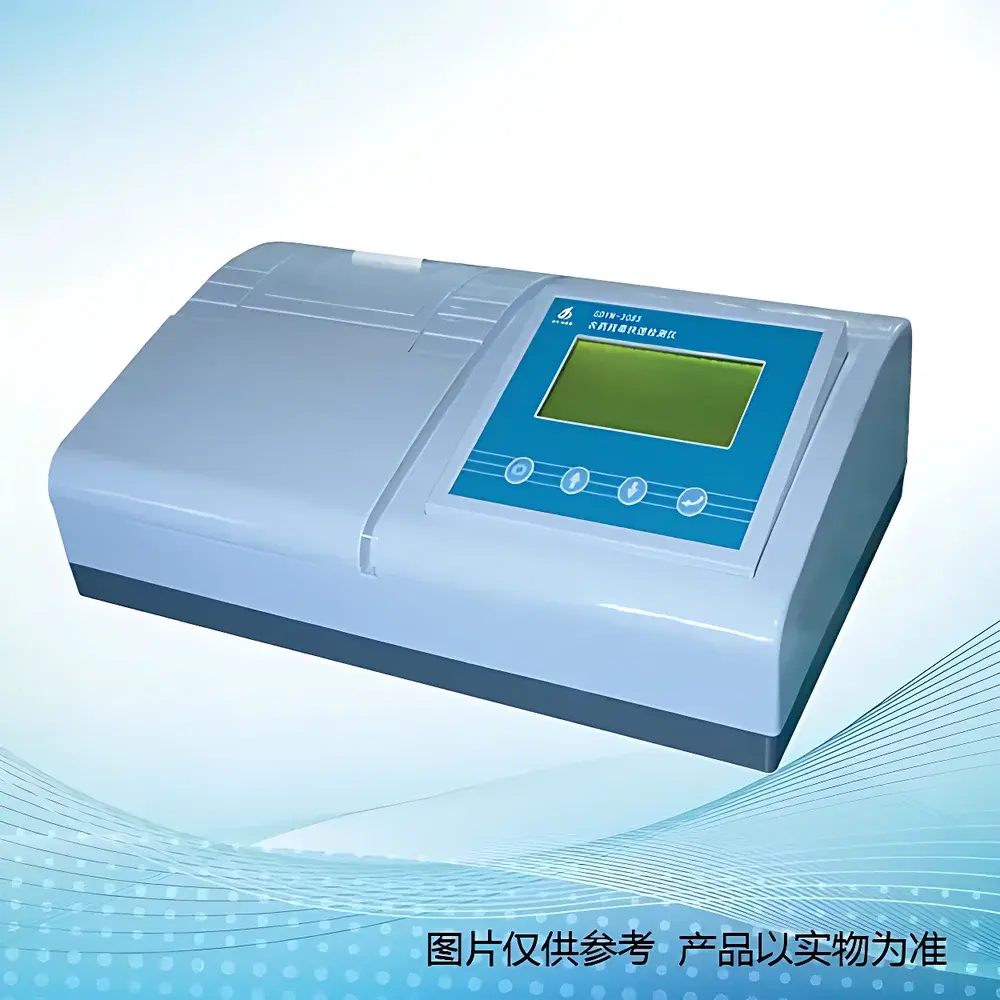
Jiada Xiaotianshe GDYN-1024SC 24-Channel Pesticide Residue Rapid Tester
| Brand | Jiada Xiaotianshe |
|---|---|
| Origin | Jilin, China |
| Manufacturer Type | Direct Manufacturer |
| Region of Origin | Domestic (China) |
| Model | GDYN-1024SC |
| Price Range | USD 4,200 – 7,000 (FOB) |
| Detection Method | Enzyme Inhibition Assay |
| Measurement Range | 0–100% inhibition |
| Number of Channels | 24 |
| Measurement Error | ±6% |
| Limit of Detection (LOD) | 0.01–3.0 mg/kg |
| Light Source | Silicon Photodiode |
| Wavelength | 405 nm |
| Absorbance Range | 0.000–2.000 Abs |
| Inhibition Rate Range | 0–100% |
| Precision | ±6% |
| Detection Limit | 0.01–3.0 mg/kg |
Overview
The Jiada Xiaotianshe GDYN-1024SC is a benchtop, multi-channel photometric analyzer engineered for rapid, on-site screening of organophosphorus and carbamate pesticide residues in fresh vegetables and agricultural commodities. It operates on the principle of acetylcholinesterase (AChE) enzyme inhibition — a well-established, standardized biochemical assay recognized by national food safety authorities in China (GB/T 5009.199–2003) and referenced in international guidance documents including ISO 15190:2022 (Clinical laboratory safety) for assay-based toxicant detection. In the presence of target pesticides, AChE activity is suppressed, leading to reduced hydrolysis of chromogenic substrates (e.g., indoxyl acetate), resulting in quantifiable changes in absorbance at 405 nm. The instrument measures this change as percentage inhibition, enabling semi-quantitative estimation of residue levels relative to control standards.
Key Features
- 24 independent optical channels with synchronized measurement capability — supports high-throughput batch analysis of up to 24 samples per run without cross-contamination or signal interference.
- Dedicated 405 nm narrow-band silicon photodiode detection system optimized for indoxyl-based colorimetric reactions, ensuring stable baseline response and minimal photometric drift over extended operation.
- Integrated temperature-controlled incubation logic during assay kinetics — maintains consistent enzymatic reaction conditions across all wells, critical for reproducibility in field-deployable settings.
- Pre-calibrated absorbance range (0.000–2.000 Abs) aligned with standard microplate spectrophotometric conventions, facilitating method transfer between lab and field instruments.
- Robust architecture designed for ambient environmental operation (10–35 °C, ≤85% RH), with ESD-protected circuitry and vibration-dampened optical path to support use in mobile labs, farmers’ markets, and regulatory inspection vehicles.
- Built-in QC flagging: automatic validation of blank absorbance, reference stability, and inhibition linearity prior to result calculation — compliant with GLP-aligned data integrity workflows.
Sample Compatibility & Compliance
The GDYN-1024SC is validated for homogenized extracts from leafy greens (e.g., spinach, cabbage), solanaceous vegetables (e.g., tomato, pepper), and fruiting vegetables (e.g., cucumber, eggplant). Sample preparation follows standardized extraction protocols using acetonitrile/water mixtures or buffer-based homogenization, compatible with AOAC Official Method 2007.01 principles for rapid pesticide screening. While not certified under ISO/IEC 17025 for accredited testing, the instrument meets functional requirements outlined in China’s NY/T 448–2021 standard for rapid pesticide residue detection equipment and supports traceability documentation required under China’s Food Safety Law (Article 112) and GB 2763–2021 maximum residue limits (MRLs). Data output formats are compatible with internal LIMS integration via CSV export.
Software & Data Management
- Proprietary Windows-based data processing software (v3.2+) includes audit trail logging, user role management (admin/operator), and electronic signature support — aligning with basic FDA 21 CFR Part 11 expectations for non-GMP environments.
- Automated inhibition rate calculation with dual-threshold alerting: samples exceeding 50% inhibition trigger visual/audible alerts; those >70% are flagged for confirmatory GC-MS or LC-MS/MS analysis per national surveillance guidelines.
- Batch report generation with embedded metadata: date/time stamp, operator ID, calibration status, reagent lot number, and raw absorbance values — supporting chain-of-custody documentation for regulatory submissions.
- No cloud dependency: all data stored locally with optional USB backup; no telemetry or remote access functionality — ensuring data sovereignty and alignment with institutional IT security policies.
Applications
This instrument serves as a frontline triage tool in food safety assurance programs across multiple operational tiers: municipal market supervision bureaus conducting routine spot checks; cooperative-owned cold-chain distribution hubs performing pre-delivery verification; university extension laboratories delivering farmer training on Good Agricultural Practices (GAP); and third-party certification bodies executing surveillance sampling under China’s “Food Safety Sampling Inspection Plan”. Its 24-channel throughput enables statistically representative sampling of heterogeneous lots — for example, analyzing 12 composite samples (2 subsamples each) from a single truckload of mixed produce within 25 minutes. While not intended for definitive compliance determination, its sensitivity range (0.01–3.0 mg/kg) covers MRL thresholds for common compounds such as chlorpyrifos (0.01 mg/kg in leafy vegetables), methamidophos (0.05 mg/kg), and carbaryl (0.5 mg/kg), making it suitable for risk-prioritization before resource-intensive confirmatory analysis.
FAQ
Is the GDYN-1024SC compliant with international regulatory standards such as ISO or AOAC?
It conforms to national Chinese standards (NY/T 448–2021, GB/T 5009.199–2003) and supports workflows referenced in AOAC guidelines for rapid screening; however, it is not AOAC Performance Tested Method (PTM) certified.
Can the instrument be used for commodities other than vegetables?
Validation data are limited to fresh horticultural produce; use with grains, animal tissues, or processed foods requires method adaptation and in-house verification per ISO/IEC 17025 Section 7.2.2.
What is the shelf life and storage requirement for the included reagent kit?
The 500-test reagent kit remains stable for 12 months when refrigerated at 2–8 °C; lyophilized enzymes must be reconstituted immediately before use and discarded after 8 hours.
Does the system support external calibration verification with NIST-traceable standards?
Yes — absorbance linearity can be verified using neutral density filters (NIST SRM 2031 series), and inhibition response may be challenged with paraoxon-methyl reference solutions at defined concentrations.
Is technical support available outside mainland China?
Limited remote firmware updates and English-language documentation are provided; hardware service requires authorized regional partners — contact Jiada Xiaotianshe directly for distributor coordination.




