
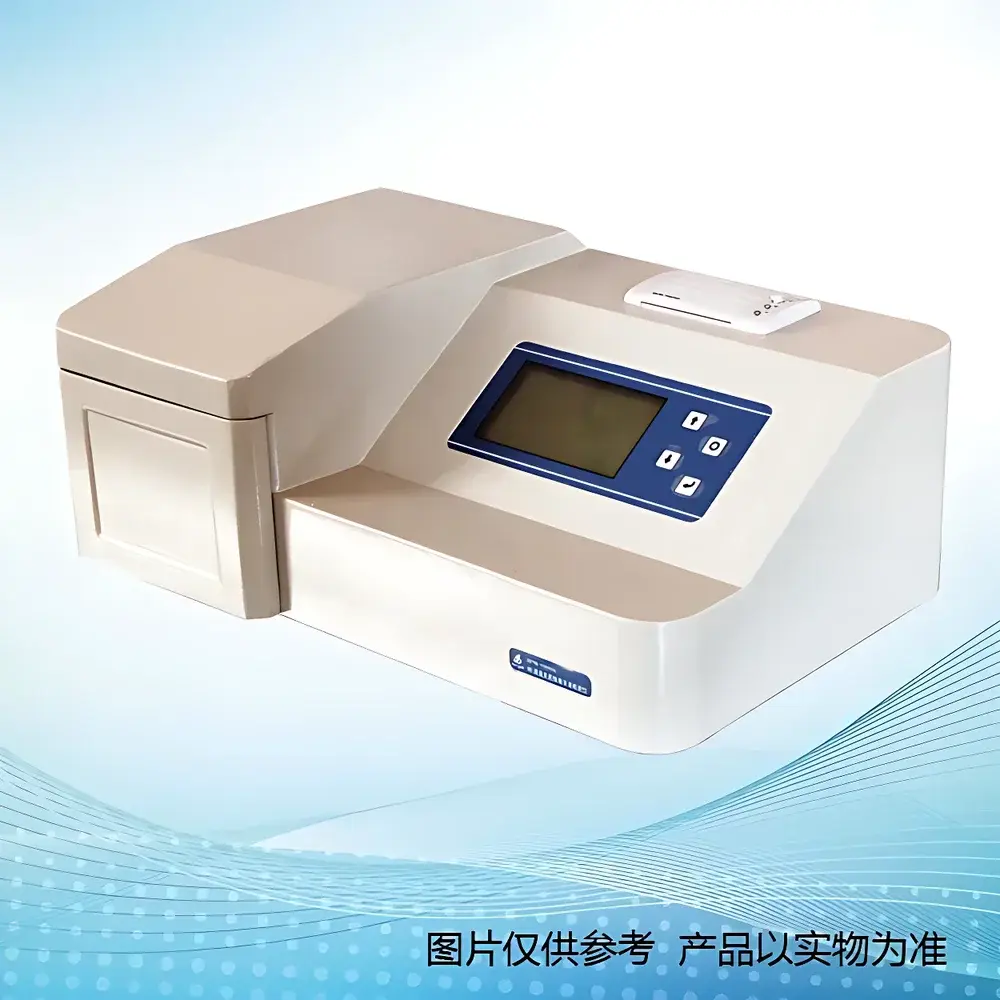
Jiada Xiaotianshe GDYN-1096SC 96-Channel Pesticide Residue Rapid Tester
| Brand | Jiada Xiaotianshe |
|---|---|
| Origin | Jilin, China |
| Manufacturer Type | Direct Manufacturer |
| Product Origin | Domestic (China) |
| Model | GDYN-1096SC |
| Detection Method | Enzyme Inhibition Assay |
| Number of Channels | 96 |
| Limit of Detection (LOD) | 0.01–3.0 mg/kg |
| Inhibition Range | 0–100% |
| Inhibition Accuracy | ±6% (at 50% inhibition) |
| Throughput | Up to 192 samples per hour |
| Data Storage Capacity | 1024 records |
| Interface | RS-232 / USB |
| Display | Full-Text LCD (Chinese) |
| Reagent Compatibility | Imported cholinesterase-based reagents (500-test kit included) |
| Optical Architecture | Solid-state array light source and detector per channel |
| Expected Service Life | >10 years |
Overview
The Jiada Xiaotianshe GDYN-1096SC is a high-throughput, laboratory-grade 96-channel pesticide residue rapid tester engineered for routine screening of organophosphorus and carbamate pesticides in agricultural commodities, fruits, vegetables, and processed food matrices. It operates on the internationally recognized enzyme inhibition principle—specifically aligned with GB/T 5009.199–2003—and quantifies residual pesticide levels by measuring the degree of acetylcholinesterase (AChE) or butyrylcholinesterase (BChE) activity suppression in extracted samples. Each of the 96 independent optical channels integrates a dedicated solid-state light-emitting diode (LED) source and photodiode detector, eliminating mechanical moving parts and ensuring long-term signal stability, inter-channel uniformity, and minimal drift over extended operation cycles. Designed for compliance-driven food safety laboratories, the instrument delivers reproducible inhibition rate measurements across its full 0–100% dynamic range, with calibrated accuracy of ±6% at mid-range (50% inhibition), supporting reliable pass/fail decision-making under regulatory threshold criteria.
Key Features
- True parallel 96-channel architecture: Simultaneous measurement of up to 96 samples without sequential scanning or multiplexing delays.
- Full solid-state optical design: No moving parts—each channel features an integrated LED-monochromator-detector assembly, minimizing maintenance and maximizing operational lifetime (>10 years).
- High-throughput capability: Processes up to 192 samples per hour when paired with optional auxiliary equipment (e.g., microplate shaker, ultrasonic extractor, water bath).
- Robust error-detection logic: Real-time validation of reagent integrity, sample volume adequacy, and assay kinetics to flag invalid runs before result calculation.
- Onboard data management: Stores 1024 test records with timestamp, sample ID, inhibition %, calculated residue concentration (mg/kg), and operator annotation.
- Regulatory-ready interface: Equipped with RS-232 and USB ports for secure bidirectional communication with LIMS or standalone PCs; supports audit-trail-capable software export.
- Human-centered HMI: Backlit full-text Chinese LCD display with intuitive menu navigation, graphical progress indicators, and context-sensitive prompts.
Sample Compatibility & Compliance
The GDYN-1096SC is validated for homogenized aqueous extracts prepared from leafy greens, root vegetables, fruits, grains, and herbal materials using standardized extraction protocols (e.g., AOAC 2007.01, EN 15662:2018). Its detection range (0.01–3.0 mg/kg) covers maximum residue limits (MRLs) established by Codex Alimentarius, the European Union (EC No. 396/2005), and China’s GB 2763–2021. While not certified to ISO/IEC 17025 as a standalone testing system, the instrument meets functional requirements for screening-level analysis under GLP-aligned workflows. When used with traceable reference standards and documented SOPs, it supports internal quality control (IQC), method verification, and pre-screening prior to confirmatory analysis via GC-MS/MS or LC-MS/MS.
Software & Data Management
The bundled Windows-compatible software provides comprehensive assay setup, calibration curve generation (using standard inhibitor solutions), batch reporting, statistical summary (mean, SD, CV%), and customizable PDF/Excel export. All raw absorbance values, inhibition calculations, and pass/fail flags are stored with immutable timestamps. The software enforces user-level access control (administrator/operator modes) and logs all critical actions—including calibration edits, result deletions, and firmware updates—satisfying basic data integrity requirements for FDA 21 CFR Part 11–aligned environments when deployed with appropriate IT governance controls.
Applications
- Routine surveillance testing in food inspection stations, customs laboratories, and municipal CDC centers.
- On-site screening at wholesale markets and cold-chain distribution hubs using portable auxiliary modules.
- Quality assurance in fresh produce processing facilities implementing HACCP prerequisite programs.
- Research applications involving comparative inhibition kinetics of novel enzyme formulations or extraction solvents.
- Educational use in food science curricula for hands-on instruction in rapid biochemical assay principles.
FAQ
What pesticides does the GDYN-1096SC detect?
It detects organophosphorus and carbamate pesticides that inhibit cholinesterase activity—including chlorpyrifos, dimethoate, carbaryl, and methomyl—based on their collective effect on enzymatic hydrolysis of chromogenic substrates.
Is the instrument compatible with international standards?
Yes—it implements the enzyme inhibition methodology specified in GB/T 5009.199–2003, which is technically equivalent to AOAC Official Method 992.11 and CEN/TR 15287:2006 for qualitative/semi-quantitative screening.
Can I integrate this instrument into an existing LIMS?
Yes—via RS-232 or USB serial emulation, the device supports ASCII-based data streaming with configurable delimiters and header formats for seamless ingestion into validated LIMS platforms.
What is the expected lifespan of the optical components?
The solid-state LED/detector arrays are rated for >50,000 hours of continuous operation, with no degradation in intensity or spectral output observed under typical ambient lab conditions (20–25°C, <60% RH).
Does the system support multi-language UI beyond Chinese?
The current firmware supports Chinese-only display; however, data files and software interfaces are encoded in UTF-8 and fully compatible with English-language operating systems and analysis tools.





