
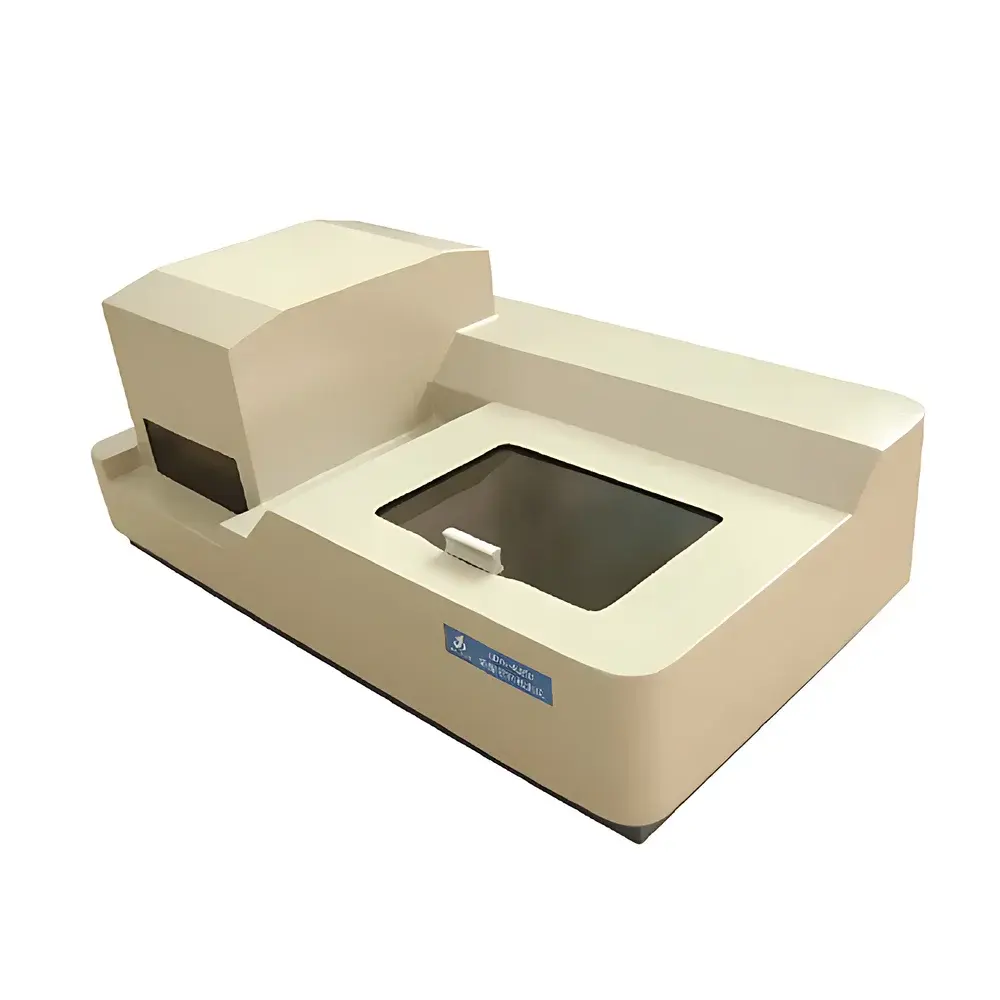
Jiada Xiaotianshe GDYN-501MA Multi-parameter Pesticide Residue Analyzer
| Brand | Jiada Xiaotianshe |
|---|---|
| Origin | Jilin, China |
| Manufacturer Type | Direct Manufacturer |
| Country of Origin | China |
| Model | GDYN-501MA |
| Detection Method | Thin-layer Chromatography (TLC) |
| Measurement Range | Organophosphates: 0.03–20 mg/kg |
| Carbamates | 0.03–20 mg/kg |
| Pyrethroids | 0.10–30 mg/kg |
| Organochlorines | 0.10–10 mg/kg |
| Light Source | 254 nm UV lamp |
| Warm-up Time | ≤5 min |
| Irradiance | ≥1000 µW/cm² |
| Lamp Lifetime | ≥12,000 h |
| Wavelength Repeatability | ±1 nm |
| Wavelength Accuracy | ±5 nm |
| Filter Transmittance | ≥95% |
| Spot Spacing | 5–30 mm |
| Sample Volume | 2.5–15 µL |
| Spot Diameter | ≤2.0 mm |
| Operating Temperature | 5–40 °C |
| Relative Humidity | 10–85% RH |
| Data Interface | USB 2.0 |
| Power Supply | 220 V ±22 V, 50 Hz ±1 Hz |
| Software Platform | Windows XP |
| Detection Modes | Transmission & Reflectance |
| Dimensions | 580 × 360 × 260 mm |
| Weight | 15.8 kg |
Overview
The Jiada Xiaotianshe GDYN-501MA Multi-parameter Pesticide Residue Analyzer is a dedicated thin-layer chromatography (TLC)-based instrument engineered for rapid, on-site screening of pesticide residues in plant-derived food matrices. It operates on the principle of selective UV absorption and densitometric quantification of developed pesticide spots on TLC plates under standardized 254 nm ultraviolet irradiation. Designed to support routine compliance verification against GB 2763–2014 — China’s national standard for maximum residue limits (MRLs) in fruits, vegetables, and tea — the system delivers semi-quantitative results within minutes of sample preparation. Its optical architecture integrates a stabilized low-pressure mercury vapor lamp with high-transmittance interference filters and precision-aligned detection optics, ensuring consistent irradiance distribution across the analytical zone. The instrument does not rely on enzymatic inhibition or immunoassay principles; instead, it leverages chromatographic separation followed by direct photometric evaluation, offering broad-spectrum coverage without antibody cross-reactivity limitations.
Key Features
- UV source optimized at 254 nm with ≥1000 µW/cm² irradiance and ≤±1 nm wavelength repeatability, enabling reproducible spot visualization and densitometric calibration
- Dual-mode detection capability: configurable transmission and reflectance measurement modes for enhanced sensitivity across diverse matrix backgrounds and plate chemistries
- Adjustable spotting parameters — including volume (2.5–15 µL), inter-spot spacing (5–30 mm), and final spot diameter (≤2.0 mm) — supporting method optimization per analyte class
- Robust thermal and humidity tolerance (5–40 °C, 10–85% RH), validated for deployment in field laboratories, QC rooms, and mobile inspection units
- Integrated USB 2.0 interface for secure data export and firmware updates; compatible with legacy Windows XP environments as specified in regulatory validation protocols
- Modular hardware design featuring a dedicated sample pre-treatment platform, reducing manual handling variability and improving inter-operator consistency
Sample Compatibility & Compliance
The GDYN-501MA is validated for use with homogenized extracts from fruits, leafy vegetables, root crops, and dried tea leaves following standardized QuEChERS or solvent extraction protocols. Its detection ranges align with common MRL thresholds defined in GB 2763–2014: organophosphates and carbamates (0.03–20 mg/kg), pyrethroids (0.10–30 mg/kg), and organochlorines (0.10–10 mg/kg). While not intended for definitive confirmatory analysis, the instrument satisfies Tier-1 screening requirements under China’s national food safety monitoring framework. All operational parameters — including lamp stability (≤5 min warm-up), filter performance (≥95% transmittance), and dimensional tolerances — are documented per internal quality control procedures aligned with ISO/IEC 17025:2017 general requirements for competence of testing and calibration laboratories.
Software & Data Management
The bundled workstation software provides guided workflow execution, from plate layout definition and spot annotation to peak integration and semi-quantitative reporting. Raw densitometric profiles are stored in proprietary binary format with embedded metadata (date/time stamp, operator ID, batch number, and instrument serial number). Export options include CSV and PDF reports compliant with basic GLP documentation needs. Although native support for FDA 21 CFR Part 11 electronic signatures is not implemented, audit trail functionality — including user login logs, parameter change history, and result modification timestamps — is enabled via local database logging. Data integrity is preserved through write-once file generation and USB-based transfer to external review systems.
Applications
- Routine surveillance testing at agricultural cooperatives and wholesale markets prior to distribution
- Pre-harvest scouting in integrated pest management (IPM) programs to verify pre-harvest intervals
- Quality assurance screening in food processing facilities receiving raw produce inputs
- Educational use in food science laboratories for teaching chromatographic separation fundamentals and residue risk assessment
- Regulatory field inspections where portable, non-destructive screening tools are required under time-constrained conditions
FAQ
Is the GDYN-501MA suitable for quantitative confirmation analysis?
No. It is designed exclusively for rapid semi-quantitative screening. Confirmatory analysis requires GC-MS or LC-MS/MS per ISO 17025-accredited methods.
Can the instrument detect neonicotinoid or fungicide residues?
Not by default. Its validated scope covers organophosphates, carbamates, pyrethroids, and organochlorines. Extension to other classes requires method re-validation and TLC solvent system optimization.
What maintenance is required for the UV lamp?
The lamp should be replaced after ≥12,000 hours of cumulative operation or if irradiance falls below 1000 µW/cm² during routine calibration checks.
Does the system support multi-user access control?
Yes. The software supports role-based operator accounts with password protection, though full electronic signature compliance requires external LIMS integration.
Is third-party calibration traceable to NIM or CNAS standards available?
Calibration services are offered by authorized Jiada Xiaotianshe service centers, with certificates traceable to National Institute of Metrology (NIM) reference standards upon request.





