
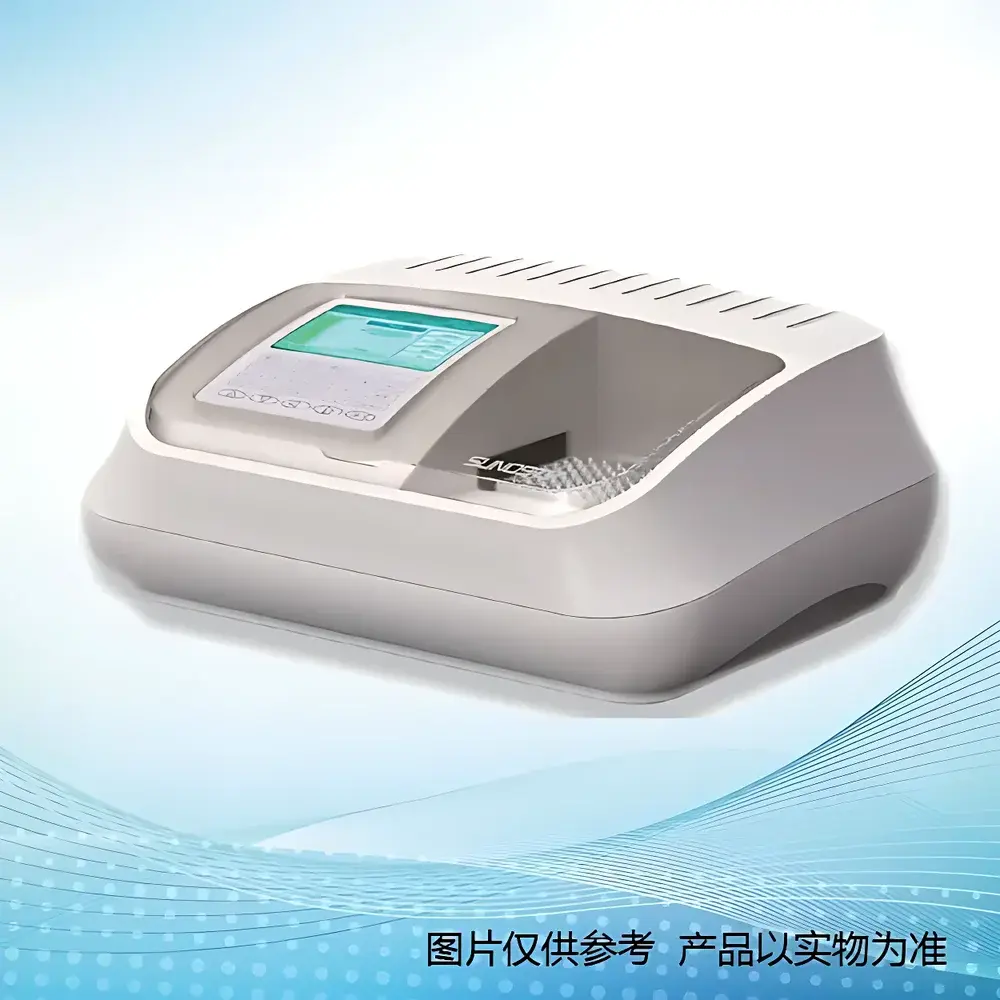
Jiada Xiaotianshe GDYQ-1400S Antibiotic Residue Immunoassay Analyzer
| Brand | Jiada Xiaotianshe |
|---|---|
| Origin | Jilin, China |
| Manufacturer Type | Direct Manufacturer |
| Origin Category | Domestic (China) |
| Model | GDYQ-1400S |
| Function Type | Single-Analyte Immunoassay Platform |
| Sample Versatility | Multi-sample Compatible (Liquid Food Matrices) |
| Wavelength Range | 400–700 nm |
| Throughput | 96-well plate in 5 seconds |
| Optical Resolution | 0.001 A (display), 0.0001 A (internal calculation) |
| Photometric Linearity | ±1% (0.000–2.000 A) |
| Absorbance Measurement Range | 0.0000–4.0000 A |
| Plate Formats | Standard 96-well and 48-well microplates |
| Filter Positions | Fixed 405 nm, 450 nm, 492 nm, 630 nm + 4 configurable slots |
| Detection Methodology | Single-, Dual-, and Multi-wavelength ELISA photometry |
| Data Processing Algorithms | Linear, Semi-log, 4PL, 5PL, Polynomial, Parabolic, Spline Curve Fitting |
| Plate Shaking | Adjustable speed and duration |
| Interface | RS232 serial port, parallel port |
| Power Supply | AC 220 V / 110 V ±22 V, 50 Hz / 60 Hz ±1 Hz |
Overview
The Jiada Xiaotianshe GDYQ-1400S Antibiotic Residue Immunoassay Analyzer is a dedicated microplate-based photometric system engineered for rapid, quantitative detection of antibiotic residues in food matrices—particularly milk, honey, meat extracts, and aquaculture samples. It operates on the principle of enzyme-linked immunosorbent assay (ELISA), where antigen–antibody binding events are quantified via enzymatic color development measured as optical density (OD) across defined visible wavelengths. Designed for routine compliance screening in food safety laboratories, regulatory inspection units, and dairy processing QC environments, the GDYQ-1400S delivers high reproducibility (≤±1% CV) and robust thermal and electronic stability through automated self-diagnostic routines at startup—including lamp intensity verification, filter positioning calibration, and baseline zeroing. Its cold-light source ensures minimal heat-induced assay interference and long-term spectral consistency without filament degradation.
Key Features
- Automated pre-run diagnostics: Real-time validation of optical path integrity, filter alignment, and detector baseline prior to each assay batch.
- Configurable multi-wavelength photometry: Four fixed-position interference filters (405 nm, 450 nm, 492 nm, 630 nm) plus four expandable slots for method-specific wavelength addition—supporting diverse ELISA protocols including competitive, indirect, and sandwich formats.
- Integrated programmable plate shaking: Adjustable oscillation speed (100–1,200 rpm) and duration (1–300 s) to ensure homogeneous termination reaction mixing—critical for reducing inter-well variability in stop-solution–dependent assays.
- High-throughput performance: Full 96-well microplate readout completed in ≤5 seconds with <0.0001 A internal computational resolution and 0.001 A display granularity.
- Dual-mode operation: Standalone use via built-in LCD interface or full remote control via PC using RS232 serial communication—enabling integration into LIMS environments and automated ELISA workflow orchestration.
- Comprehensive data processing engine: Supports 7 curve-fitting models (linear, semi-log, 4-parameter logistic, 5-parameter logistic, polynomial up to 5th order, parabolic, cubic spline) for precise standard curve interpolation and sample concentration derivation.
Sample Compatibility & Compliance
The GDYQ-1400S is validated for use with liquid-phase ELISA kits targeting tetracyclines, sulfonamides, β-lactams (e.g., penicillin G), aminoglycosides, and macrolides in raw milk, pasteurized dairy products, honey homogenates, tissue homogenates (muscle, liver), and shrimp/mollusk extracts. It conforms to core analytical requirements outlined in GB/T 22969–2008 (Chinese national standard for ELISA-based antibiotic residue testing in milk) and aligns with methodological expectations referenced in ISO 15797:2019 (immunoassay performance criteria) and AOAC Official Method 2012.05 (for tetracycline screening). While not inherently 21 CFR Part 11 compliant out-of-the-box, its RS232 interface supports audit-trail-capable third-party software deployment for GLP/GMP-regulated laboratories requiring electronic record integrity.
Software & Data Management
The instrument’s embedded firmware stores up to 100 user-defined assay programs—including wavelength selection, shaking parameters, measurement mode (single/dual/multi), kinetic intervals (if applicable), and curve-fitting configuration. Data export is supported via RS232 to Windows-based applications; CSV-formatted output includes well ID, OD values per wavelength, calculated concentrations, QC flag status (e.g., high/low control failure), and timestamped run metadata. Optional PC software enables method versioning, user access logging, and report generation compliant with ISO/IEC 17025 documentation requirements—facilitating internal audits and accreditation readiness.
Applications
- Routine monitoring of antibiotic carryover in raw milk collection centers and dairy receiving bays.
- Verification of withdrawal periods in livestock and aquaculture production systems.
- Screening of imported honey for chloramphenicol and nitrofuran metabolites under border inspection protocols.
- Validation of clean-in-place (CIP) efficacy in equipment used for antibiotic-containing pharmaceutical feed manufacturing.
- Supporting ISO 22000-certified HACCP plans where antibiotic residue control points require documented analytical verification.
FAQ
Does the GDYQ-1400S support FDA 21 CFR Part 11 compliance?
No—the device does not include built-in electronic signature, audit trail, or role-based access control. However, its RS232 interface allows integration with validated third-party LIMS or ELISA data management platforms that provide Part 11 functionality.
Can I install custom filter sets beyond the default four positions?
Yes—four additional filter slots are mechanically reserved and optically aligned; users may install certified interference filters (FWHM ≤10 nm) matching their ELISA kit manufacturer’s recommended detection wavelengths.
What is the maximum absorbance linearity range, and how is it verified?
Linearity is specified as ±1% over 0.000–2.000 A, verified per NIST-traceable neutral density filter standards during factory calibration and confirmed annually using calibrated reference solutions (e.g., potassium dichromate in 0.005 M H₂SO₄).
Is the instrument compatible with 48-well strip plates?
Yes—plate carriage accommodates both full 96-well plates and partial 48-well configurations; software automatically detects active wells and excludes empty positions from analysis.
How frequently does the cold light source require replacement?
The LED-based cold light source has a rated lifetime exceeding 10,000 hours under continuous operation; no scheduled replacement is required within typical laboratory service intervals (3–5 years).





