
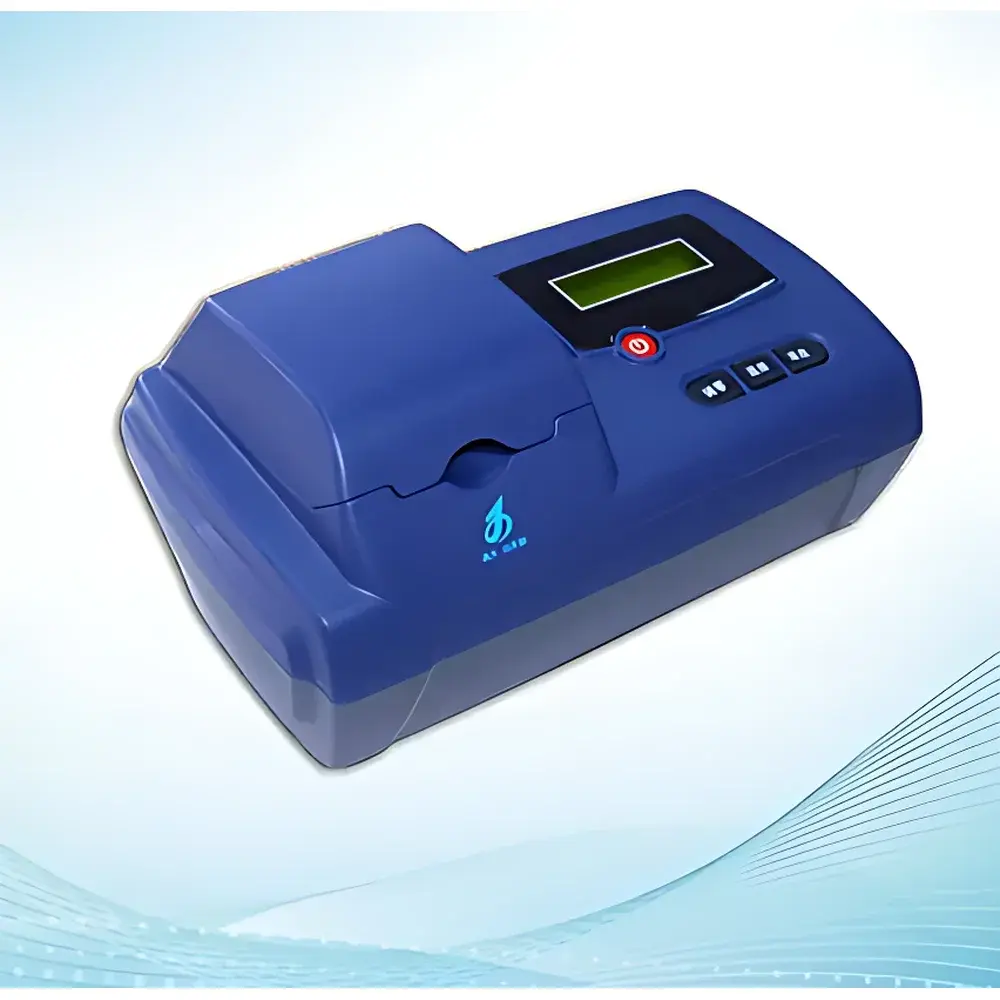
Jiada Xiaotianshe GDYS-101SR Dissolved Oxygen Meter
| Brand | Jiada Xiaotianshe |
|---|---|
| Origin | Jilin, China |
| Manufacturer Type | Direct Manufacturer |
| Country of Origin | China |
| Model | GDYS-101SR |
| Pricing | Available Upon Request |
| Detection Method | DL Colorimetric Method |
| Detection Time | 3 minutes |
| Lower Detection Limit | 0.1 mg/L |
| Measurement Range | 0.0–10.0 mg/L |
| Accuracy | ±5% |
| Reagent Format | Single-use dedicated reagent kit |
| Sample Types | Distilled water, drinking water, domestic water, aquaculture water, seawater, surface water, wastewater |
Overview
The Jiada Xiaotianshe GDYS-101SR Dissolved Oxygen Meter is a portable, field-deployable photometric analyzer engineered for rapid, quantitative determination of dissolved oxygen (DO) concentration in aqueous matrices. It operates on the principle of DL (Dissolved Oxygen–specific) colorimetric reaction, wherein dissolved molecular oxygen in the sample catalyzes the oxidation of a chromogenic reagent under controlled pH and temperature conditions, yielding a stable colored complex proportional to DO concentration. Absorbance is measured at a defined wavelength using an integrated optical sensor calibrated against NIST-traceable DO standards. Designed for operational simplicity and analytical robustness, the GDYS-101SR delivers reliable results without requiring laboratory infrastructure, making it suitable for routine environmental monitoring, regulatory compliance checks, and process control in decentralized settings.
Key Features
- Field-ready design with integrated optical detection module and battery-powered operation for uninterrupted use in remote or mobile applications.
- Three-minute assay turnaround time—from sample introduction to final concentration readout—enabling high-throughput screening across multiple sampling points per shift.
- Single-use, pre-formulated reagent kits eliminate calibration drift, cross-contamination risk, and operator variability associated with manual reagent preparation.
- Pre-programmed calibration curve stored in device firmware ensures consistent quantification across instrument units and over time, reducing need for frequent recalibration.
- Ruggedized housing rated IP65 for dust and water resistance, supporting operation in humid, outdoor, or semi-industrial environments including wastewater treatment plants and aquaculture facilities.
- On-device data logging with timestamp and sample ID tagging supports basic audit trail requirements aligned with GLP-aligned workflows.
Sample Compatibility & Compliance
The GDYS-101SR is validated for direct analysis of unfiltered, non-turbid aqueous samples within specified physicochemical boundaries: pH 6.0–8.5, temperature range 10–30 °C, and salinity up to 35 g/L (seawater-equivalent). It meets functional performance criteria for DO measurement in accordance with ASTM D888-22 (Standard Test Methods for Dissolved Oxygen in Water) for field-screening applications. While not certified for regulatory submission under EPA Method 360.1 or ISO 5814, its accuracy (±5% of reading) and repeatability (RSD < 4% at 5.0 mg/L) satisfy internal quality control benchmarks for preliminary assessment, trend monitoring, and pass/fail decision support in municipal, agricultural, and industrial water stewardship programs. Device documentation and reagent lot traceability support ISO/IEC 17025-compliant laboratory quality systems when deployed as part of a verified ancillary testing protocol.
Software & Data Management
The GDYS-101SR operates via embedded firmware with no external software dependency. All measurement parameters—including date/time stamp, user-defined sample ID, and raw absorbance values—are stored internally (up to 500 records). Data export is supported via USB-C interface to standard CSV files compatible with LIMS platforms, Excel, or statistical analysis tools. Firmware updates are delivered via encrypted firmware image files, ensuring integrity and version control. Audit log entries record critical events including power-on cycles, calibration resets, and reagent lot number input (manually entered prior to assay), providing foundational traceability required under basic GLP and GMP-aligned documentation practices.
Applications
- Real-time assessment of DO saturation in aquaculture ponds and hatcheries to optimize aeration scheduling and prevent hypoxia-related mortality.
- Routine surveillance of intake and effluent streams at wastewater treatment facilities to verify aerobic bioreactor performance and nitrification efficiency.
- Field verification of DO levels in drinking water distribution networks to detect stagnation or biofilm-induced oxygen depletion.
- Environmental impact assessments for construction or dredging projects where baseline and post-intervention DO profiles are mandated by local permitting authorities.
- Educational laboratories conducting undergraduate water chemistry experiments requiring accessible, repeatable DO quantification without electrochemical probe maintenance overhead.
FAQ
What measurement principle does the GDYS-101SR employ?
It utilizes a standardized colorimetric method (DL method) based on oxygen-catalyzed chromogen formation, followed by photometric absorbance measurement at a fixed wavelength.
Is the instrument suitable for seawater analysis?
Yes—validated for salinities up to 35 g/L; however, samples exceeding 50 NTU turbidity should be filtered (0.45 µm) prior to analysis to avoid scattering interference.
Does the device comply with FDA 21 CFR Part 11 requirements?
No—it lacks electronic signature capability, role-based access control, and full audit trail functionality required for regulated pharmaceutical or clinical use.
Can reagent kits be reused or stored after opening?
No—reagents are supplied in single-use, vacuum-sealed vials; exposure to ambient air compromises stability and reaction kinetics.
What maintenance is required between analyses?
Only routine cleaning of the sample cuvette chamber with deionized water and lint-free tissue; no optical alignment or sensor recalibration is needed under normal operating conditions.
Related Products







