
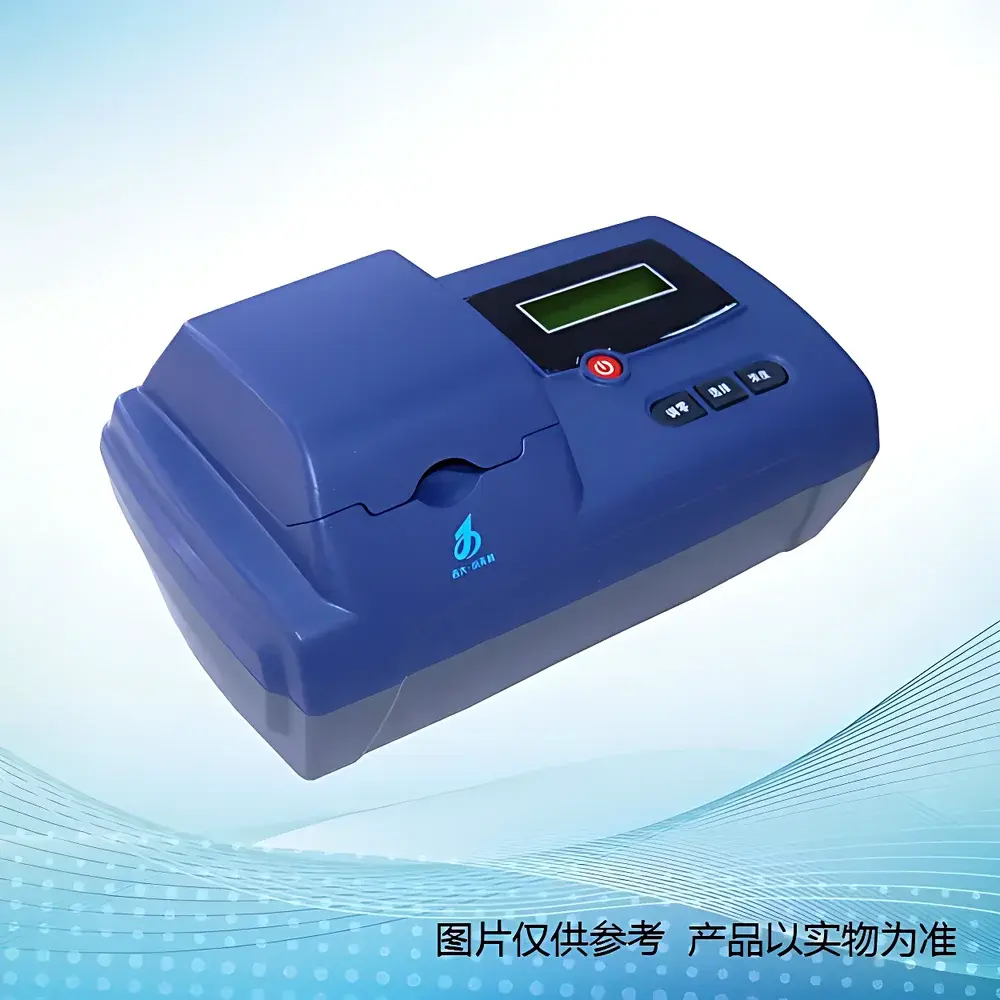
Jiada Xiaotianshe GDYS-101SX3 Portable Nitrite-Nitrogen (NO₂⁻-N) Water Quality Analyzer
| Brand | Jiada Xiaotianshe |
|---|---|
| Origin | Jilin, China |
| Manufacturer Type | Direct Manufacturer |
| Country of Origin | China |
| Model | GDYS-101SX3 |
| Instrument Type | Portable/Handheld Water Quality Analyzer |
| Measured Parameter | Nitrite-Nitrogen (NO₂⁻-N) |
| Detection Limit | 0.001 mg/L |
| Measurement Range | 0.000–0.100 mg/L |
| Accuracy | ±5% |
| Compliance | GB/T 5750.5–2006 |
| Display | LCD with Microcontroller Control |
| Design | Compact, Lightweight, Field-Deployable |
Overview
The Jiada Xiaotianshe GDYS-101SX3 is a portable, microprocessor-controlled photometric analyzer engineered for rapid, on-site quantification of nitrite-nitrogen (NO₂⁻-N) in drinking water and source water samples. It operates on the principle of diazotization-coupling colorimetry—where nitrite ions react under acidic conditions with sulfanilamide to form a diazonium salt, which subsequently couples with N-(1-naphthyl)ethylenediamine dihydrochloride (NED) to yield a stable pink-to-magenta azo dye. The intensity of this colored complex, measured at 540 nm via integrated optical detection, is directly proportional to the NO₂⁻-N concentration. Designed specifically for compliance with Chinese national standard GB/T 5750.5–2006 (Methods for Examination of Drinking Water – Inorganic Nonmetallic Indicators), the instrument delivers trace-level sensitivity (detection limit: 0.001 mg/L) and high reproducibility across its calibrated range (0.000–0.100 mg/L), making it suitable for routine surveillance, emergency response, and field-based water safety verification.
Key Features
- Field-optimized hardware architecture: compact footprint (≤200 × 120 × 80 mm), lightweight design (<0.8 kg), and battery-powered operation (rechargeable Li-ion or AA options) enable deployment in remote sampling locations, mobile labs, or disaster-affected zones without AC infrastructure.
- Integrated microcontroller system with embedded calibration algorithms ensures consistent photometric performance and automatic zero-point correction prior to each measurement cycle.
- LCD graphical interface provides intuitive navigation, real-time absorbance readout, and direct concentration display in mg/L NO₂⁻-N—eliminating manual calculation or external lookup tables.
- Pre-packaged, single-use reagent kits minimize operator exposure, reduce cross-contamination risk, and eliminate volumetric pipetting errors—critical for untrained personnel or high-throughput field operations.
- Robust optical path design features fixed-wavelength LED source (540 ± 5 nm) and silicon photodiode detector, optimized for stability under variable ambient temperature (10–35 °C) and humidity (30–85% RH, non-condensing).
Sample Compatibility & Compliance
The GDYS-101SX3 is validated for use with clarified, low-turbidity aqueous matrices including municipal tap water, groundwater, spring water, bottled drinking water, and treated surface water sources. Samples requiring filtration (e.g., >1 NTU turbidity) must be pre-filtered through 0.45 µm membrane filters prior to analysis. The method conforms strictly to GB/T 5750.5–2006 Section 10.1 (Determination of Nitrite Nitrogen by N-(1-Naphthyl)ethylenediamine Spectrophotometry), and supports documentation practices aligned with ISO/IEC 17025:2017 general requirements for competence of testing and calibration laboratories. While not certified to US EPA Method 354.1 or ISO 6775:1984, its analytical performance profile meets threshold criteria for preliminary screening and regulatory triage in decentralized monitoring programs.
Software & Data Management
The device operates autonomously without PC connectivity; however, optional infrared (IR) or Bluetooth-enabled data loggers (sold separately) support export of timestamped measurement records—including sample ID, date/time, absorbance value, calculated concentration, and instrument serial number—to CSV or Excel-compatible formats. Internal memory retains up to 500 test results with audit trail functionality (operator ID input optional). All firmware updates are delivered via secure USB flash drive, ensuring traceability and version control per GLP-aligned data integrity protocols.
Applications
- Routine compliance monitoring of nitrite-nitrogen in public drinking water distribution systems and rural water supply schemes.
- Emergency assessment following nitrification failures, pipe corrosion events, or post-disinfection anomalies where nitrite accumulation poses acute health risk (e.g., methemoglobinemia in infants).
- Verification of treatment efficacy in small-scale chloramination or biological denitrification units.
- Field validation of laboratory reference measurements during inter-laboratory comparison exercises or proficiency testing.
- Educational use in environmental science curricula for teaching colorimetric assay fundamentals and water quality parameter interrelationships.
FAQ
What is the shelf life of the reagent kits, and how should they be stored?
Unopened reagent vials retain full activity for 12 months when stored at 2–8 °C in darkness. Once opened, kits must be used within 30 days and kept desiccated at room temperature.
Can the instrument measure nitrite in wastewater or seawater?
No—matrix interference from high chloride (>200 mg/L), suspended solids, or organic matter compromises accuracy. It is validated exclusively for low-conductivity, low-turbidity potable water matrices.
Is calibration verification required before each use?
Yes—a blank (deionized water) measurement is mandatory prior to sample analysis to establish optical baseline and compensate for cuvette variability or ambient light drift.
Does the device support multi-point calibration?
No—it uses a single-point factory calibration traceable to NIST-certified nitrite standards; users perform daily verification using a 0.050 mg/L QC standard included in the reagent kit.
How is measurement uncertainty estimated for reporting?
Total uncertainty is calculated per GUM (Guide to the Expression of Uncertainty in Measurement) as combined standard uncertainty (k = 2), incorporating repeatability (±2.1%), reagent lot variation (±1.8%), and photometric noise (±0.9%)—yielding an expanded uncertainty of ±4.8% at mid-range concentration.







