
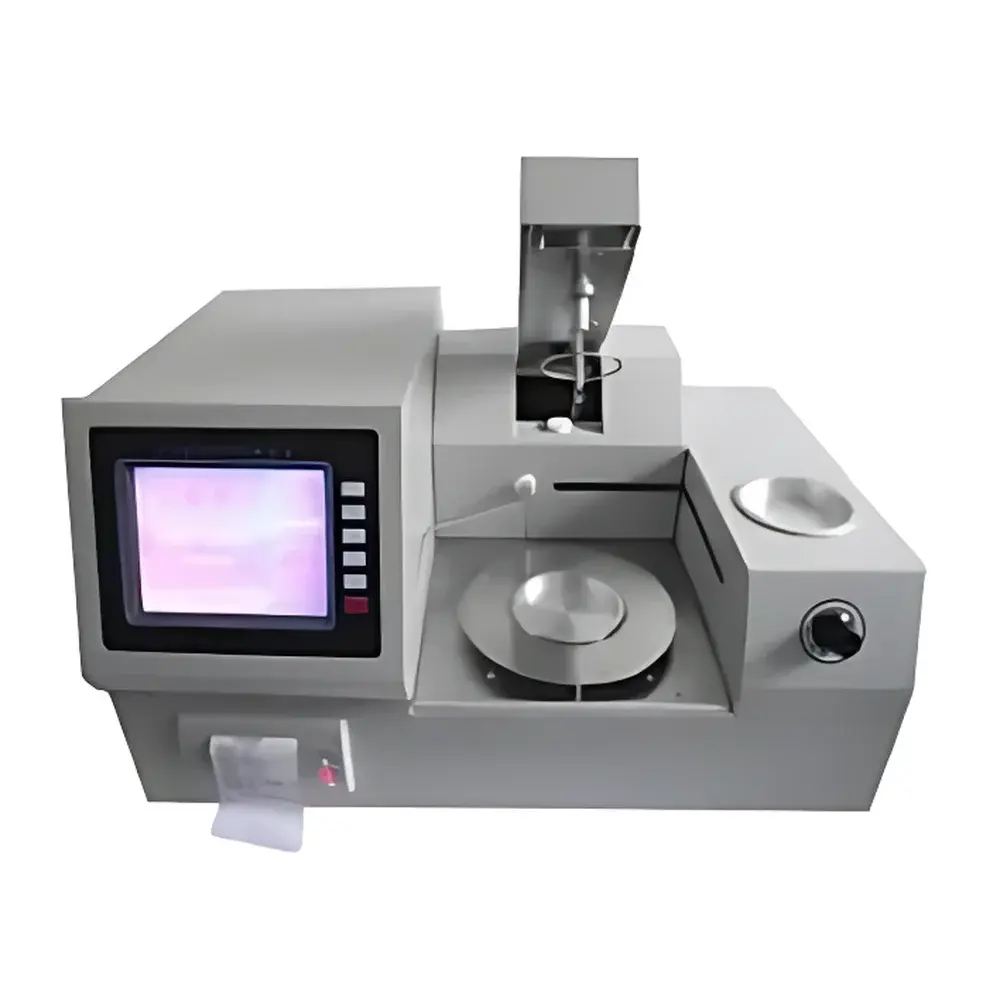
JIAHANG HSY-3536D Automatic Cleveland Open-Cup Flash Point Tester
| Brand | JIAHANG |
|---|---|
| Origin | Shanghai, China |
| Manufacturer Type | Direct Manufacturer |
| Country of Origin | China |
| Model | HSY-3536D |
| Detection Method | Cleveland Open-Cup (COC) |
| Operation Mode | Fully Automatic |
| Applicable Standard | GB/T 3536–2008 |
| Repeatability | ≤8 °C (flash point and fire point) |
| Ignition Method | Electronic spark ignition |
| Temperature Range | Ambient to 400 °C |
| Power Supply | AC 220 V ±10%, 50 Hz |
| Display | 8-inch industrial true-color touchscreen (Windows CE OS, bilingual Chinese/English interface) |
| Temperature Sensor | Imported German PT1000 (resolution: 0.1 °C) |
| Microcontroller | Renesas MCU |
| Data Storage | 120 test records onboard |
| Safety Features | Auto-shutdown on overtemperature, flame-quenching lid for fire point, real-time millisecond-level flash detection |
| Environmental Operating Conditions | 10–40 °C, RH ≤80% |
| Power Consumption | ≤500 W |
| Dimensions (lowered/lifted) | 520 × 360 × 310 / 420 mm (L×W×H) |
Overview
The JIAHANG HSY-3536D Automatic Cleveland Open-Cup Flash Point Tester is a precision-engineered instrument designed in strict compliance with GB/T 3536–2008, the Chinese national standard equivalent to ASTM D92 and ISO 2592 for determining the flash point and fire point of petroleum products using the Cleveland Open-Cup (COC) method. This technique relies on controlled conductive heating of a sample in an open crucible while introducing a standardized ignition source at defined temperature intervals. The flash point—the lowest temperature at which vapors above the heated sample ignite momentarily upon exposure to a flame—is determined by visual observation of the first flash across the surface. The fire point—the temperature at which sustained combustion occurs for at least 5 seconds—is recorded thereafter. The HSY-3536D automates the entire sequence: heating ramp control, temperature monitoring, timed sweep-and-ignition cycles, flash/fire event detection, and result validation—eliminating operator variability while maintaining full traceability to reference methodology.
Key Features
- Fully automated operation per GB/T 3536–2008, including heating, sweeping, electronic ignition, flash detection, and fire point confirmation—all executed without manual intervention.
- Industrial-grade 8-inch true-color touchscreen with embedded Windows CE OS, supporting seamless switching between English and Chinese interfaces for international laboratory use.
- High-accuracy temperature measurement system featuring a certified German-imported PT1000 platinum resistance sensor (±0.1 °C resolution) and Renesas microcontroller-based thermal regulation.
- Real-time temperature-versus-time curve visualization during testing, enabling immediate verification of heating rate conformity to standard-specified profiles.
- Integrated atmospheric pressure compensation: users input local barometric pressure to automatically correct flash point values per ASTM E1–21 guidelines, ensuring metrological rigor across elevation zones.
- Onboard diagnostic self-check at startup and during operation; fault codes and status indicators provide rapid troubleshooting capability.
- Dual safety architecture: automatic thermal shutdown upon exceeding preset limits and a motorized flame-quenching lid that deploys instantly upon fire point confirmation to extinguish combustion safely.
- Millisecond-response optical flash detection sensor ensures reliable, non-subjective identification of the initial vapor ignition event.
Sample Compatibility & Compliance
The HSY-3536D is validated for use with lubricating oils, residual fuels, bituminous materials, and other non-volatile petroleum derivatives whose flash points exceed 79 °C—consistent with the scope limitations of GB/T 3536–2008 and ASTM D92. It is not intended for low-flash liquids such as gasoline, diesel, or solvents. Instrument design conforms to IEC 61010–1 for electrical safety in laboratory equipment. Data integrity supports GLP and GMP environments through timestamped, non-editable test records stored locally (120 entries), each containing ambient pressure input, raw temperature/time data, ignition timing, and final flash/fire point values. While not FDA 21 CFR Part 11–certified out-of-the-box, audit trails are exportable in CSV format for integration into validated LIMS or ELN platforms.
Software & Data Management
The embedded Windows CE operating system manages all instrument functions without external PC dependency. Test parameters—including target heating rate, ignition interval, pressure correction factor, and pass/fail thresholds—are configurable via the touchscreen interface. Each test generates a structured record containing: date/time stamp, operator ID (optional), sample ID, ambient pressure, observed flash point (°C), fire point (°C), repeatability deviation (if applicable), and system diagnostic log. Records are retained in non-volatile memory and exportable via USB port in comma-separated values (CSV) format for post-analysis, regulatory reporting, or QA documentation. No proprietary software installation is required for data retrieval or archiving.
Applications
This instrument serves critical quality assurance and regulatory compliance functions across multiple sectors: refining laboratories verifying crude fraction stability; power generation facilities assessing turbine and transformer oil degradation; aviation maintenance depots screening hydraulic fluids for thermal breakdown; rail and marine fuel testing centers validating bunker fuel specifications; and academic research groups studying oxidation kinetics in base oils. Its robust construction and repeatable performance make it suitable for routine QC workflows in ISO/IEC 17025–accredited testing laboratories where adherence to standardized open-cup methodology is mandated by internal procedures or contractual obligations.
FAQ
What standards does the HSY-3536D comply with?
It fully implements GB/T 3536–2008, which is technically aligned with ASTM D92 and ISO 2592 for Cleveland Open-Cup flash and fire point determination.
Can this instrument be used for diesel or gasoline testing?
No. Per GB/T 3536–2008 scope, it is restricted to samples with flash points ≥79 °C. Low-flash fuels require closed-cup methods (e.g., ASTM D56 or D93).
How is atmospheric pressure compensated?
Users manually enter local barometric pressure (kPa or mmHg); the instrument applies empirically derived correction factors to reported flash/fire points in accordance with ASTM E1–21 Annex A1.
Is remote data export supported?
Yes—via USB 2.0 port. All test records are exportable as CSV files compatible with Excel, LIMS, or statistical analysis tools.
What safety mechanisms prevent uncontrolled combustion?
Two independent systems: (1) thermal cutoff at 410 °C prevents overheating, and (2) an actuated lid seals the cup within 1 second of confirmed fire point to suppress flame propagation.




