
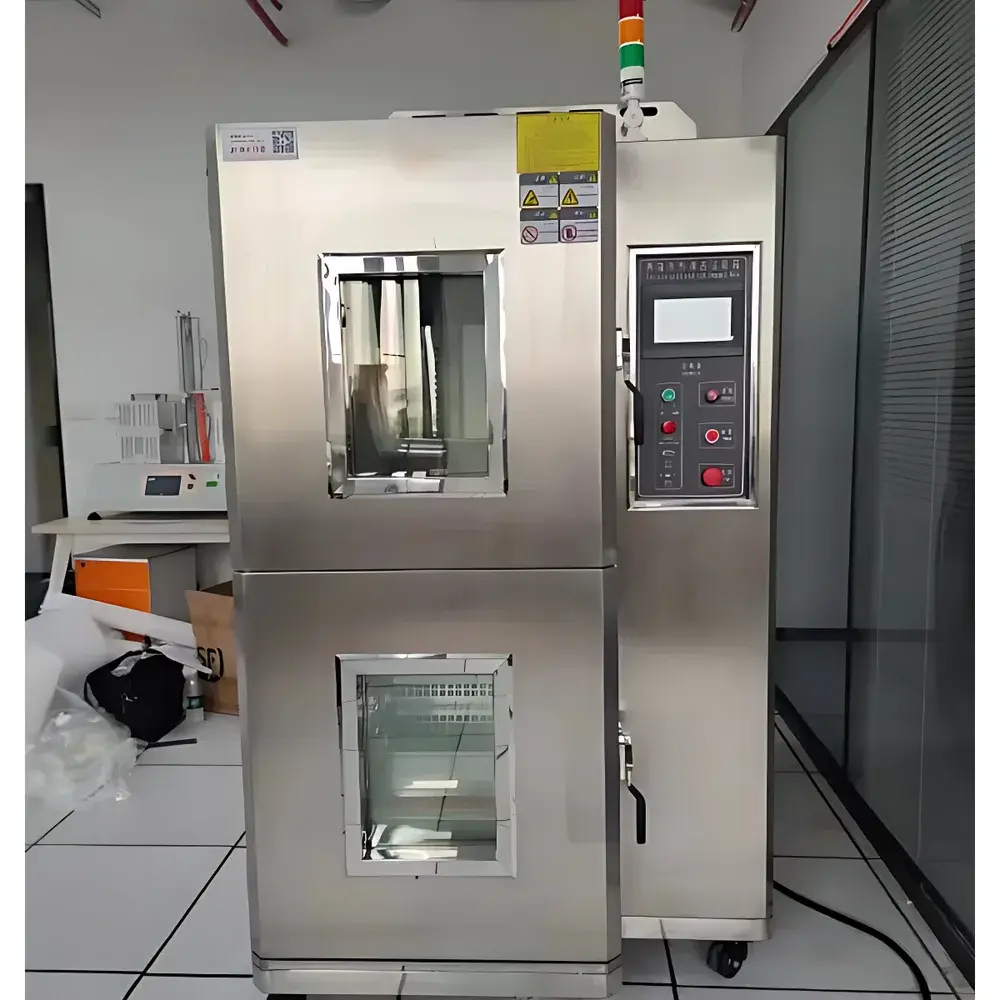
Jianhu JH-CTI Series Electronic Components Thermal Shock Test Chamber
| Brand | Jianhu |
|---|---|
| Origin | Shanghai, China |
| Manufacturer Type | Authorized Distributor |
| Country of Origin | China |
| Model | JH-CTI Series |
| Price Range | USD 750 – 108,000 |
Overview
The Jianhu JH-CTI Series Electronic Components Thermal Shock Test Chamber is an engineered environmental stress screening (ESS) system designed to evaluate the reliability of electronic components—particularly high-power semiconductor devices, automotive ECUs, photovoltaic inverters, and aerospace-grade modules—under rapid, extreme temperature transitions. Unlike conventional temperature cycling chambers that rely on single-zone ramping (typically ≤5 °C/min), this chamber employs a dual-chamber, air-transfer thermal shock architecture with independent cryogenic (liquid nitrogen–assisted) and high-temperature zones. It operates on the principle of accelerated thermal fatigue induction: by subjecting test specimens to repeated, high-rate thermal transients (up to 20 °C/min), it amplifies interfacial stresses arising from coefficient of thermal expansion (CTE) mismatches between dissimilar materials (e.g., silicon die, solder joints, ceramic substrates, and PCB laminates). This enables detection of latent defects—including micro-cracks in solder interconnects, delamination at die-attach interfaces, sealant shrinkage, and contact resistance instability—that remain undetectable under slow-ramp or static temperature exposure per standards such as IEC 60068-2-14 and MIL-STD-883H Method 1010.
Key Features
- Dual-zone thermal shock configuration with physically isolated hot and cold chambers, minimizing cross-contamination and enabling precise dwell-time control at extreme setpoints
- Temperature range: –55 °C to +180 °C, with programmable upper/lower limits configurable per test profile
- Thermal transition rate: up to 20 °C/min between chambers (measured at specimen location per ASTM E1545), verified via calibrated thermocouple arrays
- Temperature uniformity: ±0.3 °C within working volume (per IEC 60068-3-5), maintained via multi-point PID feedback and optimized airflow distribution
- Programmable test sequencing: supports up to 1000-step cycles with variable dwell times, transfer delays, and repeat logic—compliant with test protocols defined in JEDEC JESD22-A104, ISO 16750-4, and IEC 62108
- Stainless-steel interior chamber with non-corrosive insulation; external housing constructed from powder-coated steel for long-term lab durability
- Integrated safety systems: over-temperature cut-off, liquid nitrogen low-pressure alarm, door interlock, and real-time chamber pressure monitoring
Sample Compatibility & Compliance
The JH-CTI series accommodates standard JEDEC trays (JEDEC MO-178), 24-pin DIP carriers, QFN/QFP packages up to 40 mm × 40 mm, and board-level assemblies with maximum dimensions of 500 mm × 450 mm × 350 mm (W×D×H). Its design conforms to the mechanical and operational requirements of multiple international reliability standards, including but not limited to: IEC 60749-25 (integrated circuit thermal shock testing), AEC-Q100 Rev H (automotive IC qualification), IPC-9701A (performance testing of solder interconnections), and NASA-HDBK-7102 (electronics parts selection and qualification). All units undergo factory calibration traceable to NIM (National Institute of Metrology, China) and include a certificate of conformance compliant with ISO/IEC 17025–based internal quality procedures. Optional validation packages support IQ/OQ/PQ documentation for GLP and GMP-regulated environments.
Software & Data Management
The chamber is controlled via Jianhu’s proprietary TouchView™ operating interface—a 10.1″ capacitive touchscreen running embedded Linux with deterministic real-time scheduling. The software supports full audit trail functionality per FDA 21 CFR Part 11 requirements, including user authentication, electronic signatures, immutable event logging (start/stop, alarms, parameter changes), and encrypted data export (CSV, PDF, XML). Remote monitoring and control are available via Ethernet (TCP/IP) or optional Wi-Fi module, enabling integration into centralized laboratory information management systems (LIMS) or MES platforms. Data acquisition records temperature at ≥1 Hz sampling rate from up to six user-defined thermocouple inputs (Type K or T), synchronized with chamber state events (transfer initiation, dwell expiration, fault triggers). Exported datasets include time-stamped metadata essential for root-cause analysis and regulatory submissions.
Applications
This thermal shock chamber serves critical roles across high-reliability electronics development and manufacturing. In power electronics R&D, it validates bond wire integrity and substrate adhesion under repeated thermal excursions typical of EV traction inverters. For satellite communication modules, it replicates orbital thermal cycling profiles (e.g., –65 °C to +125 °C) while meeting MIL-STD-202G vibration compatibility thresholds. In medical device qualification, it verifies hermetic seal stability of implantable sensor housings per ISO 10993-12. Photovoltaic component manufacturers use it to assess encapsulant delamination resistance in bifacial modules exposed to desert diurnal cycles. Additionally, the system supports combined stress testing when integrated with optional humidity control (JH-CTI-H variant) or vibration shakers (via external trigger synchronization), enabling multi-stress HALT/HASS workflows aligned with ANSI/GEIA-STD-0010.
FAQ
How do I select appropriate temperature extremes and transition rates for my sensor application?
Select temperature bounds based on worst-case operational envelope: e.g., outdoor industrial sensors require –40 °C to +150 °C; enclosed-system sensors may need only –20 °C to +100 °C. Transition rate should reflect field-relevant thermal gradients—5–10 °C/min for ambient cycling, ≥15 °C/min for proximity to heat sources (e.g., motors, power converters). Jianhu provides application-specific profiling support upon submission of use-case documentation.
What is the typical number of thermal cycles required to validate component reliability?
Cycle count depends on end-use standard: automotive ECUs follow ISO 16750-4 (100–300 cycles); PV inverters comply with IEC 62108 (≥500 cycles); consumer electronics often use 100–200 cycles per JEDEC JESD22-A104. Each full cycle (hot → cold → return) takes 30–60 minutes depending on dwell duration and chamber size.
How does thermal shock testing differ fundamentally from standard temperature cycling?
Standard cycling applies gradual ramping (1–3 °C/min) across a single zone, inducing bulk thermal strain. Thermal shock uses rapid air-transfer between isolated extremes, generating steep thermal gradients across material interfaces—thereby exposing CTE-driven failures (e.g., solder joint fracture, package cracking) that slow ramping cannot initiate.
Can this chamber be validated for regulated industries like aerospace or medical devices?
Yes. The JH-CTI series supports IQ/OQ/PQ execution with full traceability, 21 CFR Part 11–compliant software, and calibration documentation aligned with ISO/IEC 17025 practices. Jianhu has delivered validated systems to SGS, CNAS-accredited labs, and Tier-1 aerospace suppliers under AS9100-compliant project management.
Related Products



