
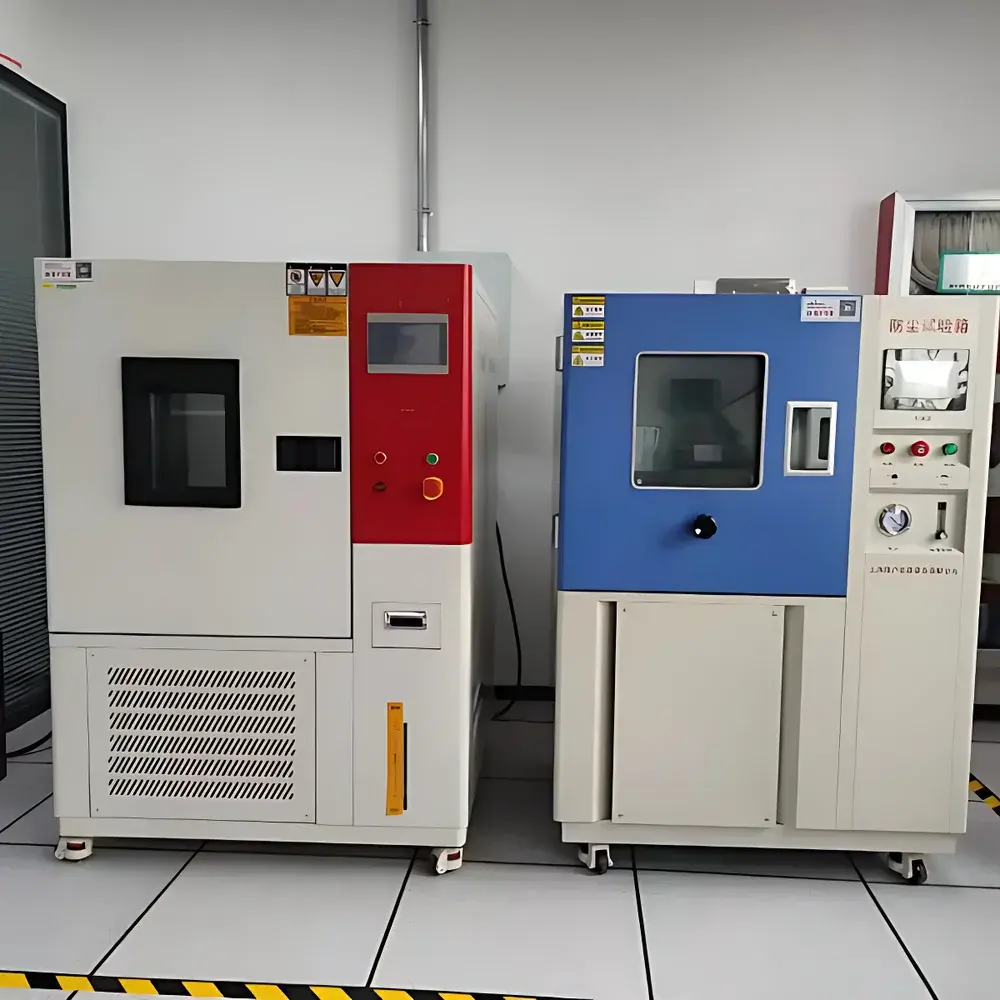
Jianhu JH-ETC Series Automotive Component Thermal Cycling Environmental Test Chamber
| Brand | Jianhu |
|---|---|
| Origin | Shanghai, China |
| Manufacturer Type | Authorized Distributor |
| Product Category | Domestic |
| Model | JH-ETC Series |
| Price Range | USD 4,200 – 42,000 |
| Temperature Range | −70 °C to +150 °C |
| Refrigeration Method | Mechanical Compression Cooling |
| Explosion-Proof Design | Yes |
| Temperature Fluctuation | ±0.5 °C |
| Temperature Deviation | ±2.0 °C |
| Temperature Uniformity | ±2.0 °C |
| Heating Rate (Empty) | ≤60 min (−70 °C → +150 °C) |
| Cooling Rate (Empty) | ≤45 min / ≤60 min / ≤80 min (depending on configuration) |
Overview
The Jianhu JH-ETC Series Automotive Component Thermal Cycling Environmental Test Chamber is an engineered solution for accelerated environmental stress testing of automotive subsystems and non-metallic materials—including lighting assemblies, polymer housings, elastomeric seals, and thermoplastic composites. Based on forced-air convection with dual-stage cascade refrigeration and PID-controlled electric heating, the chamber delivers precise, repeatable thermal profiles compliant with international reliability test standards such as ISO 16750-4, SAE J2334, GB/T 2423.22, and IEC 60068-2-14. Its explosion-proof construction meets Class I, Division 2, Group C/D requirements per NEC 500 and enables safe evaluation of components containing volatile solvents or operating under energized conditions—critical for LED headlamp modules, battery management enclosures, and fuel system gaskets.
Key Features
- Wide operational temperature range of −70 °C to +150 °C, validated across full load conditions using calibrated PT100 Class A sensors traceable to NIM (National Institute of Metrology, China)
- High-fidelity thermal control architecture featuring dual-loop PID regulation, 0.1 °C resolution setpoint programming, and programmable ramp/soak profiles with up to 999 segments
- Explosion-proof enclosure certified to GB 3836.1–2010 (equivalent to IEC 60079-0), including intrinsically safe wiring conduits, pressurized junction boxes, and non-sparking internal hardware
- Optimized airflow design with rear-mounted centrifugal blower and adjustable baffle system ensures ±2.0 °C spatial uniformity (per GB/T 5170.2) and ±0.5 °C temporal stability at sensor location during steady-state operation
- Thermal performance verified under defined thermal load conditions: standard calibration includes 10 kg aluminum mass load; optional thermal load simulation reports available upon request
- Robust stainless-steel inner chamber (SUS304) with electrostatically applied epoxy-coated outer shell, supporting long-term exposure to UV-stabilized polymers and halogen-free flame-retardant compounds
Sample Compatibility & Compliance
The JH-ETC chamber accommodates samples up to 1,200 mm (W) × 1,000 mm (D) × 1,000 mm (H), with configurable shelf supports and cable ports (Φ50/Φ80 mm). It supports dynamic thermal cycling protocols required for automotive qualification (e.g., 1,000-cycle tests per LV 124), as well as static endurance tests for lighting optics, instrument panel substrates, and under-hood rubber hoses. All units ship with factory calibration certificates issued by a CNAS-accredited third-party laboratory (CNAS L5882), confirming compliance with GB/T 5170.2–2017 for temperature performance. The chamber’s mechanical design adheres to GB/T 14710–2009 for environmental adaptability and EMC immunity per GB/T 18268.1–2010.
Software & Data Management
Equipped with the Jianhu E-Logic™ controller (v3.2), the system provides touchscreen HMI with multilingual UI (English, Chinese, German, Japanese), real-time graphing, and audit-trail-enabled data logging. Software features include user-level permission management (admin/operator/viewer), electronic signature support, immutable event logs with timestamped operator ID, and automatic report generation in PDF/CSV formats. Data export is supported via USB 2.0, Ethernet (TCP/IP), and optional RS-485 Modbus RTU interface. Firmware complies with ALCOA+ principles and supports 21 CFR Part 11 readiness when deployed with validated IT infrastructure—enabling integration into GLP/GMP environments requiring full data integrity and traceability.
Applications
- Automotive electronics: ECUs, ADAS camera housings, radar modules, and infotainment displays subjected to thermal shock per ISO 16750-4 Clause 4.2
- Lighting systems: LED headlamps, tail lamps, and interior ambient lighting assemblies undergoing thermal cycling to assess lens delamination, seal integrity, and phosphor degradation
- Polymer & elastomer validation: TPE/TPO bumpers, EPDM door seals, silicone gaskets, and polyamide engine covers tested per SAE J2334 for crack initiation and dimensional stability
- R&D labs and certification bodies: Used by Tsinghua University, Harbin Institute of Technology, SGS Shanghai, and CNAS-accredited testing centers for material qualification and failure mode analysis
- Supply chain quality assurance: Supports PPAP submission packages through documented thermal profile repeatability, uncertainty budgets, and metrological traceability
FAQ
What standards does the JH-ETC chamber comply with for automotive testing?
It meets ISO 16750-4, SAE J2334, GB/T 2423.22, and IEC 60068-2-14 for thermal cycling; structural and safety compliance follows GB 3836.1–2010 (explosion-proof) and GB/T 14710–2009 (environmental adaptability).
Is the temperature uniformity specification valid under loaded conditions?
Yes—uniformity of ±2.0 °C is measured per GB/T 5170.2–2017 with a 10 kg aluminum thermal mass installed at center load position.
Can the chamber be integrated into a LabVantage or LIMS environment?
Yes, via Ethernet-based Modbus TCP or OPC UA (optional add-on module), supporting structured data exchange for automated test record generation and audit-ready archiving.
Does the system include a certified calibration certificate at shipment?
Each unit ships with a CNAS-accredited calibration certificate (L5882) covering temperature performance at three points (−40 °C, 25 °C, +85 °C) under no-load and 10 kg load conditions.
What maintenance intervals are recommended for long-term reliability?
Compressor oil and refrigerant filter replacement every 24 months; annual verification of sensor accuracy and airflow velocity mapping; biannual inspection of explosion-proof conduit seals and grounding continuity.



