
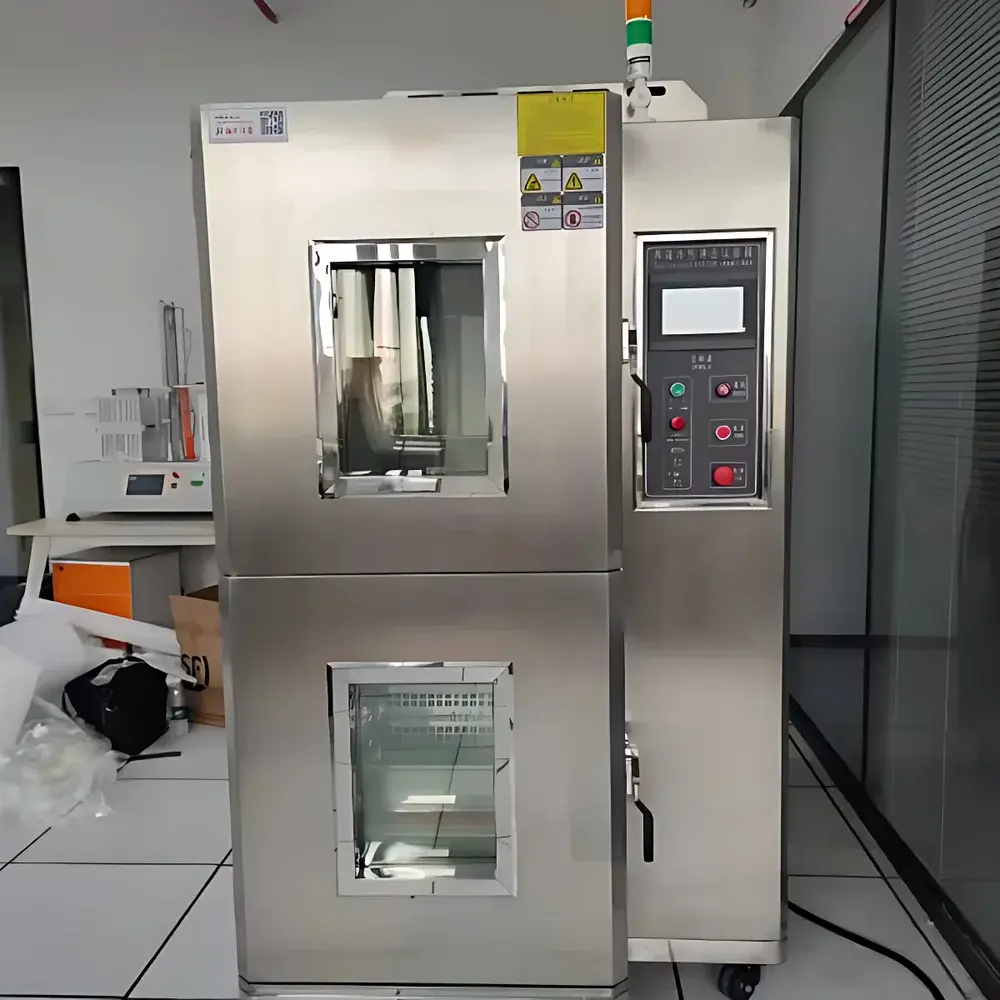
Jianhu JH-Series Dual-Wall Explosion-Proof Battery Test Chamber with Intelligent Temperature Control & Multi-Layer Safety Protection
| Brand | Jianhu |
|---|---|
| Origin | Shanghai, China |
| Model | JH-Series Dual-Wall Explosion-Proof Battery Test Chamber |
| Temperature Range | −70 °C to +150 °C |
| Refrigeration Method | Compressor-Based Cooling |
| Explosion-Proof Design | Certified ATEX/IECEx-Compatible Enclosure (Class I, Division 1, Group D) |
| Temperature Uniformity | ±2.0 °C |
| Temperature Fluctuation | ±0.5 °C |
| Temperature Deviation | ±2.0 °C |
| Heating Rate | ≤60 min (−70 °C to +150 °C) |
| Cooling Rate | ≤45 min (25 °C to −40 °C), ≤60 min (25 °C to −70 °C), ≤80 min (25 °C to +150 °C → −70 °C) |
| Internal Chamber Dimensions | Customizable (Standard Options: W600 × D600 × H700 mm to W1500 × D1200 × H1800 mm) |
| Compliance | Meets ISO 12405-4, UN 38.3 Section 38.3.4 (Thermal Abuse & External Short Circuit Conditioning), GB/T 31485–2015, GB/T 31467.3–2015 |
Overview
The Jianhu JH-Series Dual-Wall Explosion-Proof Battery Test Chamber is an engineered environmental test system specifically designed for rigorous safety-critical evaluation of lithium-ion, solid-state, sodium-ion, and other electrochemical energy storage devices under extreme thermal conditions. It operates on a dual-chamber thermal conditioning principle combined with intrinsically safe mechanical containment—enabling controlled execution of standardized abuse tests including thermal runaway propagation, overcharge simulation, external short circuit preconditioning, and post-abuse thermal soak per UN 38.3, IEC 62133-2, and GB/T 31485. The chamber’s structural architecture integrates active thermal management with passive explosion mitigation, making it suitable for use in battery cell R&D laboratories, QC validation suites, and third-party certification facilities operating under GLP-compliant workflows.
Key Features
- Dual-wall containment structure: Inner chamber constructed from high-strength austenitic stainless steel (AISI 316L) with optimized wall thickness and reinforced seam welding; outer shell fabricated from carbon steel with integrated flame-arresting epoxy-polyester composite coating rated for Class I, Division 1 hazardous locations.
- Explosion-proof instrumentation interface: All internal sensors—including PT100 temperature probes, piezoresistive pressure transducers (0–20 bar range), and gas detection modules (CO, H₂, HF)—are certified for use in explosive atmospheres and connected via intrinsically safe barriers compliant with IEC 60079-11.
- Intelligent adaptive temperature control: PID-controlled dual-stage refrigeration (cascade compressor system) coupled with electric heating elements delivers precise ramp-soak profiles across the full −70 °C to +150 °C range, with real-time deviation compensation enabled by distributed sensor feedback loops.
- Multi-layer safety interlock system: Hardware-based emergency shutdown triggers automatic activation of forced ventilation (ATEX-rated centrifugal fans), nitrogen purge injection (optional), and pressure-relief venting upon detection of >1.2 bar gauge pressure or >120 °C internal temperature.
- Modular chamber configuration: Standardized flanged access ports (DN100, DN150), integrated cable feedthroughs (IP67-rated), and removable interior lining allow seamless integration with external data acquisition systems, video monitoring rigs, and gas chromatography interfaces.
Sample Compatibility & Compliance
The JH-Series chamber accommodates cylindrical (18650, 21700, 4680), prismatic, and pouch-format battery cells and modules up to 300 mm in height and 20 kg mass. Its design supports both open-cell testing (with inert atmosphere purging) and sealed-module evaluation. Regulatory alignment includes conformance to ISO 12405-4 (electric vehicle battery testing), UN Manual of Tests and Criteria Part III, subsection 38.3.4 (thermal abuse), and Chinese national standards GB/T 31485–2015 (safety requirements for traction batteries) and GB/T 31467.3–2015 (performance testing). Optional calibration certificates traceable to NIM (National Institute of Metrology, China) and UKAS-accredited reference labs are available for audit-ready documentation.
Software & Data Management
Built-in embedded controller runs proprietary Jianhu TestSuite firmware supporting programmable multi-step test sequences, real-time parameter logging at 1 Hz resolution, and export of time-synchronized datasets in CSV and MATLAB (.mat) formats. Remote operation is enabled via Ethernet TCP/IP or optional Wi-Fi module, with role-based user access control (admin/operator/viewer tiers). Audit trail functionality complies with FDA 21 CFR Part 11 requirements when configured with digital signature authentication and electronic record retention policies. Data integrity safeguards include cyclic redundancy checksums, non-volatile memory backup, and automatic generation of PDF test reports with embedded metadata (operator ID, timestamp, chamber ID, calibration status).
Applications
- Thermal abuse testing per UN 38.3 Section 38.3.4 and IEC 62133-2 Clause 8.4.2
- Cell-level thermal runaway propagation studies using calibrated heater tape or nail penetration fixtures
- Preconditioning cycles for external short circuit, overcharge, and forced discharge validation
- Environmental stress screening (ESS) of battery management systems (BMS) under rapid thermal transients
- Accelerated aging protocols combining temperature cycling with humidity exposure (when integrated with optional humidification kit)
- Support for DOE-funded ARPA-E projects requiring NIST-traceable thermal test infrastructure
FAQ
Is this chamber certified for use in Class I, Division 1 hazardous locations?
Yes—the mechanical enclosure, sensor suite, and power distribution system meet IEC 60079-0 and IEC 60079-1 requirements for Group D atmospheres, with optional ATEX marking available upon request.
Can the chamber be integrated with external gas analyzers or high-speed cameras?
Absolutely. Standardized 6-mm and 12-mm optical viewports (fused silica, AR-coated), NPT-threaded gas sampling ports, and shielded analog/digital I/O terminals enable direct interfacing with GC-MS systems, infrared thermography units, and event-triggered imaging platforms.
What maintenance intervals are recommended for long-term reliability?
Compressor oil and filter replacement every 12 months; annual verification of pressure relief valve setpoint and temperature sensor calibration against NIST-traceable references; biannual inspection of gasket integrity and explosion-proof conduit seals.
Does the system support automated test reporting aligned with ISO/IEC 17025 documentation requirements?
Yes—TestSuite firmware generates timestamped, tamper-evident reports containing raw data, pass/fail determinations per selected standard clauses, operator annotations, and instrument calibration history, all exportable in PDF/A-2b format.
Are custom chamber dimensions available for large-format EV battery modules?
Yes—custom engineering services cover internal volume optimization up to 2.5 m³, structural reinforcement for >100 kg payloads, and integration of liquid-cooled base plates compatible with 5–35 °C chiller loops.
Related Products



