
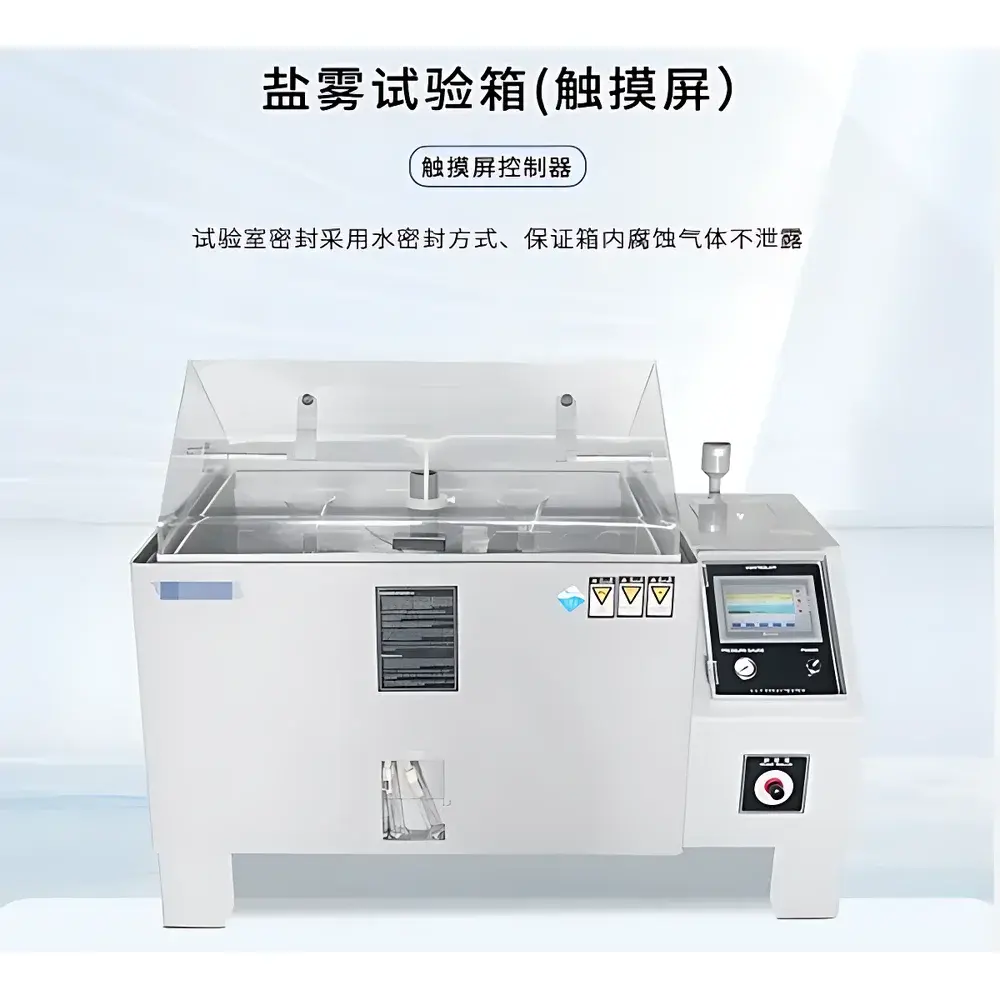
JianHu JH-Series Laboratory Salt Spray Test Chamber with Extended Temperature Range (-20°C to +80°C)
| Brand | JianHu |
|---|---|
| Origin | Shanghai, China |
| Manufacturer Type | Manufacturer |
| Product Category | Domestic |
| Model | JH-Series Laboratory Salt Spray Test Chamber |
| Price Range | USD 1,150 – 11,500 (FOB Shanghai) |
| Spray Method | Continuous Atomization |
| Spray Rate | 1–2 mL / 80 cm²·hr |
| Nozzle Pressure | 0.7–1.0 kgf/cm² |
| Fog Removal | Pneumatic Air-Compression Exhaust |
Overview
The JianHu JH-Series Laboratory Salt Spray Test Chamber is an engineered environmental simulation system designed for accelerated corrosion testing in accordance with international standards including ASTM B117, ISO 9227, JIS Z2201, and GB/T 2423.17. Unlike conventional salt fog chambers limited to ambient or mild elevated temperatures, the JH-Series integrates a dual-refrigeration/heating thermal control architecture enabling stable operation across an extended temperature range of −20°C to +80°C. This capability supports not only standard neutral salt spray (NSS), acetic acid salt spray (AASS), and copper-accelerated acetic acid salt spray (CASS) tests—but also multi-stress corrosion protocols involving low-temperature condensation, thermal cycling, and combined humidity-salt exposure. The chamber employs a gravity-fed, corrosion-resistant PVC/PVC-coated brass nozzle assembly with precision-regulated air pressure control to ensure uniform aerosol generation and reproducible droplet size distribution (median diameter ≈ 1–3 µm). Its closed-loop saturation tower maintains >95% RH at the test zone while minimizing drift in pH (6.5–7.2 for NSS) and conductivity (<50 µS/cm post-filtration).
Key Features
- Extended thermal operating range: −20°C to +80°C with ±0.5°C temperature stability and ≤±2% RH fluctuation under load
- Corrosion-resistant 316L stainless steel interior chamber and PVC-coated structural frame for long-term chemical inertness
- Dual-seal door design with high-elasticity silicone gaskets (dual-layer compression sealing) preventing salt fog leakage and cross-contamination
- Intelligent pneumatic fog exhaust system utilizing regulated compressed air displacement—eliminating mechanical fans that degrade in saline environments
- 7-inch full-color capacitive touchscreen HMI with multilingual UI (English, German, French, Japanese, Chinese), embedded help videos, and context-sensitive parameter guidance
- Preloaded test templates compliant with ASTM B117, ISO 9227, and MIL-STD-810H Method 509.6; user-definable multi-step profiles with up to 99 segments
- Real-time sensor fusion: PT100 temperature probes, capacitive RH sensors, conductive salinity monitors, and pressure transducers feed data to a PID-controlled embedded PLC
Sample Compatibility & Compliance
The JH-Series accommodates specimens up to 600 mm × 450 mm × 400 mm (W×D×H) and supports rack-mounted, hanging, and inclined sample configurations per ISO 9227 Annex A. Internal chamber geometry ensures laminar airflow and uniform salt deposition (verified via collection funnel mapping per ASTM B117 Appendix X1). All electronic components—including power supplies, relays, and I/O modules—are conformally coated and housed in external enclosures rated IP54. The system complies with CE marking requirements (2014/30/EU EMC Directive, 2014/35/EU LVD Directive), meets RoHS 2011/65/EU material restrictions, and supports audit-ready documentation for GLP and GMP environments. Optional validation packages include IQ/OQ protocols traceable to NIST-calibrated reference instruments.
Software & Data Management
The integrated JianHu TestMaster™ firmware provides local data logging at 1-second intervals for all critical parameters (chamber temp/RH, saturation tower temp, nozzle pressure, solution pH/conductivity). Export formats include CSV, PDF test reports, and XML for LIMS integration. Remote monitoring is supported via Ethernet (TCP/IP) or optional Wi-Fi module, enabling secure HTTPS access through role-based user accounts. Audit trail functionality records all parameter changes, user logins, and alarm events with timestamps—fully compliant with FDA 21 CFR Part 11 requirements when paired with digital signature add-ons. Data retention exceeds 12 months onboard; external USB backup and cloud-sync options are available.
Applications
This chamber serves R&D and QA laboratories in automotive component manufacturing (e.g., brake calipers, fasteners, battery enclosures), aerospace alloys (Al 7075-T6, Ti-6Al-4V), medical device coatings (stainless steel surgical tools, nitinol stents), printed circuit board conformal coatings, and polymer composites used in offshore wind infrastructure. It enables comparative evaluation of electroplated zinc-nickel vs. trivalent chromium passivation, assessment of galvanic corrosion in bimetallic assemblies, and qualification of anti-corrosion paints under cyclic thermal-salt stress. Universities and national metrology institutes utilize it for inter-laboratory round-robin studies supporting ISO/IEC 17025 accreditation.
FAQ
What standards does the JH-Series chamber support out-of-the-box?
ASTM B117, ISO 9227, JIS Z2201, GB/T 2423.17, and DIN 50021—preconfigured test modes include NSS, AASS, and CASS with auto-adjusted saturation temperature compensation.
Can the chamber operate continuously at −20°C during salt spray exposure?
Yes—its dual-stage refrigeration system maintains sub-zero chamber temperature while sustaining stable atomization via heated nozzle manifolds and insulated saturation tower.
Is third-party calibration and qualification support available?
Yes—JianHu provides factory-issued IQ/OQ documentation, on-site SAT (Site Acceptance Testing), and NIST-traceable calibration certificates upon request.
How is salt solution replenishment managed during long-duration tests?
The chamber includes a 20-L reservoir with level sensors and automatic refill interface compatible with external deionized water supply and programmable dosing pumps.
Does the system meet cybersecurity requirements for network-connected labs?
Firmware v3.2+ implements TLS 1.2 encryption, configurable firewall rules, disabled default credentials, and periodic security patch updates aligned with IEC 62443-4-2.



