
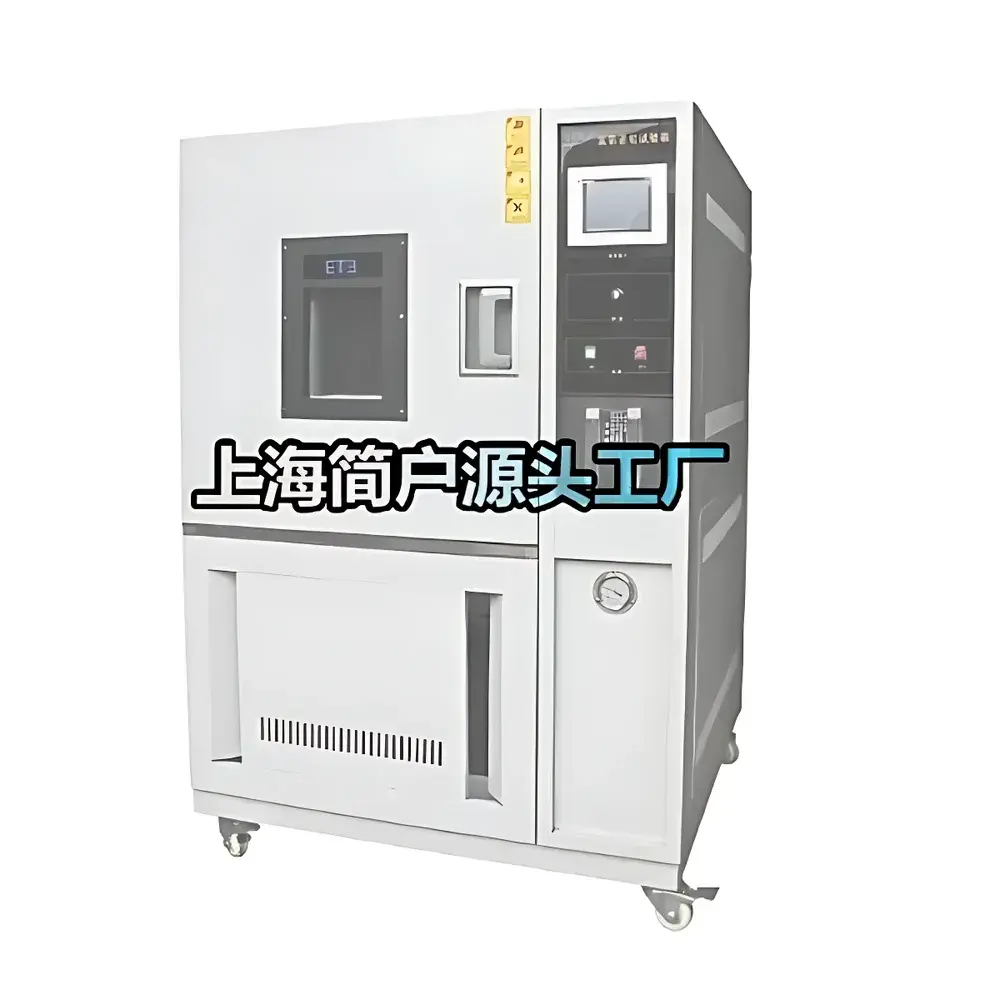
JianHu JH-Series Ozone Aging Test Chamber
| Brand | JianHu |
|---|---|
| Origin | Shanghai, China |
| Model | JH-Ozone Aging Test Chamber |
| Temperature Range | Ambient to 70 °C |
| Ozone Concentration Range | 0–1000 pphm (adjustable with UV ozone generator) |
| Humidity Control | Optional RH 20–98% (±3% RH) |
| Chamber Volume | 100–1000 L (customizable) |
| Compliance | ISO 1431-1, ASTM D1149, GB/T 7762, IEC 60811-501 |
Overview
The JianHu JH-Series Ozone Aging Test Chamber is an engineered environmental simulation system designed for accelerated evaluation of elastomeric and polymeric materials under controlled ozone exposure. It operates on the principle of dynamic or static ozone-induced cracking—where ozone gas (O₃), generated via ultraviolet (UV) photolysis of ambient oxygen, reacts selectively with unsaturated carbon–carbon double bonds in rubber compounds (e.g., natural rubber, SBR, NBR), initiating surface oxidation and microcrack propagation. Unlike thermal or UV aging, ozone degradation occurs at ambient or elevated temperatures without requiring light exposure, making this chamber uniquely suited for assessing critical failure modes in seals, gaskets, tires, and cable insulation. The chamber maintains precise, traceable control over ozone concentration (0–1000 parts per hundred million, pphm), temperature (ambient to 70 °C), and optional relative humidity (20–98% RH), enabling reproducible test conditions aligned with internationally recognized accelerated aging protocols.
Key Features
- UV-based ozone generation system with real-time ozone concentration monitoring via electrochemical sensor (calibrated per ISO 1431-3); output stability ±5% over 24 h
- Dual-wall insulated stainless-steel chamber construction (SUS304 interior, SUS201 exterior) with forced-air circulation for uniform temperature distribution (±1.5 °C across working volume)
- Programmable controller with Ethernet interface supporting remote monitoring, data logging, and alarm relay outputs
- Optional integrated humidity control module with steam humidifier and refrigerative dehumidifier, compliant with ASTM D1149 Annex A2 for wet-condition testing
- Sample rotation mechanism (optional) to ensure uniform ozone exposure on all specimen surfaces per ISO 1431-1 Clause 6.3
- Compliance-ready architecture: supports audit trails, user access levels, and electronic signature functionality compatible with GLP/GMP documentation workflows
Sample Compatibility & Compliance
The JH-Series accommodates standardized dumbbell-shaped specimens (ISO 1431-1 Type 1, ASTM D1149 Type A), ring specimens, and finished components (e.g., O-rings, hose sections, extruded profiles) up to 500 mm in length. Specimen holders are non-reactive (anodized aluminum or PTFE-coated stainless steel) to prevent catalytic ozone decomposition. The system is validated for conformance to ISO 1431-1:2017 (Rubber — Determination of resistance to ozone cracking — Part 1: Static strain method), ASTM D1149-19 (Standard Test Method for Rubber Deterioration — Surface Ozone Cracking), GB/T 7762–2014 (Chinese national standard equivalent), and IEC 60811-501:2012 (for electric cable insulation). Chamber calibration certificates include as-found/as-left ozone concentration profiles, temperature uniformity maps, and sensor linearity verification against NIST-traceable reference standards.
Software & Data Management
JianHu’s proprietary JianHuTest Control Suite (v4.2+) provides full test lifecycle management: method creation, real-time parameter visualization (ozone ppm, temp, RH), automated pass/fail classification based on crack initiation time and depth per ISO criteria, and export of CSV/PDF reports compliant with FDA 21 CFR Part 11 requirements (electronic records, audit trail, role-based permissions). Data integrity safeguards include cyclic redundancy checksums for logged files, automatic backup to network drives, and timestamped event logs covering operator actions, alarm triggers, and hardware status changes. Integration with LIMS platforms is supported via OPC UA and Modbus TCP protocols.
Applications
- Automotive: Accelerated validation of EPDM door seals, silicone brake hoses, and butyl inner liners under simulated roadside ozone concentrations (50–200 pphm)
- Aerospace: Qualification of nitrile rubber fuel system components per SAE AMS3276 and MIL-DTL-83528
- Medical Devices: Biocompatibility assessment of silicone tubing and thermoplastic elastomer (TPE) housings per ISO 10993-12
- Wire & Cable: Evaluation of cross-linked polyethylene (XLPE) jacketing per IEEE 1202 and UL 1581 Section 1060
- Construction: Durability testing of EPDM roofing membranes and neoprene expansion joint fillers per ASTM C1353 and EN 13948
- Academic Research: Kinetic modeling of ozone diffusion coefficients in filled rubber composites using time-to-crack datasets
FAQ
What ozone concentration ranges are achievable, and how is concentration verified?
The chamber delivers 0–1000 pphm ozone, adjustable in 1-pphm increments. Concentration is continuously monitored by a factory-calibrated electrochemical sensor traceable to NIST Standard Reference Material (SRM) 2192; annual recalibration is recommended.
Does the system support dynamic strain testing per ISO 1431-2?
Yes—optional motorized specimen stretching fixtures enable static and dynamic strain modes (20% ±2% elongation) per ISO 1431-2:2017, with load cell feedback and programmable cycle profiles.
Is humidity control mandatory for compliance with ASTM D1149?
No—ASTM D1149 permits both dry and wet condition testing; however, the optional humidity module is required for Annex A2 (wet method) and essential for evaluating hygroscopic polymers like TPU or nylon.
How is temperature uniformity validated across the working volume?
Per IEC 60068-3-5, 9-point temperature mapping is performed during factory acceptance testing (FAT), with results documented in the IQ/OQ report; users may repeat mapping using calibrated PT100 probes.
Can test data be exported to third-party statistical analysis tools?
Yes—CSV exports include timestamps, raw sensor values, calculated metrics (e.g., crack density/mm²), and metadata (operator ID, method name, chamber ID), compatible with JMP, Minitab, and Python pandas workflows.



