
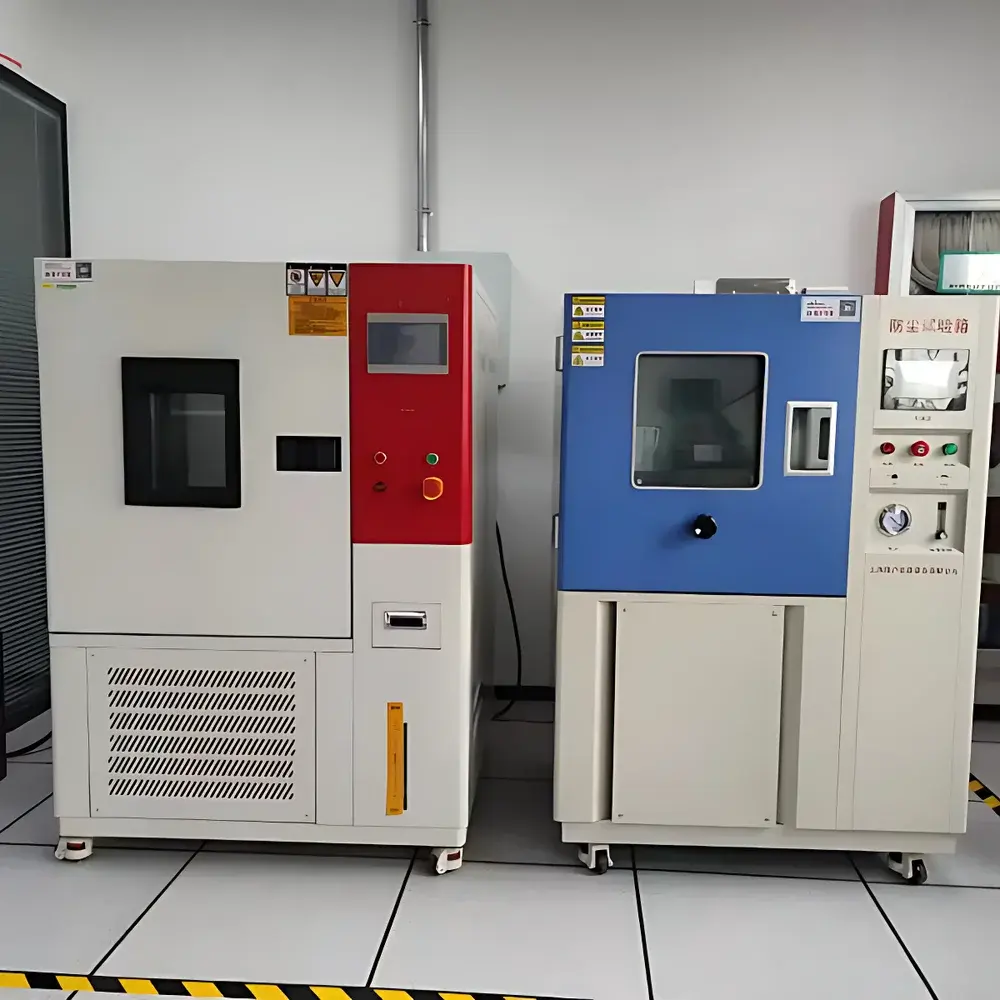
Jianhu JH-TCI Series Temperature Cycling Shock Chamber (Customizable Workspace, Explosion-Proof Configuration)
| Brand | Jianhu |
|---|---|
| Origin | Shanghai, China |
| Manufacturer Type | Authorized Distributor & System Integrator |
| Product Category | Domestic High-Performance Environmental Test Chamber |
| Model | JH-TCI Series |
| Price Range | USD 900 – 9,000 (FOB Shanghai) |
| Temperature Range | −70 °C to +150 °C |
| Cooling Method | Dual-Stage Mechanical Refrigeration System |
| Explosion-Proof Certification | Ex d IIB T4 Gb compliant (IEC 60079-1) |
| Temperature Stability | ±0.5 °C (at setpoint, steady-state) |
| Temperature Uniformity | ±2.0 °C (within working volume) |
| Temperature Deviation | ±2.0 °C (vs. sensor reference) |
| Ramp-Up Time | ≤60 min (−70 °C → +150 °C, empty chamber) |
| Ramp-Down Time | ≤45 min (25 °C → −70 °C), ≤60 min (150 °C → −70 °C), ≤80 min (full thermal load) |
| Internal Dimensions | Custom-engineered per client specification (standard base options: W600 × D600 × H600 mm to W1200 × D1000 × H1000 mm) |
Overview
The Jianhu JH-TCI Series Temperature Cycling Shock Chamber is an industrial-grade environmental test system engineered for accelerated reliability validation of automotive components, electronic modules, and aerospace subsystems under extreme thermal stress conditions. It operates on a dual-chamber, air-to-air thermal shock principle—featuring independent high-temperature (+150 °C) and low-temperature (−70 °C) zones with rapid pneumatic transfer mechanisms. This architecture enables precise, repeatable thermal cycling profiles per ISO 16750-4, AEC-Q200, and MIL-STD-810H Method 503.5, supporting both step-stress and ramped-cycle protocols. Designed specifically for high-mix, high-volume production environments, the JH-TCI integrates robust mechanical refrigeration, explosion-proof enclosure compliance, and factory-calibrated temperature metrology traceable to NIM (National Institute of Metrology, China). Its core function is not merely temperature exposure—but controlled, quantifiable thermal fatigue induction to expose latent defects in solder joints, polymer seals, wire harness terminations, and MEMS packaging prior to field deployment.
Key Features
- Explosion-proof configuration certified to IEC 60079-1 (Ex d IIB T4 Gb), suitable for testing battery management systems (BMS), EV power electronics, and fuel-system sensors in classified areas.
- Dual-stage cascade refrigeration system with environmentally compliant R-404A/R-23 mixed-refrigerant circuitry, enabling stable sub-zero operation without liquid nitrogen dependency.
- Real-time temperature uniformity monitoring via 9-point calibrated PT100 sensor array (3×3 grid), with automated drift compensation algorithms embedded in the controller firmware.
- Programmable transfer time down to 10 seconds between chambers, supporting high-frequency cycling (≥1,000 cycles) with <±0.3 °C inter-chamber setpoint repeatability.
- Modular internal workspace design—fully customizable dimensions, removable shelves, optional stainless-steel liners, and integrated cable/port interfaces for in-situ electrical monitoring during thermal cycling.
- Compliance-ready data logging: 100 ms sampling interval, encrypted binary storage, and audit trail export (CSV/Excel) meeting FDA 21 CFR Part 11 requirements for electronic records and signatures.
Sample Compatibility & Compliance
The JH-TCI accommodates diverse automotive component geometries—from compact ECU housings (≤200 mm × 150 mm × 80 mm) to full-size HVAC actuators and brake control units. Its non-standardized internal volume supports fixture-integrated testing per OEM-specific test plans (e.g., BMW GS 95024-2, Ford WSS-M99P1111-A). All thermal profiles are validated against ASTM E1545-20 (Standard Test Method for Calibration of Thermal Shock Chambers) and ISO 16750-4 Annex B (Temperature Cycling Test Procedures). The system meets GLP and IATF 16949-aligned operational documentation standards—including calibration certificates (NIST-traceable reference sensors), preventive maintenance logs, and user-accessible uncertainty budgets for each temperature zone.
Software & Data Management
Control and analysis are executed via Jianhu’s proprietary TCS-Studio v4.2 software platform, running on an embedded industrial PC with Windows IoT Enterprise OS. The interface supports multi-user role-based access (Operator, Engineer, QA Auditor), password-protected parameter locking, and automatic generation of test reports compliant with AIAG CQI-9 guidelines. Raw thermal data—including chamber air temperature, specimen surface thermocouple readings (optional K-type input), and compressor duty cycle—is timestamped and stored with SHA-256 hash integrity verification. Export formats include PDF (with digital signature), XML (for LIMS integration), and CSV (compatible with JMP, Minitab, and MATLAB). Remote diagnostics and firmware updates are performed over TLS 1.2-secured Ethernet or optional 4G LTE module—enabling predictive maintenance alerts based on refrigerant pressure trending and compressor current harmonics analysis.
Applications
- Automotive Tier-1 suppliers validating thermal endurance of ADAS radar modules, camera lens assemblies, and 48V DC-DC converters under repeated −40 °C ↔ +105 °C cycling.
- EV battery pack manufacturers performing preconditioning and failure mode screening of cell interconnects and busbar welds prior to vibration + thermal combined testing.
- Aerospace subcontractors qualifying avionics cooling ducts and composite housing materials per RTCA/DO-160 Section 4.12 (Temperature Variation).
- Medical device OEMs verifying hermetic seal integrity of implantable pulse generator enclosures across −55 °C ↔ +135 °C profiles per ISO 14971 risk management protocols.
- Research institutions conducting accelerated aging studies on polymer-based gaskets, potting compounds, and conformal coatings used in harsh-environment electronics.
FAQ
Is the JH-TCI Series compliant with international thermal shock testing standards?
Yes. The system is pre-validated for ISO 16750-4, AEC-Q200 Rev H, and MIL-STD-810H Method 503.5. Full compliance documentation—including uncertainty budgets, sensor calibration certificates, and chamber mapping reports—is provided with each unit.
Can the chamber be integrated into an existing automated test line?
Absolutely. Standard Modbus TCP and optional SECS/GEM protocol support enable seamless PLC-level integration with MES and SCADA systems. Digital I/O terminals allow hardware-triggered start/stop, emergency stop interlocking, and status signaling.
What is the recommended calibration frequency and traceability path?
Annual calibration is advised per ISO/IEC 17025. Jianhu provides accredited calibration services through CNAS-certified labs; all reference sensors are traceable to NIM (China) and NIST (USA) via bilateral recognition agreements.
Does the explosion-proof version support continuous operation at maximum temperature extremes?
Yes. The Ex d IIB T4 Gb-rated enclosure maintains structural integrity and thermal containment under sustained operation at −70 °C and +150 °C, with verified surface temperature limits below 135 °C at ambient 40 °C.
How does Jianhu ensure long-term stability in high-cycle applications typical of automotive production lines?
Each JH-TCI undergoes 200-hour burn-in testing with thermal cycling stress, followed by 72-hour continuous operation validation. Critical subsystems—including refrigeration compressors, transfer actuators, and PID controllers—are sourced from Tier-1 industrial suppliers with ≥100,000-hour MTBF ratings.
Related Products



