
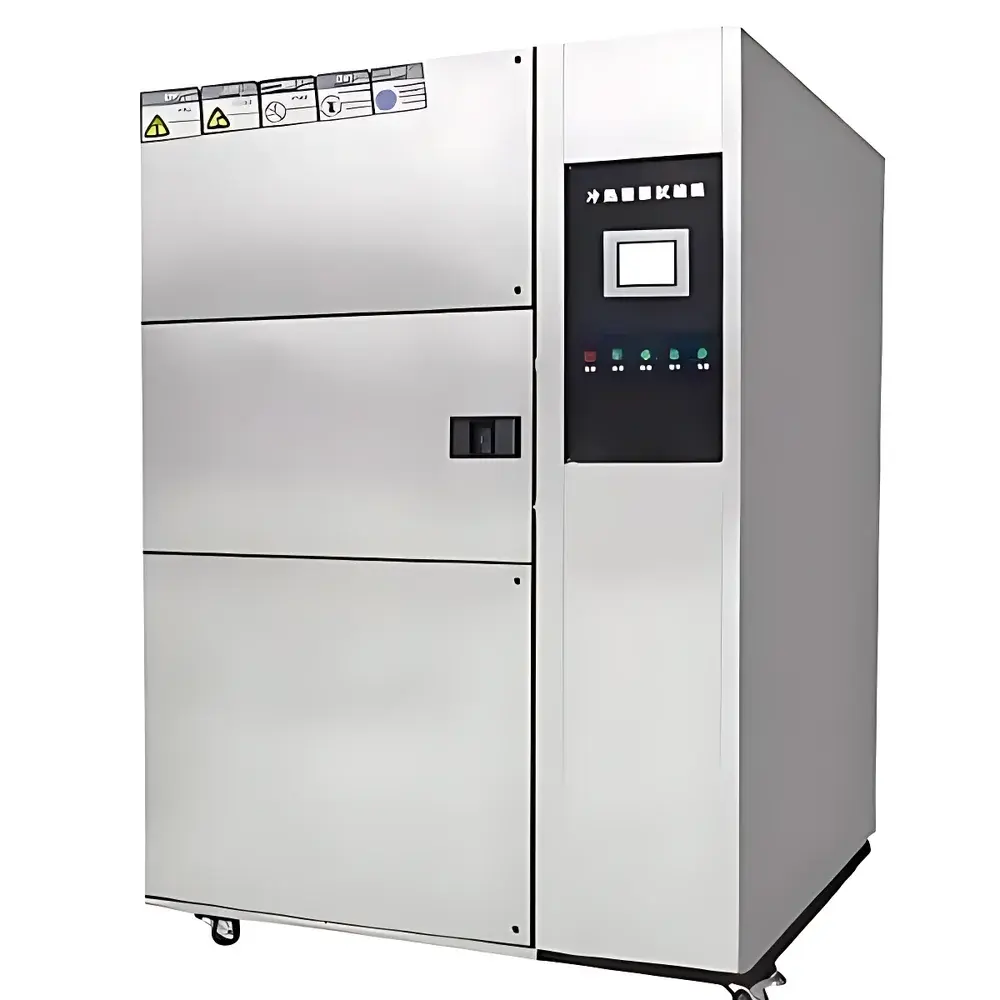
Jianhu JH-TSC Series Rapid Thermal Shock Test Chamber
| Brand | Jianhu |
|---|---|
| Origin | Shanghai, China |
| Type | Domestic Environmental Test Chamber |
| Model | JH-TSC Series |
| Price Range | USD 750 – 75,000 (FOB Shanghai) |
| High-Temperature Range | +60 °C to +200 °C |
| Low-Temperature Range | −78 °C to 0 °C |
| Thermal Shock Range | −55 °C to +125 °C |
| Temperature Stability | ±0.5 °C |
| Heating Rate | +60 °C → +200 °C (typical ramp under no-load conditions) |
| Cooling Rate | +20 °C → −75 °C (typical ramp under no-load conditions) |
Overview
The Jianhu JH-TSC Series Rapid Thermal Shock Test Chamber is an engineered environmental simulation system designed for accelerated reliability assessment of electrochemical energy storage components—particularly lithium-ion battery cells, modules, and pack assemblies—under extreme transient thermal stress. It operates on a dual-chamber (hot/cold) or single-chamber with cryogenic/thermal actuation architecture, enabling rapid transitions between predefined high- and low-temperature setpoints via forced-air convection and high-efficiency heat exchangers. Unlike standard temperature cycling chambers, the JH-TSC series meets the functional requirements of IEC 62133-2, UN 38.3 Section 38.3.4 (thermal shock), and GB/T 31485–2015 for electric vehicle battery safety validation. Its core purpose is to induce controlled thermal strain gradients across heterogeneous materials (e.g., electrode coatings, separator membranes, busbar welds), thereby exposing interfacial delamination, solder joint fatigue, electrolyte volatility, and SEI layer instability—failure modes that are not detectable under static thermal exposure.
Key Features
- Triple-zone independent temperature control architecture (hot chamber, cold chamber, transfer zone) ensuring minimal thermal cross-contamination during specimen transfer.
- High-efficiency cascade refrigeration system utilizing R404A/R23 mixed-refrigerant stages, certified for continuous operation down to −78 °C without compressor overload or oil migration issues.
- Patented airflow management design with turbulence-suppressed laminar flow ducting, achieving ≤±1.0 °C temperature uniformity (9-point measurement per IEC 60068-3-5) across full working volume at steady state.
- Industrial-grade programmable logic controller (PLC) with PID+FF (feedforward) algorithm, supporting up to 999-step profiles with dwell time, ramp rate, and conditional branching logic.
- Stainless steel 304 inner chamber with 100 mm polyurethane rigid foam insulation (density ≥40 kg/m³, thermal conductivity ≤0.022 W/m·K), validated per ASTM C177 for thermal resistance integrity.
- Integrated real-time data logging with timestamped thermocouple inputs (Type K, Class 1 accuracy), compliant with GLP audit trail requirements per 21 CFR Part 11 when paired with optional validation software package.
Sample Compatibility & Compliance
The JH-TSC accommodates specimens up to 500 mm × 500 mm × 500 mm (W×D×H) and supports standardized battery test fixtures including ISO 12405-2 mounting brackets, UL 1642 cell holders, and custom-designed EV module sleds. All internal surfaces are electropolished stainless steel (Ra ≤ 0.4 µm) to prevent galvanic corrosion during extended exposure to off-gassed electrolyte vapors. The system conforms to electromagnetic compatibility (EMC) standards EN 61326-1 and safety requirements EN 61010-1. Calibration traceability is maintained to NIM (National Institute of Metrology, China) via optional factory-applied certificate of calibration (ISO/IEC 17025 accredited). It satisfies preconditioning requirements in ISO 16750-4 (road vehicles), MIL-STD-810H Method 503.5 (temperature shock), and JIS C 60068-2-14.
Software & Data Management
Jianhu’s proprietary TSC-Control Suite (v4.2+) provides Windows-based configuration, remote monitoring, and automated report generation in PDF/XLSX formats. The software implements role-based access control (RBAC), electronic signature workflows, and full 21 CFR Part 11 compliance—including audit trails for parameter changes, user logins, and test aborts. Raw thermocouple data is stored in binary .tdms format (NI LabVIEW-compatible) with metadata embedding (test ID, operator, ambient conditions, firmware version). Optional integration with LIMS platforms (e.g., Thermo Fisher SampleManager, LabVantage) is supported via OPC UA and RESTful API endpoints. Firmware updates are delivered via signed OTA packages with SHA-256 verification to ensure integrity and prevent unauthorized modification.
Applications
- Accelerated aging of lithium iron phosphate (LFP), NMC, and solid-state battery cells under repeated thermal shock cycles (−40 °C ↔ +85 °C, 10–15 min dwell, >1000 cycles).
- Validation of thermal interface material (TIM) performance at battery module level under dynamic load conditions.
- Qualification testing of BMS housings, current sensors, and HV connectors per ISO 20653 IP6K9K and SAE J2344 durability protocols.
- Material compatibility screening of encapsulants, adhesives, and flame-retardant films used in battery pack assembly.
- Root cause analysis of field failures linked to thermal expansion mismatch (e.g., aluminum/copper busbar cracking, pouch cell corner delamination).
FAQ
What is the verified thermal shock transition time between −55 °C and +125 °C?
Typical transfer time is ≤15 seconds for specimens ≤1 kg, measured per IEC 60068-2-14 Annex A using calibrated surface-mount thermistors. Actual values depend on specimen mass, thermal mass, and fixture geometry.
Does the system support automated test sequencing per UN 38.3 Section 38.3.4?
Yes—preloaded test templates include full UN 38.3 thermal shock profiles with configurable dwell times, ramp rates, and pass/fail criteria based on voltage decay, impedance shift, or visual inspection triggers.
Is third-party calibration documentation available?
Yes—NIM-traceable calibration certificates (including uncertainty budgets) are provided with each shipment. On-site IQ/OQ/PQ validation support is available upon request.
Can the chamber operate continuously at −78 °C?
Yes—the cascade refrigeration system is rated for indefinite operation at −78 °C under no-load conditions. Load-dependent derating curves are supplied in the technical manual.
What maintenance intervals are recommended for long-term reliability?
Compressor oil analysis every 2,000 operating hours; refrigerant leak check every 6 months; airflow filter replacement every 3 months; full thermocouple recalibration annually or after any physical impact event.



