
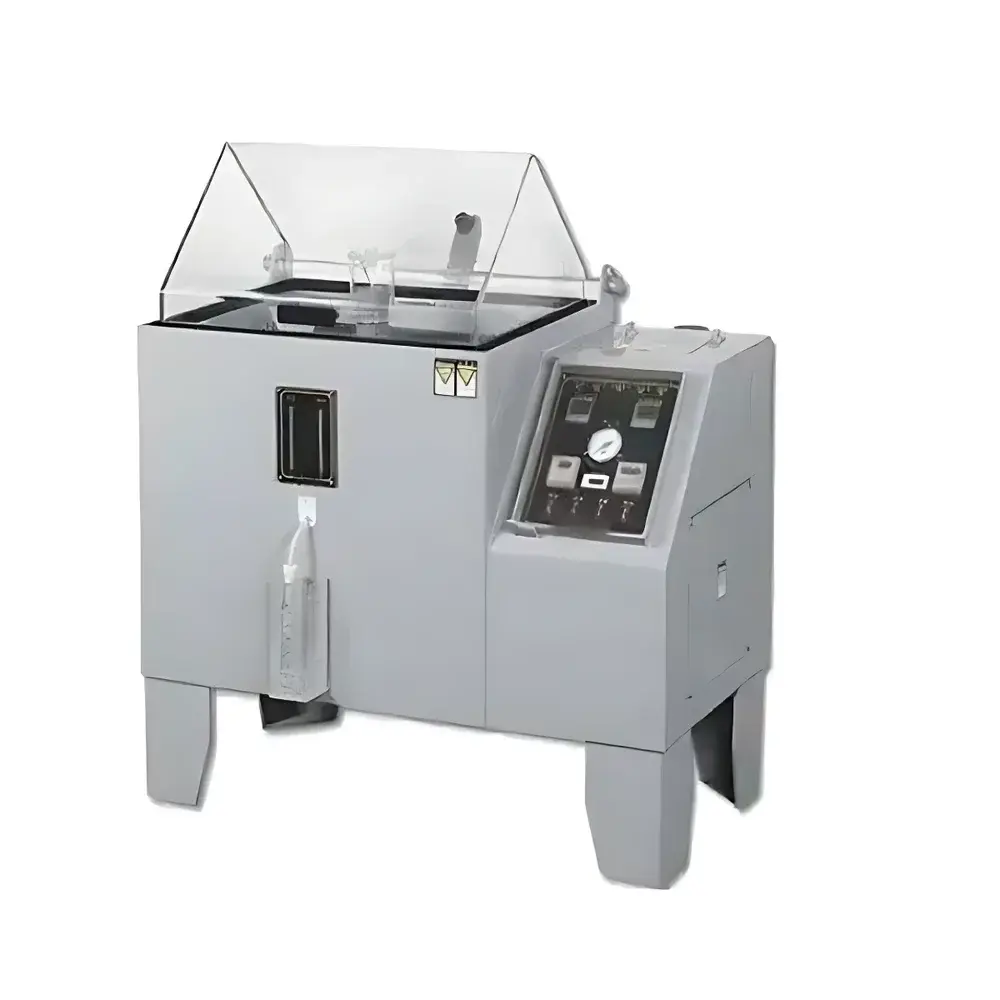
Jianhu SH-SSC Series Advanced Acidic Salt Spray Test Chamber with Intelligent Multi-Mode Cycling
| Brand | Jianhu |
|---|---|
| Origin | Shanghai, China |
| Model | SH-SSC Series |
| Spray Mode | Continuous Spray |
| Spray Rate | 1–2 mL/(80 cm²·h) |
| Nozzle Pressure | 0.7–1 kgf/cm² |
| De-misting Method | Air-Pressure Exhaust |
| Compliance | GB/T 10125, ISO 9227, ASTM B117 (configurable), IEC 60068-2-11 |
Overview
The Jianhu SH-SSC Series Advanced Acidic Salt Spray Test Chamber is an engineered environmental test system designed for accelerated corrosion evaluation of metallic and coated components under controlled, reproducible saline conditions. It operates on the principle of atomized salt solution delivery—typically 5% NaCl or pH-adjusted acidic brine (pH 3.1–3.3)—into a thermally stabilized test chamber, where temperature (35–40 °C), humidity (>95% RH), and spray dynamics are precisely regulated to replicate aggressive marine and coastal industrial exposure environments. Unlike basic static salt fog chambers, the SH-SSC Series supports programmable multi-mode cycling—including continuous spray, intermittent spray (e.g., 12 h on / 12 h off), and hybrid sequences coupled with thermal or mechanical stimuli—enabling scenario-specific simulation aligned with real-world service life challenges in lithium-ion battery enclosures, automotive under-hood components, marine electronics housings, and power infrastructure hardware. Its robust stainless-steel construction, corrosion-resistant internal plumbing, and calibrated aerosol generation ensure long-term metrological stability and inter-laboratory repeatability.
Key Features
- Intelligent multi-mode operation: Programmable spray cycles (continuous, intermittent, duty-cycled) synchronized with optional external stimulus inputs (e.g., vibration, thermal ramping)
- Acidic salt spray capability: Adjustable pH control (3.1–7.2) via inline acid dosing module, compliant with ISO 9227 Acetic Acid Salt Spray (AASS) and Copper-Accelerated Acetic Acid Salt Spray (CASS) protocols
- Precise aerosol delivery: Dual-nozzle system with pressure-regulated atomization (0.7–1 kgf/cm²), delivering uniform spray rate of 1–2 mL/(80 cm²·h) per ASTM B117 and GB/T 10125 requirements
- Integrated de-misting system: Compressed-air-assisted exhaust mechanism minimizes residual fog accumulation during non-spray phases, reducing cross-contamination and enabling rapid post-test inspection
- Chamber integrity: Double-wall insulated design with PTFE-sealed viewing window, corrosion-resistant chamber liner (SUS316L), and leak-tested cabinet structure meeting IP54 enclosure rating
- Calibration-ready architecture: Built-in ports for traceable temperature/humidity sensor verification and optional third-party calibration accreditation (ISO/IEC 17025)
Sample Compatibility & Compliance
The SH-SSC Series accommodates flat panels, cylindrical housings, welded assemblies, and modular battery enclosures up to 1200 mm × 800 mm × 600 mm (W × D × H). Sample racks are configurable for vertical or angled mounting to simulate real-world orientation-dependent corrosion. The chamber meets essential international corrosion testing standards including GB/T 10125 (Chinese national standard), ISO 9227 (neutral, acetic, and copper-accelerated salt spray), ASTM B117 (standard salt spray), and IEC 60068-2-11 (environmental testing – test Ka: salt mist). When integrated into GLP/GMP-compliant laboratories, it supports audit-ready documentation through optional data logging modules compliant with FDA 21 CFR Part 11 requirements (electronic signatures, audit trails, user access controls).
Software & Data Management
Equipped with a touchscreen HMI running embedded Linux-based firmware, the SH-SSC Series enables full cycle programming, real-time parameter monitoring (chamber temperature, nozzle pressure, elapsed spray time), and event-triggered alarms. Optional PC software (Jianhu TestSuite™) provides CSV export, graphical trend analysis, and automated report generation per ISO/IEC 17025 Annex A.2 requirements. All operational logs—including start/stop timestamps, setpoint deviations, and manual interventions—are stored with tamper-proof timestamps and retained for ≥18 months. Remote diagnostics and firmware updates are supported via secure HTTPS interface; no cloud dependency or vendor-hosted data storage is required.
Applications
This chamber is extensively deployed in R&D and QA/QC labs serving the lithium-ion battery industry for evaluating corrosion resistance of aluminum alloy and stainless-steel battery enclosures under simulated maritime transport (96 h cyclic salt + vibration) and coastal power station operation (240 h acidic salt + high-humidity + thermal cycling). It is also used for validating surface treatments (epoxy coatings, anodizing, passivation), weld integrity assessment, and comparative screening of material substitutions in automotive, aerospace, and renewable energy sectors. Validated use cases include: coating adhesion loss quantification per ISO 2409, rust grade evaluation per ISO 10289, and electrochemical corrosion current density measurement (via optional potentiostat integration) at weld seams.
FAQ
How does the SH-SSC Series differ from conventional salt spray chambers?
It supports programmable multi-mode cycling (not just continuous spray), integrates acidic brine capability (pH 3.1–3.3), and features calibrated air-pressure de-misting—enabling scenario-specific testing aligned with ISO 9227 AASS/CASS and custom hybrid protocols.
Can the chamber be validated for ISO/IEC 17025 compliance?
Yes—its modular sensor architecture, traceable calibration interfaces, and audit-trail-capable software support formal laboratory accreditation when combined with documented SOPs and third-party verification.
Is vibration coupling supported natively?
Vibration synchronization is enabled via TTL-level trigger output (0–5 V) compatible with standard electrodynamic shakers; full integration requires external controller coordination per user-defined test profiles.
What maintenance intervals are recommended for long-term reliability?
Daily: nozzle cleaning and solution tank inspection; quarterly: pressure regulator calibration and seal integrity check; annually: full system performance verification against ASTM B117 reference criteria.
Does the system meet regulatory requirements for medical or aerospace applications?
While not certified to DO-160 or ISO 13485 out-of-the-box, its hardware design and documentation framework comply with foundational requirements for qualification in regulated environments—subject to customer-specific validation protocols and change control procedures.



