
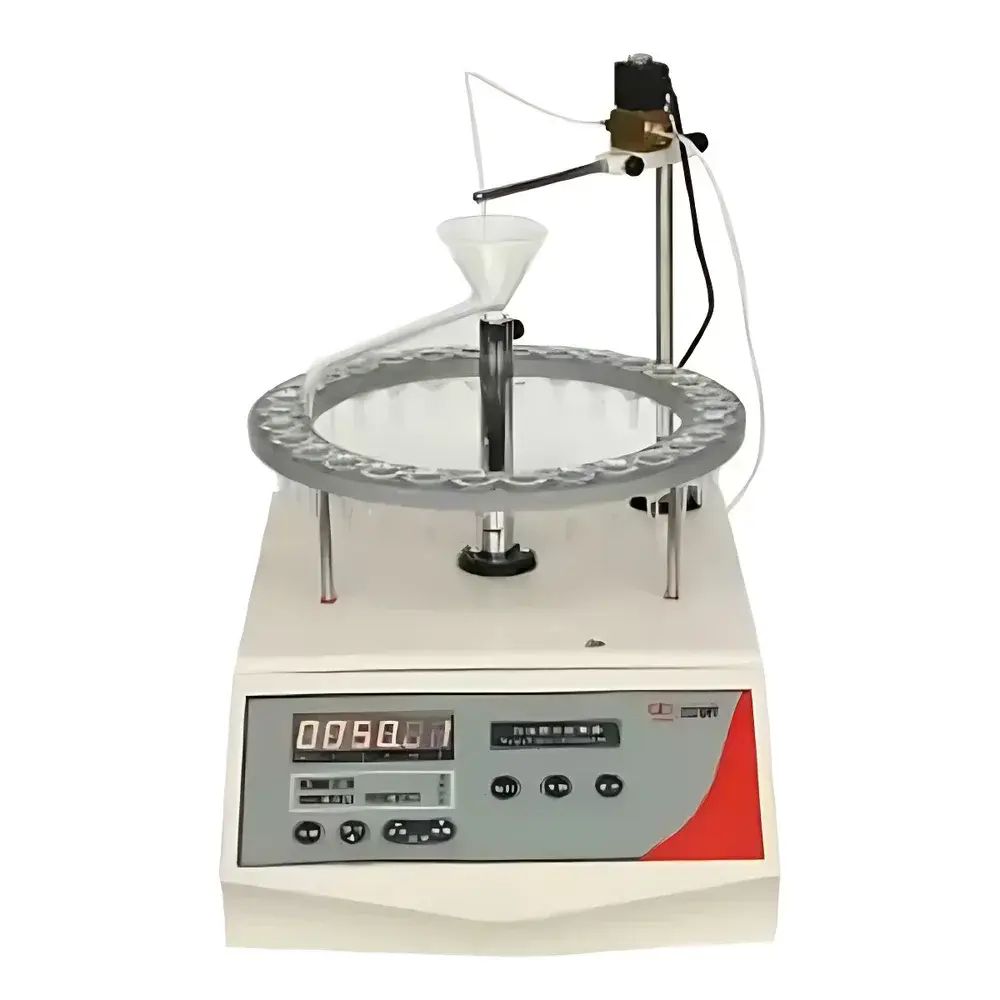
Jiapeng BS-30A Automatic Fraction Collector
| Brand | Jiapeng |
|---|---|
| Model | BS-30A |
| Type | Liquid-phase Fraction Collector |
| Collection Method | Time-based |
| Number of Collection Positions | 30 |
| Collection Volume Capacity | Unlimited (via external containers) |
| Timing Range | 1 second to 24 hours (adjustable in 1-second increments) |
| Power Supply | AC 220 V, 50/60 Hz |
| Display | 6-digit high-brightness LED |
| Data Retention After Power Loss | ≥10 years |
| Continuous Operation Time | >200 hours |
| Housing Material | ABS (impact-resistant, solvent-resistant grade) |
| Control Interface | RS-232 COM port for external pump synchronization |
| Dimensions (W×D×H) | 265 × 390 × 530 mm |
| Net Weight | 6.5 kg |
Overview
The Jiapeng BS-30A Automatic Fraction Collector is a precision-engineered time-triggered liquid-phase fraction collection system designed for integration into medium- and low-pressure chromatographic workflows. It operates on the principle of programmable time-based eluent segmentation—dividing continuous column effluent into discrete, temporally defined fractions without flow interruption or mechanical drift. This architecture ensures reproducible fractionation aligned with retention time profiles, making it especially suitable for preparative HPLC, gel filtration, ion exchange, and affinity chromatography applications where temporal resolution correlates directly with compound elution windows. Built for laboratory environments requiring long-duration unattended operation, the BS-30A supports continuous collection over 200 hours while retaining all user-defined parameters—including timing intervals, start/stop tube indices, and direction mode—following power interruption. Its microprocessor-controlled valve actuation and optical position sensing eliminate tube misalignment during sequential switching, maintaining spatial fidelity across all 30 collection positions.
Key Features
- 30-position circular collection tray with engraved numeric indexing—each position corresponds to a unique digit for unambiguous tube identification and retrieval;
- High-precision 6-digit LED display with 35° ergonomic tilt panel design, enabling intuitive parameter input and real-time status monitoring without posture strain;
- Time-programmable collection from 1 second to 24 hours in 1-second increments; supports both forward and reverse countdown modes;
- Non-volatile memory retains all configuration data—including timing schedules, tube range definitions, and operational history—for ≥10 years post-power loss;
- RS-232 serial interface enables hardware-level synchronization with peristaltic or piston-driven constant-flow pumps (e.g., Keebio or equivalent), permitting external trigger initiation and flow-rate–coupled collection logic;
- Housing constructed from medical-grade ABS polymer—certified for resistance to common organic solvents (acetonitrile, methanol, chloroform, ethyl acetate) when equipped with optional solvent-compatible tubing and valve seals;
- Modular tray design allows interchangeability between standardized 13 mm, 16 mm, and 18 mm diameter tube formats without recalibration.
Sample Compatibility & Compliance
The BS-30A is compatible with aqueous, polar organic, and moderately aggressive mobile phases typical in bioseparation workflows. When fitted with fluoropolymer-coated solenoid valves and PTFE fluid paths (optional configuration), it meets material compatibility requirements for USP Class VI solvents and complies with ISO 13485-aligned manufacturing controls. While not intrinsically certified for GMP production environments, its deterministic timing engine, audit-ready parameter logging, and non-volatile memory support GLP-compliant documentation practices. The device adheres to IEC 61010-1 safety standards for laboratory electrical equipment and includes thermal overload protection and short-circuit current limiting on the 220 V AC input stage.
Software & Data Management
The BS-30A operates as a standalone instrument with no proprietary software dependency. All configuration is performed via front-panel keypad entry and confirmed through LED feedback. Parameter sets—including start tube, end tube, interval duration, and direction mode—are stored in EEPROM with timestamped write cycles. Though no native PC connectivity is provided beyond the RS-232 control port, third-party LabVIEW or Python-based automation scripts can log collection events and synchronize with chromatography data systems (CDS) via TTL-level handshaking. Audit trails are maintained locally and may be exported manually using external terminal emulation tools compliant with FDA 21 CFR Part 11 principles (e.g., user-authenticated session logs and immutable parameter snapshots).
Applications
- Purification of recombinant proteins and monoclonal antibodies via size-exclusion or ion-exchange chromatography;
- Isolation of natural product fractions from plant extracts in phytochemical screening;
- Collection of metabolic intermediates during enzymatic reaction monitoring in continuous-flow bioreactors;
- Preparative separation of oligonucleotides and synthetic peptides under RP-HPLC conditions;
- Multi-step gradient fractionation in academic teaching labs where reproducibility and student-accessible interface design are critical;
- Integration into automated purification platforms where deterministic time-gated collection replaces UV peak-triggered logic in absence of inline detection.
FAQ
Does the BS-30A support volume-based or UV-triggered collection?
No—the BS-30A implements time-based fractionation only. It does not include integrated flow meters, UV sensors, or analog input channels for external signal triggering beyond RS-232 pump synchronization.
Can the collection tray accommodate tubes larger than 18 mm in diameter?
Standard configuration supports up to 18 mm OD tubes. Custom trays with expanded radial geometry are available upon request but require mechanical validation prior to shipment.
Is firmware upgrade capability supported?
Firmware is固化 in mask ROM and not field-upgradable. Functional enhancements are delivered exclusively through hardware revision (e.g., BS-30A v2.1 with enhanced solvent seal package).
What maintenance intervals are recommended for long-term reliability?
Valve actuation mechanism requires cleaning and lubrication every 12 months under continuous operation; optical position sensors should be inspected quarterly for dust accumulation.
How is tube alignment verified during high-speed collection cycles?
Each collection cycle initiates a homing sequence that references a mechanical zero-stop pin and confirms positional accuracy via dual-channel optical encoder feedback before fluid path engagement.




