
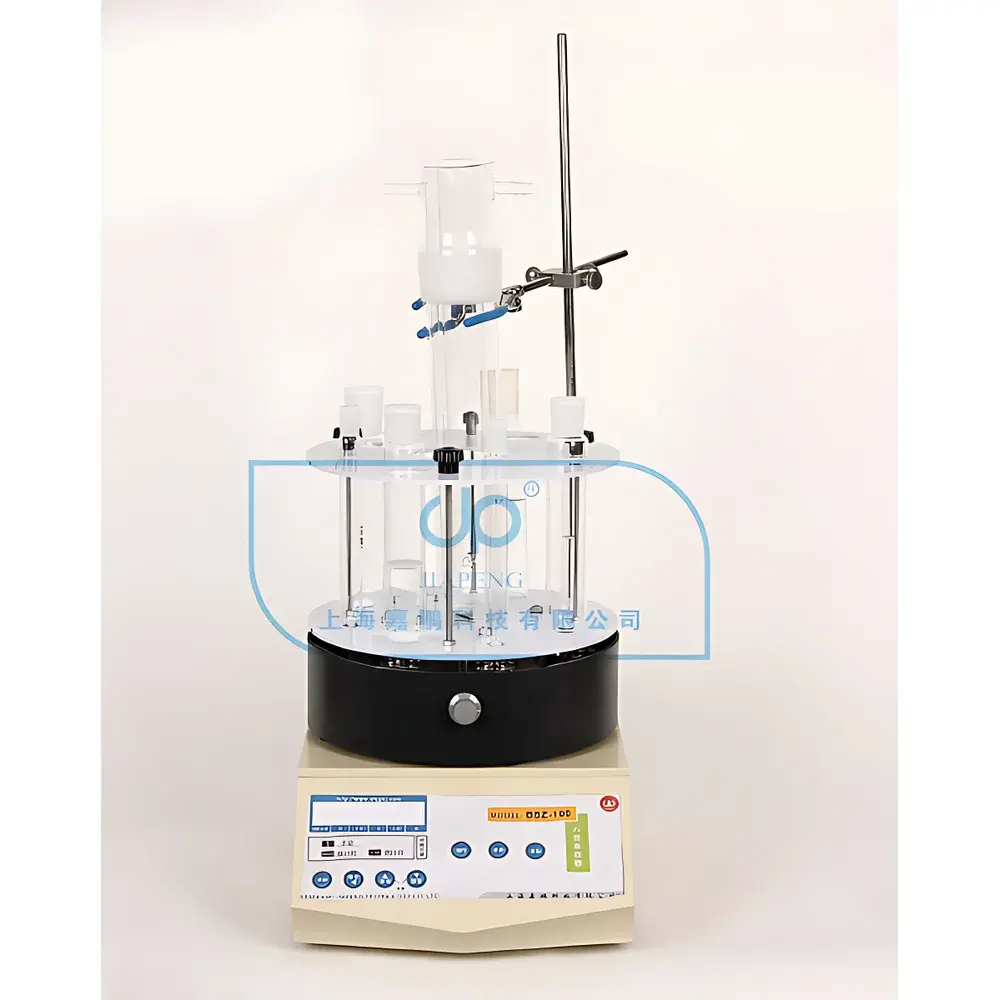
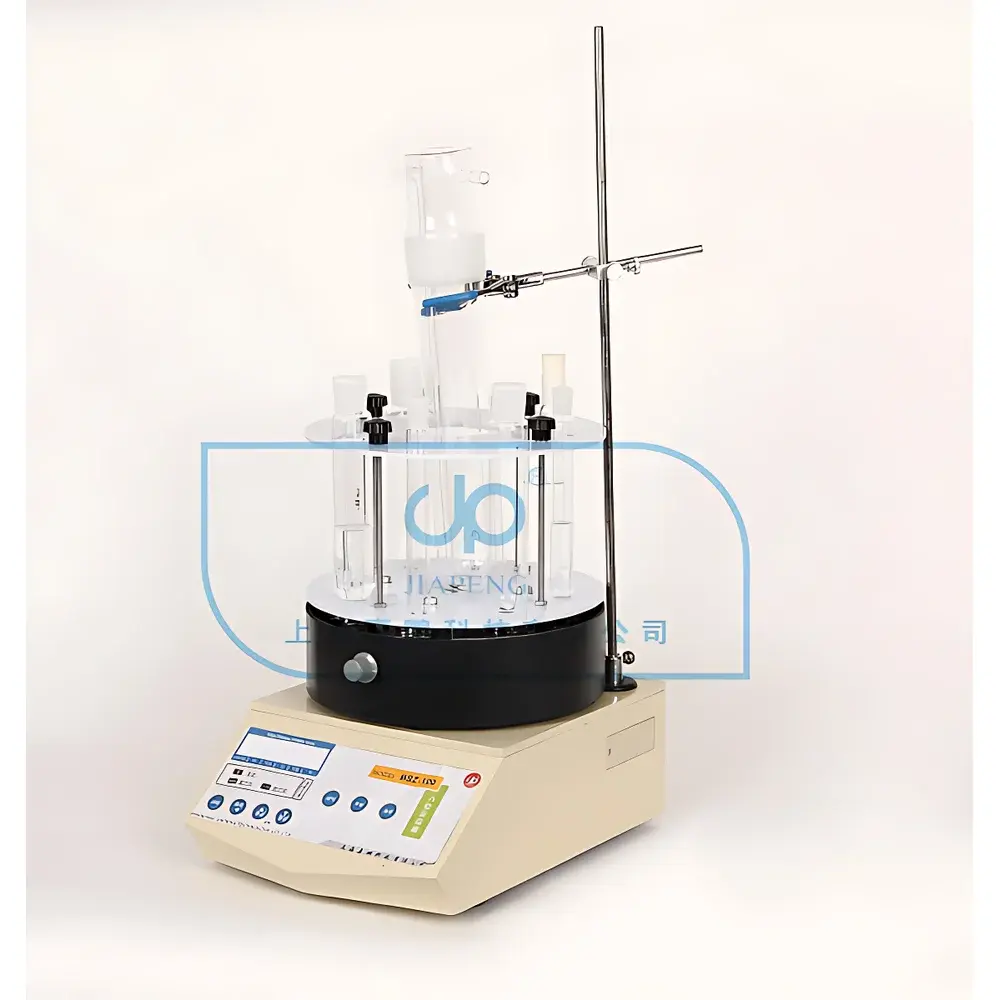
Jiapeng BSZ-8 Rotating Eight-Position Photochemical Reactor
| Brand | Jiapeng |
|---|---|
| Origin | Shanghai, China |
| Manufacturer Type | Authorized Distributor |
| Product Origin | Domestic (China) |
| Model | BSZ-8 |
| Light Source Type | Mercury Lamp |
| Irradiation Mode | Internal Illumination |
| Sample Capacity | 8 positions |
| Quartz Reaction Tube Options | 30 mL or 50 mL (customizable up to 200 mL) |
| Quartz Cold Finger Dimensions | Φ70 × 380 mm |
| Stirring Speed Range | 0–1800 rpm (continuously adjustable) |
| Rotation Cycle per Tube | 1 s – 24 h (continuously adjustable) |
| Filter Configuration | 16 standard optical filters + 2 dedicated 8-position filter holders |
| Light Incidence Geometry | Perpendicular transmission through filters |
Overview
The Jiapeng BSZ-8 Rotating Eight-Position Photochemical Reactor is a precision-engineered platform designed for controlled, reproducible photochemical experimentation under ultraviolet (UV) or simulated visible light irradiation. It operates on the principle of simultaneous rotational agitation and radial illumination geometry—where each reaction tube rotates concentrically around a centrally mounted mercury lamp housed within a full-quartz cold finger. This dual-motion architecture ensures uniform photon flux distribution across all eight sample positions, minimizing spatial irradiance gradients that commonly compromise kinetic consistency in parallel photoreaction studies. The system supports both heterogeneous photocatalytic reactions (e.g., TiO₂-mediated degradation) and homogeneous photochemical transformations in gas-phase or liquid-phase media. Its modular quartz construction—including the cold finger, reaction tubes, and optical path components—ensures high UV transmittance (>90% down to 200 nm), thermal stability up to 120 °C, and chemical inertness toward aggressive reagents such as H₂O₂, ozone, or acidic/alkaline electrolytes.
Key Features
- Dual-axis motion control: Independent continuous rotation of each quartz tube around the central lamp axis (0–9999 s/cycle), coupled with magnetic stirring (0–1800 rpm) inside each tube for enhanced mass transfer and boundary layer disruption.
- Full-quartz optical train: Includes a Φ70 × 380 mm cold finger for efficient lamp cooling and spectral stability, eight interchangeable quartz reaction tubes (standard 30 mL or 50 mL; custom volumes up to 200 mL available), and precisely aligned perpendicular filter mounting.
- Modular optical filtering: Accommodates 16 certified interference or bandpass filters via two dedicated 8-position rotating filter holders—enabling wavelength-selective irradiation from 254 nm (low-pressure Hg line) to 546 nm (green line) without manual realignment.
- Digital microprocessor control: Integrated chip-based interface with LED numeric display for precise setting and real-time monitoring of rotation period, stirring speed, and cumulative irradiation time per position.
- Scalable configuration: Base system supports eight parallel reactions; additional tube sets, cold finger extensions, or gas-tight sealing caps can be integrated for multi-phase or anaerobic protocols.
Sample Compatibility & Compliance
The BSZ-8 accommodates a broad range of sample types including aqueous suspensions, organic solvents (e.g., acetonitrile, methanol), colloidal catalyst dispersions, and low-pressure gaseous mixtures (via optional septum-sealed caps). All wetted parts are fabricated from synthetic fused quartz (SiO₂ ≥ 99.99%), compliant with ASTM E438 Type I, Class A specifications for UV-transmitting laboratory glassware. The reactor design aligns with ISO 10677:2020 (photocatalytic activity measurement) and supports experimental workflows traceable to USP and EP 3.2.1 for material compatibility documentation. While not intrinsically rated for explosion-proof operation, it may be deployed in ventilated fume hoods meeting EN 14175-3 requirements when handling volatile or photosensitive compounds.
Software & Data Management
The BSZ-8 operates as a standalone instrument with embedded firmware; no proprietary software is required for basic operation. However, time-stamped operational logs—including start/stop timestamps, set parameters per position, and total elapsed irradiation duration—are retained in non-volatile memory for GLP-compliant recordkeeping. Optional RS-232 or USB-to-serial interface enables integration with third-party data acquisition systems (e.g., LabVIEW, MATLAB) for automated protocol sequencing and audit-trail generation. When used in regulated environments, the device supports 21 CFR Part 11–compliant electronic signatures via external validation packages that log user ID, parameter changes, and session metadata.
Applications
- Kinetic evaluation of photocatalytic degradation pathways (e.g., pharmaceuticals, dyes, endocrine disruptors) under standardized UV-A/UV-C exposure conditions.
- Screening of semiconductor photocatalysts (TiO₂, g-C₃N₄, BiVO₄) for hydrogen evolution or CO₂ reduction under controlled stoichiometric gas atmospheres.
- Photo-Fenton and persulfate activation studies requiring precise dosing control and uniform radical generation across replicates.
- Photostability testing of APIs and excipients per ICH Q1B guidelines using calibrated mercury lamp spectra.
- Development of wavelength-resolved action spectra for photobiological endpoints using sequential filter-based irradiation.
FAQ
What lamp types are compatible with the BSZ-8?
The BSZ-8 is engineered specifically for medium-pressure mercury vapor lamps (e.g., 300–1000 W Hg arc) with standard R7s base; xenon lamp retrofitting is not supported due to thermal and spectral coupling constraints.
Can the BSZ-8 operate under inert or vacuum conditions?
Yes—when equipped with optional PTFE-sealed quartz caps and Swagelok-compatible gas inlet/outlet ports, the system supports static or dynamic purging with N₂, Ar, or synthetic air.
Is calibration certification included with purchase?
Each unit ships with a factory-verified irradiance map report (measured at 254 nm, 365 nm, and 436 nm using NIST-traceable radiometers) and a quartz transmittance certificate per batch.
How is temperature managed during extended irradiation?
The full-quartz cold finger enables active water circulation (recommended flow rate: 1.5–2.0 L/min); auxiliary Peltier-cooled sample blocks or immersion chillers may be added for sub-ambient control.
Are replacement filters and tubes supplied with validated lot documentation?
Yes—optical filters are provided with individual spectral transmission curves (±1.5 nm bandwidth tolerance), and quartz tubes include batch-specific hydrolytic resistance test reports per ISO 719.






