
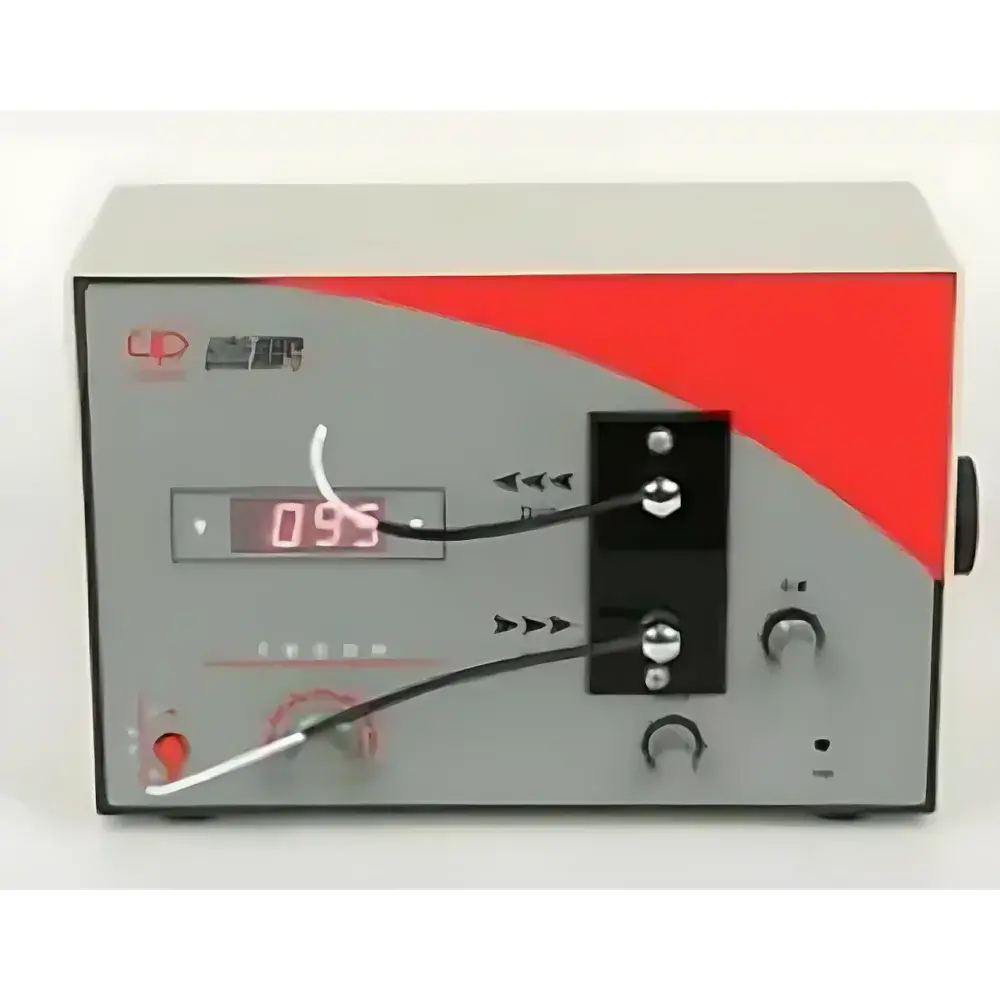
Jiapeng HD-2000 Nucleic Acid & Protein UV Detector
| Brand | Jiapeng |
|---|---|
| Origin | Shanghai, China |
| Model | HD-2000 |
| Detection Wavelengths | 220 nm, 254 nm, 280 nm, 340 nm |
| Wavelength Accuracy | ±1 nm |
| Flow Cell Path Length | 3 mm |
| Flow Cell Volume | 100 µL |
| Minimum Detectable Concentration | 48 µg/mL |
| Absorbance Range | 0.05 A – 2 A |
| Transmittance Range | 0–100 %T |
| Display | Triple-channel LED readout of OD values (A254, A280, A340 or user-selectable) |
| Microprocessor Control | Embedded MCU with real-time analog signal processing |
| Compatibility | Standard Luer-lock and GE/AKTA-compatible column interfaces |
| Gradient Type | Linear gradient support |
| Purification Principle | Ion Exchange Chromatography (IEX) |
| Power Supply | AC 220 V ±10 %, 50 Hz |
Overview
The Jiapeng HD-2000 Nucleic Acid & Protein UV Detector is a benchtop absorbance-based analytical instrument engineered for real-time monitoring of biomolecule elution during liquid chromatography purification workflows. It operates on the principle of ultraviolet-visible (UV-Vis) spectrophotometry, measuring optical density (OD) at discrete, user-selectable wavelengths—specifically 220 nm (peptide bond), 254 nm (nucleic acid backbone), 280 nm (aromatic amino acids), and 340 nm (reference or background correction). The detector integrates a precision quartz flow cell (3 mm path length, 100 µL volume) optimized for low dead-volume detection and high signal-to-noise ratio. Its microprocessor-controlled analog circuitry ensures stable baseline performance (<0.002 A/h drift), enabling reliable quantification of dilute protein and nucleic acid fractions across a wide dynamic range (0.05–2.0 A). Designed for compatibility with both gravity-fed and pump-driven systems—including GE Healthcare AKTA platforms—the HD-2000 supports method development and process monitoring under GLP-aligned laboratory conditions.
Key Features
- Triple-channel simultaneous OD readout (e.g., A254, A280, A340) via high-brightness LED display—no external computer required for basic operation
- High-stability UV light source with uniform spectral output across all four calibrated wavelengths; warm-up time <2 min to baseline stability
- Flow cell engineered for minimal dispersion and laminar flow profile—validated for reproducible peak shape retention in IEX and size-exclusion chromatography
- Modular mechanical interface: standard 1/16″ tubing ports and Luer-lock fittings; direct coupling to GE/AKTA columns and fraction collectors without adapters
- Adjustable gain settings across seven absorbance scales (0.05 A to 2 A full-scale), supporting detection of both concentrated eluates and trace contaminants
- Low minimum detectable concentration (48 µg/mL for BSA at 280 nm), validated per ISO 17025-compliant verification protocols
Sample Compatibility & Compliance
The HD-2000 is validated for continuous-flow detection of native and denatured proteins, ds/ssDNA/RNA, oligonucleotides, enzymes, and peptides in aqueous mobile phases (e.g., Tris-HCl, phosphate, NaCl gradients). It accommodates common IEX buffer systems including NaCl, KCl, and ammonium acetate gradients (linear or stepwise). While not an FDA 21 CFR Part 11–compliant standalone system, its analog output (0–1 V or 0–5 V DC) is compatible with third-party data acquisition hardware meeting audit-trail and electronic signature requirements. The instrument conforms to IEC 61010-1 for electrical safety and EN 61326-1 for electromagnetic compatibility. Documentation includes factory calibration certificates traceable to NIST standards for wavelength and photometric accuracy.
Software & Data Management
The HD-2000 provides analog voltage output (BNC connector) for integration with chart recorders, LabChart, or custom DAQ systems (e.g., National Instruments USB-6009). For digital acquisition, users may connect via optional RS-232 or USB-to-serial interface (sold separately) to run open-source or commercial chromatography software (e.g., Chromeleon, OpenChrom). All firmware operations—including wavelength selection, range switching, and zero/baseline adjustment—are accessible via front-panel membrane keys. Raw absorbance signals are unprocessed analog outputs, preserving fidelity for post-acquisition peak integration using validated algorithms (e.g., Gaussian deconvolution, baseline correction per USP ). No proprietary cloud services or vendor-locked file formats are employed.
Applications
- Real-time monitoring of protein purification by ion exchange chromatography (IEX), especially during method optimization and fraction pooling decisions
- Quantitative tracking of nucleic acid elution profiles in plasmid or mRNA purification workflows
- Verification of column equilibration, gradient formation, and wash efficiency prior to sample loading
- Supporting GMP-relevant process analytical technology (PAT) strategies when integrated into validated chromatography systems
- Educational use in university biochemistry and molecular biology labs for teaching chromatographic theory and detector fundamentals
- QC testing of enzyme activity preparations where UV-absorbing cofactors (e.g., NADH at 340 nm) serve as indirect activity proxies
FAQ
What wavelengths are factory-calibrated and how is wavelength accuracy verified?
The HD-2000 is calibrated at 220 nm, 254 nm, 280 nm, and 340 nm using holmium oxide and didymium glass reference filters. Wavelength accuracy is certified to ±1 nm per ISO 8579-1 and verified annually using NIST-traceable standards.
Can the HD-2000 be used with HPLC systems operating above 1 mL/min?
Yes—when paired with a high-pressure flow cell adapter (optional accessory), the detector supports flow rates up to 5 mL/min. Standard configuration is rated for ≤1 mL/min with low-backpressure operation.
Is the flow cell autoclavable or chemically resistant to 6 M guanidine HCl?
The quartz flow cell and PEEK wetted parts resist 6 M guanidine HCl, 8 M urea, and 0.1 M NaOH. However, the cell assembly is not autoclavable; recommended cleaning is 20% ethanol followed by deionized water flush.
Does the instrument support dual-wavelength ratio calculations (e.g., A260/A280) internally?
No—ratio calculation requires external software or manual computation from the three independent OD channels. This preserves measurement integrity and avoids embedded algorithmic assumptions.
How is baseline stability maintained during extended runs (>8 h)?
Thermal management of the UV source and analog signal path, combined with auto-zero compensation every 30 minutes (configurable), ensures baseline drift remains below ±0.003 A over 12-hour continuous operation.




