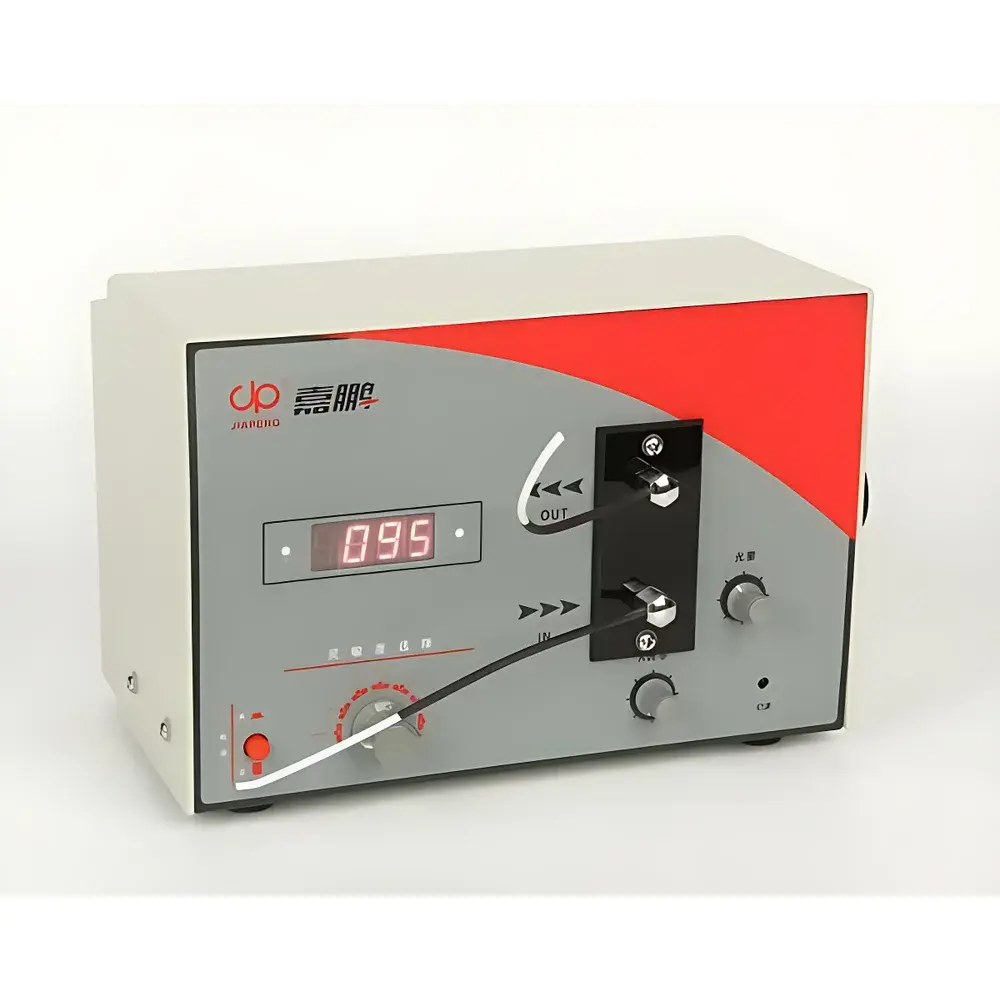
Jiapeng HD-97-1 Nucleic Acid & Protein UV Detector
| Brand | Jiapeng |
|---|---|
| Origin | Shanghai, China |
| Model | HD-97-1 |
| Detection Wavelengths | 220 nm, 254 nm, 280 nm, 340 nm |
| Wavelength Accuracy | ±1 nm |
| Flow Cell Path Length | 3 mm |
| Flow Cell Volume | 100 µL |
| Minimum Detectable Concentration | 48 µg/mL |
| Absorbance Range | 0.05 A – 2 A (7 ranges) |
| Transmittance Range | 0–100% T |
| Display | High-clarity LED, triple-channel OD readout |
| Control System | Embedded microcomputer chip |
| Compatibility | GE/AKTA-compatible column fittings |
| Gradient Type | Linear |
| Max. System Pressure | 3 MPa |
| Purification Principle | Ion Exchange Chromatography (IEX) |
Overview
The Jiapeng HD-97-1 Nucleic Acid & Protein UV Detector is a benchtop absorbance-based analytical instrument engineered for real-time monitoring of biomolecule elution during liquid chromatography purification workflows. It operates on the principle of ultraviolet absorbance spectroscopy—measuring optical density (OD) at discrete, user-selectable wavelengths (220 nm, 254 nm, 280 nm, and 340 nm) to quantitatively track nucleic acids (peak at 260 nm, approximated by 254 nm/280 nm dual-channel ratio), proteins (280 nm aromatic residue absorption), and contaminants or buffer components (e.g., 220 nm for peptide backbone, 340 nm for turbidity or particulate interference). Its fixed-pathlength flow cell (3 mm × 100 µL) enables high-sensitivity detection with a minimum detectable concentration of 48 µg/mL under standard conditions, supporting reproducible quantification across gradient elution protocols. Designed for integration into low-to-medium pressure chromatography systems—up to 3 MPa—the HD-97-1 serves as a core detection module in IEX-based purification of antibodies, recombinant proteins, plasmid DNA, and oligonucleotides. Its compact architecture and AKTA-compatible fluidic interface allow seamless deployment in academic core facilities, bioprocess development labs, and QC environments where trace-level monitoring and method development agility are essential.
Key Features
- Multi-wavelength UV detection at 220 nm, 254 nm, 280 nm, and 340 nm—enabling simultaneous tracking of protein, nucleic acid, and buffer-related absorbance signals
- Triple-channel LED display showing real-time OD values at three user-defined wavelengths, eliminating need for external software during preliminary runs
- Stable optical baseline achieved via imported deuterium/halogen light source with uniform spectral intensity distribution and <5-minute warm-up stabilization time
- Fixed-flow cuvette with 3 mm path length and 100 µL internal volume—optimized for low dispersion and minimal band broadening in analytical to semi-preparative separations
- Embedded microcomputer control system providing automatic range switching across seven absorbance scales (0.05 A to 2 A), ensuring linear response without manual gain adjustment
- GE/AKTA-standard column port compatibility (¼”–28 UNF or M6 threaded connections), enabling direct coupling with ÄKTA pure, avant, or other FPLC/HPLC systems
- Support for linear gradient elution profiles; compatible with peristaltic and piston-type pumps delivering flow rates from 0.5 mL/h to 14,500 mL/h (dependent on pump configuration)
Sample Compatibility & Compliance
The HD-97-1 is validated for aqueous mobile phases commonly used in ion exchange chromatography—including Tris-HCl, phosphate, sodium acetate, and arginine-based buffers—across pH 3–10 and conductivity ranges up to 200 mS/cm. Its quartz flow cell resists corrosion from low-concentration chaotropes (e.g., ≤1 M NaCl, ≤0.5 M NaSCN) and mild organic modifiers (≤10% ethanol, ≤5% acetonitrile). While not certified to IEC 61010-1 or ISO/IEC 17025 out-of-the-box, the instrument’s design adheres to general laboratory safety principles for Class II UV-emitting devices. When operated within validated methods, data generated supports GLP-compliant documentation when paired with compliant recording systems (e.g., chart recorders meeting FDA 21 CFR Part 11 audit-trail requirements or validated LIMS-integrated acquisition software).
Software & Data Management
The HD-97-1 operates as a standalone detector with no proprietary software dependency. Analog voltage output (0–1 V or 0–10 V, selectable) and TTL-compatible trigger signals enable direct interfacing with third-party data acquisition hardware—including National Instruments DAQ cards, LabChart, Chromeleon, or custom Python/Matlab scripts. For full chromatographic data capture, users integrate the detector with external chart recorders or PC-based acquisition systems capable of time-stamped analog input logging. The triple-OD display facilitates rapid visual assessment of peak symmetry, retention time shifts, and co-elution events during method scouting—reducing reliance on post-run analysis during early-stage purification optimization.
Applications
- Real-time monitoring of monoclonal antibody purification via SP-Sepharose (cation exchange) or Q Sepharose (anion exchange) columns
- Plasmid DNA isolation and quality assessment during anion exchange polishing steps
- Enzyme fractionation and activity correlation using 280 nm/260 nm absorbance ratios
- Validation of column equilibration and wash efficiency through baseline stability assessment at 220 nm
- Method development for multi-domain protein purification where differential UV signatures aid in identifying misfolded or aggregated species
- Educational use in undergraduate biochemistry labs for teaching chromatographic theory, Beer-Lambert law application, and buffer selection logic
FAQ
Does the HD-97-1 support wavelength scanning or spectral acquisition?
No. It is a fixed-wavelength, multi-channel photometer—not a scanning spectrophotometer. Users select up to three discrete wavelengths for concurrent monitoring.
Can the flow cell be replaced with a micro-volume or capillary variant?
Yes. Optional flow cells with 1 mm path length (50 µL volume) or 10 mm path length (200 µL volume) are available as accessories for specialized sensitivity or dynamic range requirements.
Is the analog output calibrated and traceable to NIST standards?
Calibration certificates are provided upon request; however, field recalibration requires optical alignment verification and reference standard (e.g., potassium dichromate solution at 257 nm) validation per ASTM E275–22 guidelines.
What maintenance is required for long-term baseline stability?
Annual inspection of lamp intensity output and cleaning of quartz windows with spectroscopic-grade methanol is recommended. No optical realignment tools are user-serviceable.
How does the HD-97-1 handle air bubble interference in the flow cell?
The instrument includes a built-in bubble detection algorithm that pauses OD calculation and triggers visual alert when signal variance exceeds ±5% over 2 seconds—minimizing false peak identification during transient flow interruptions.