
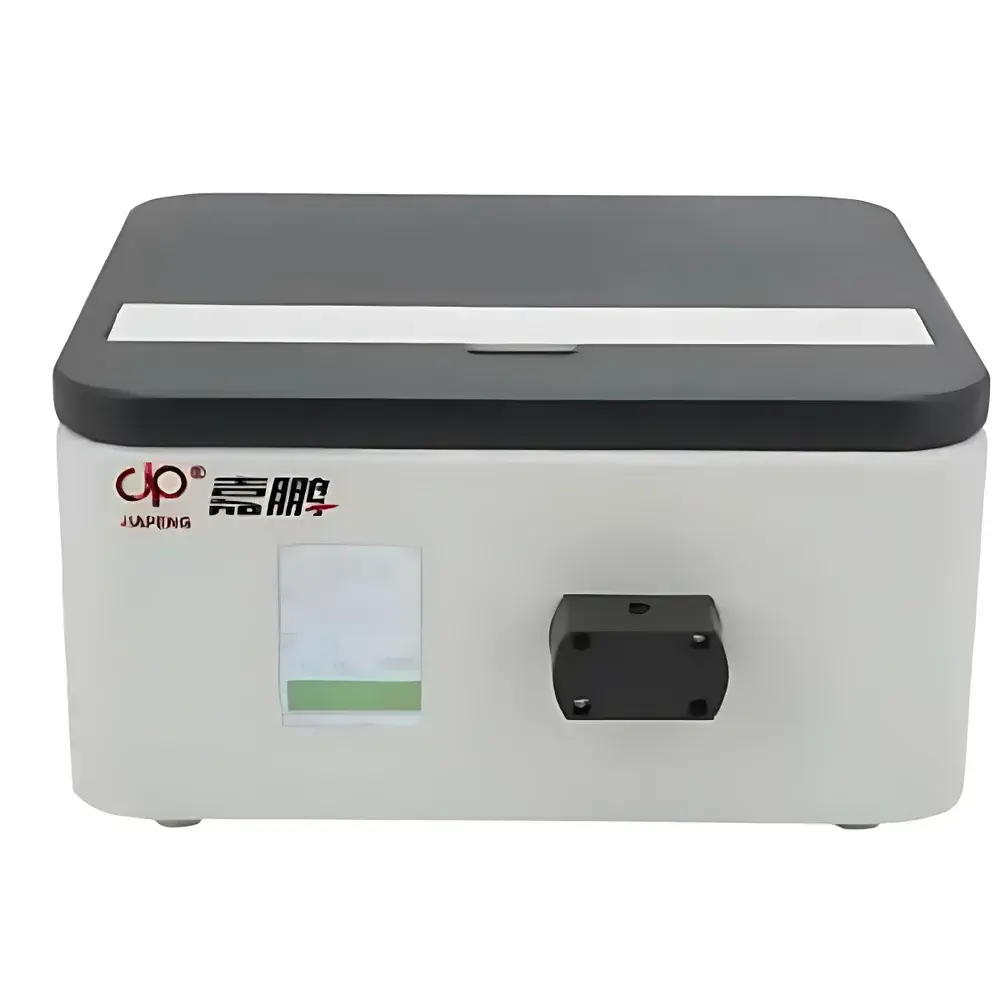
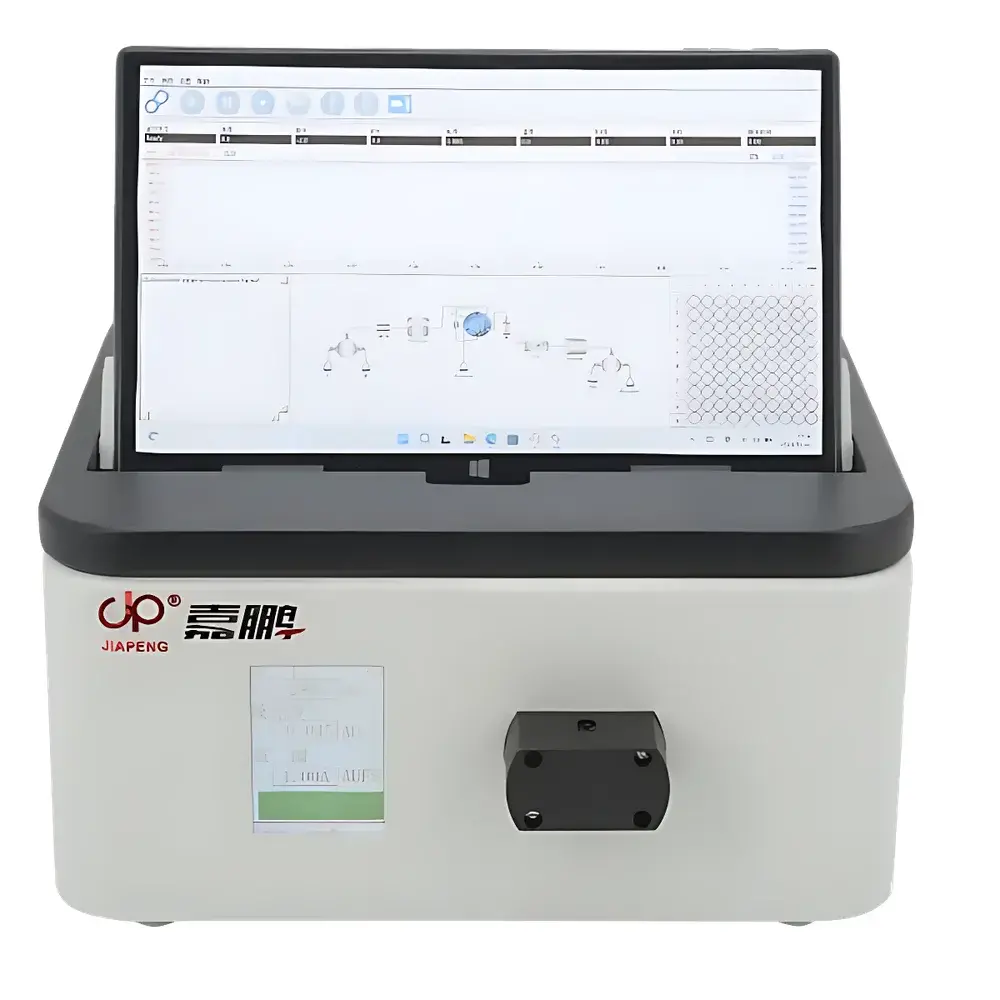
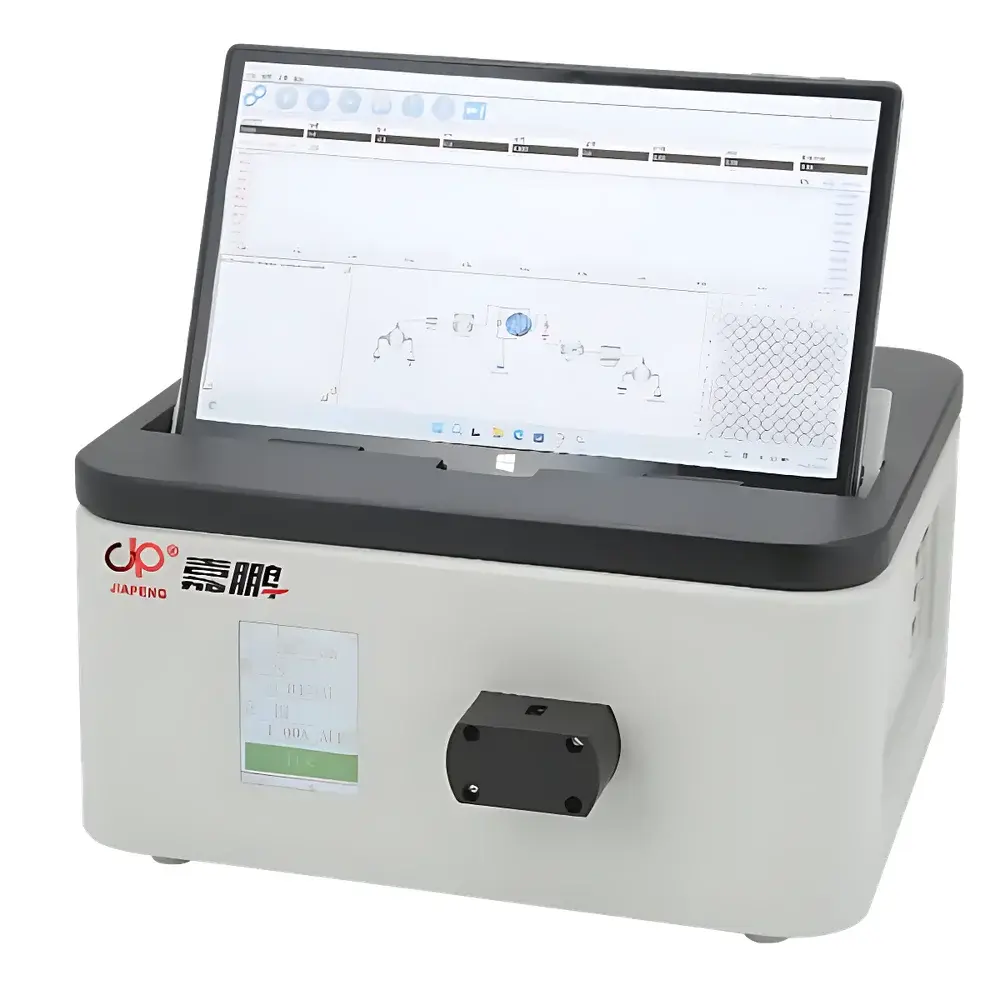
Jiapeng JP-3008 Full-Range UV Detector
| Brand | Jiapeng |
|---|---|
| Origin | Shanghai, China |
| Model | JP-3008 |
| Detection Range | 190–400 nm |
| Light Source | Deuterium Lamp (≥1000 h warranty) |
| Optical Path Length | 1 mm |
| Flow Cell Volume | 10–120 µL |
| Spectral Bandwidth | 6 nm |
| Wavelength Accuracy | ≤ ±1 nm |
| Wavelength Repeatability | ≤ ±0.1 nm |
| Baseline Noise | < 0.0001 AU |
| Baseline Drift | ≤ 0.002 AU/s |
| Wavelength Control | Stepper Motor–Driven Monochromator |
| Data Acquisition Rate | Dual-Channel High-Speed Sampling |
| Power Supply | AC 220 V, 50/60 Hz |
| Dimensions (W×D×H) | 340 × 330 × 175 mm |
| Weight | 6 kg |
| Integrated Touchscreen Display | 12-inch Industrial LCD |
Overview
The Jiapeng JP-3008 Full-Range UV Detector is a precision optical detection module engineered for integration into liquid chromatography (LC) and fast protein liquid chromatography (FPLC) systems used in biomolecule purification workflows. It operates on the principle of dual-beam absorbance photometry, employing a high-stability deuterium lamp and a 1200-line/mm concave holographic grating monochromator to deliver continuous spectral coverage from 190 nm to 400 nm—encompassing the critical absorption bands of proteins (280 nm), nucleic acids (260 nm), aromatic amino acids, and co-factors. Its fixed 1-mm optical path length flow cell ensures consistent Beer-Lambert law compliance across concentration ranges, while the dual-beam architecture actively compensates for lamp intensity drift and solvent baseline fluctuations—essential for extended gradient runs in ion exchange chromatography (IEX) and other high-resolution separation protocols.
Key Features
- Dual-beam optical design with real-time monitoring of both sample and reference beam intensities—enabling immediate diagnostics of lamp output degradation or flow cell fouling.
- Stepper motor–controlled wavelength selection with ≤ ±0.1 nm repeatability and ≤ ±1 nm absolute accuracy—certified per ISO 17025 traceable calibration procedures.
- High-stability deuterium lamp (≥1000 h rated lifetime) paired with low-noise silicon photodiode detection—achieving baseline noise < 0.0001 AU and drift ≤ 0.002 AU/s under standard operating conditions.
- Precision-machined dual-lens flow cell with adjustable volume range (10–120 µL) and chemically resistant quartz windows—compatible with aqueous and low-organic mobile phases used in IEX and size-exclusion chromatography (SEC).
- Integrated 12-inch industrial-grade touchscreen interface supporting time-programmable wavelength switching, auto-zero calibration, and real-time absorbance peak tracking without external PC dependency.
- Multi-range analog output (0–1 V, 0–5 V, 0–10 V) and digital USB/RS-232 connectivity—designed for seamless synchronization with third-party LC controllers and data acquisition systems.
Sample Compatibility & Compliance
The JP-3008 is routinely deployed in applications requiring strict adherence to analytical method validation frameworks. Its optical performance meets the sensitivity and stability requirements outlined in USP , EP 2.2.25, and ISO 13843 for UV-Vis detection in pharmaceutical process development and QC release testing. The detector supports GLP-compliant operation when integrated with chromatography data systems (CDS) that provide audit trails, electronic signatures, and 21 CFR Part 11–compliant user access controls. It is compatible with standard HPLC/FPLC tubing (1/16″ OD), PEEK and stainless-steel frits, and common biopurification buffers—including Tris-HCl, sodium acetate, and phosphate-based eluents at pressures up to 3 MPa (435 psi).
Software & Data Management
While the JP-3008 operates autonomously via its embedded touchscreen controller, it exports calibrated absorbance data in ASCII format for post-run analysis in MATLAB, OriginLab, or industry-standard CDS platforms such as Chromeleon, UNICORN, or Empower. Time-programmed wavelength transitions allow dynamic monitoring—for example, simultaneous tracking of A260/A280 ratios during nucleic acid–protein co-elution studies. All system diagnostics—including lamp hours, temperature logs, and error codes—are timestamped and exportable for quality documentation. Firmware updates are delivered via USB flash drive with cryptographic signature verification to ensure integrity in regulated environments.
Applications
- Real-time monitoring of protein elution profiles in cationic/anionic exchange chromatography (IEX) for monoclonal antibody (mAb) and fusion protein purification.
- Quantitative analysis of oligonucleotides and plasmid DNA during polishing steps in gene therapy vector manufacturing.
- Enzyme activity assays based on NAD(P)H or FAD absorbance shifts at 340 nm and 450 nm.
- Quality control of natural product extracts—e.g., flavonoids (360 nm), alkaloids (280 nm), and polyphenols—under gradient UV scanning.
- Method development support for multi-wavelength peak purity assessment in complex biological matrices (serum, lysates, fermentation broths).
FAQ
Does the JP-3008 support GMP-compliant data handling?
Yes—when connected to a validated CDS with full 21 CFR Part 11 functionality, the detector’s analog/digital outputs and internal event logs satisfy raw data retention and audit trail requirements.
Can the flow cell be cleaned in place (CIP) with NaOH or 70% ethanol?
The quartz flow cell is compatible with 0.1–1.0 M NaOH and ≤70% ethanol; however, prolonged exposure to >0.5 M NaOH at elevated temperatures requires post-rinse with DI water to prevent alkali-induced etching.
Is wavelength calibration traceable to NIST standards?
Factory calibration uses holmium oxide and didymium oxide reference filters certified to NIST SRM 2034 and SRM 2035; end-user recalibration kits are available upon request.
What is the maximum recommended flow rate for optimal signal-to-noise ratio?
For 10–50 µL flow cells, optimal performance is achieved at 0.2–2.0 mL/min; higher flow rates may increase dispersion but remain within specification up to 5 mL/min with appropriate dwell volume compensation.
Does the instrument support remote control via Ethernet or Modbus TCP?
Standard configuration includes RS-232 and USB; optional Ethernet-to-serial gateway modules enable Modbus RTU integration for PLC-controlled purification platforms.




