
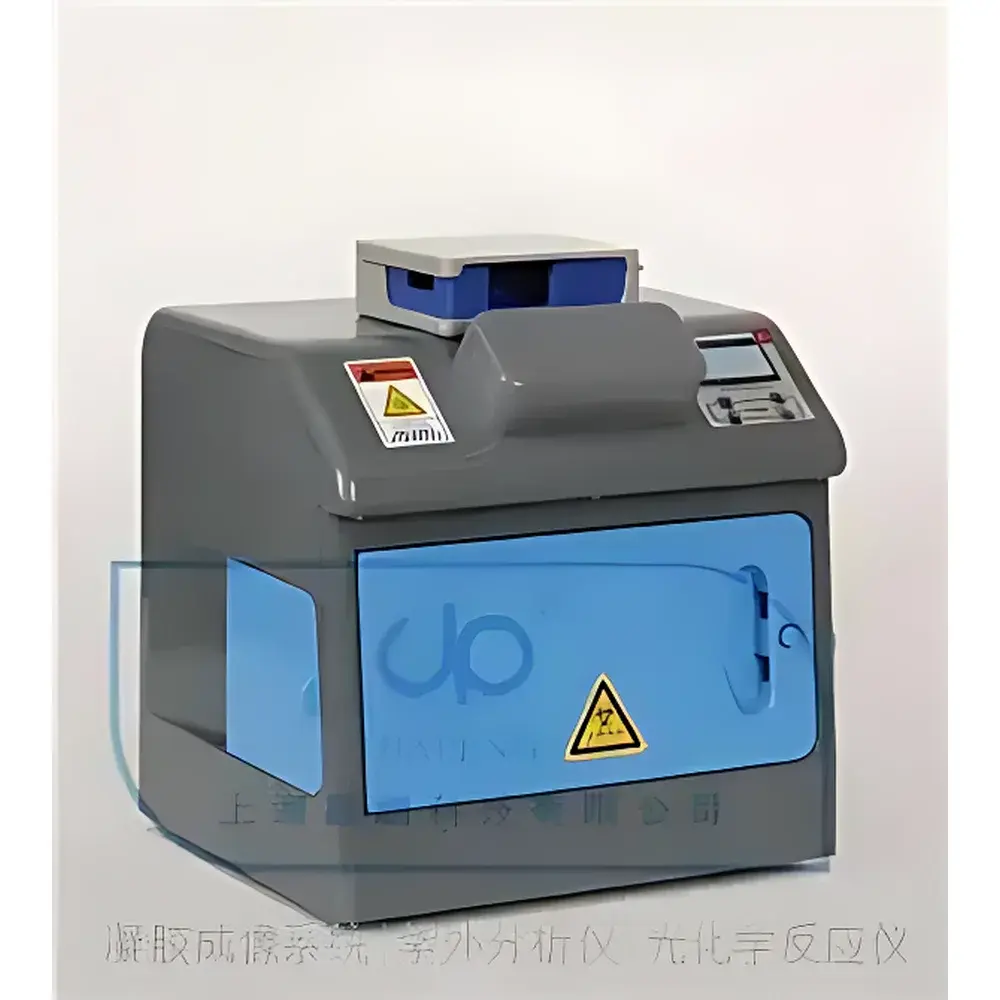
Jiapeng ZF-109 Dual-Wavelength UV Transilluminator for Fluorescent Whitening Agent (FWA) Detection
| Brand | Jiapeng |
|---|---|
| Origin | Shanghai, China |
| Model | ZF-109 |
| Instrument Type | Darkroom-style transilluminator |
| Wavelengths | 254 nm and 365 nm |
| UV Filter Dimensions | 200 × 50 mm |
| UV Lamps | 2 |
| Input Voltage | 220 V AC |
| Operating Mode | AC-powered (with optional DC operation via internal rechargeable battery) |
| Display | LCD with Chinese interface |
| Camera Integration | Built-in digital camera module |
| Image Storage Capacity | ≥5000 images |
| UV Intensity at 20 cm | ≥20 µW/cm² |
| Dimensions (L×W×H) | 310 × 200 × 300 mm |
| Weight | 3 kg |
| Compliance | Designed per NY/T 1257–2006 (Detection of Fluorescent Substances in Edible Fungi) |
Overview
The Jiapeng ZF-109 Dual-Wavelength UV Transilluminator is a purpose-built darkroom instrument engineered for rapid, on-site qualitative detection of fluorescent whitening agents (FWAs) and other UV-excitable compounds in food, agricultural products, packaging materials, and biological samples. It operates on the principle of ultraviolet-induced fluorescence: when exposed to short-wave (254 nm) or long-wave (365 nm) UV radiation, certain synthetic optical brighteners—commonly added to flour, edible fungi (e.g., mushrooms and shiitake), paper-based food containers, honey, fats, and confectionery—emit characteristic visible fluorescence under controlled darkroom conditions. Unlike general-purpose gel documentation systems, the ZF-109 is calibrated and validated specifically against the Chinese agricultural standard NY/T 1257–2006, which defines the visual assessment protocol for fluorescent substances in edible fungi. Its enclosed darkroom architecture eliminates ambient light interference, ensuring high-contrast fluorescence visualization and minimizing operator UV exposure through an integrated anti-UV observation window.
Key Features
- Darkroom-style enclosure with dual side-access ports and a shielded viewing window featuring UV-blocking acrylic, enabling safe real-time observation without protective eyewear
- Dual-wavelength UV excitation: independently selectable 254 nm (for detecting highly conjugated aromatic FWAs and nucleic acid contaminants) and 365 nm (optimized for common stilbene-based optical brighteners in food packaging and processed foods)
- Adjustable UV lamp angle and intensity control, allowing optimization of illumination geometry and irradiance uniformity across the 200 × 50 mm filter area
- Integrated digital imaging system with microcontroller-based capture, supporting direct image transfer to PC via USB; no external computer required for standalone operation
- LCD display with native Chinese-language menu navigation, simplifying field use by regulatory inspectors, QC technicians, and agricultural extension personnel
- AC-powered design (220 V, 50 Hz) with optional DC backup via built-in 4800 mAh rechargeable lithium battery—enabling fully portable deployment at border checkpoints, cold storage facilities, or rural markets
Sample Compatibility & Compliance
The ZF-109 accommodates flat, opaque, or semi-transparent solid and semi-solid specimens up to 300 mm in length, including sliced mushrooms, powdered flour, packaged paper cups, chocolate bars, honey droplets on glass slides, and cut sections of fruit peel or fat tissue. It does not support liquid-phase cuvette-based quantification or spectral analysis. Its operational methodology aligns strictly with NY/T 1257–2006, which prescribes visual fluorescence grading under standardized UV illumination and background conditions. While not certified to ISO/IEC 17025 or FDA 21 CFR Part 11, the instrument’s fixed-wavelength configuration, documented irradiance output (>20 µW/cm² at 20 cm), and repeatable darkroom geometry support method reproducibility in routine screening workflows. It is routinely deployed in Chinese provincial CDC laboratories, customs inspection stations, and food safety supervision centers as a Tier-1 triage tool prior to confirmatory HPLC or LC-MS analysis.
Software & Data Management
The ZF-109 employs embedded firmware—not PC-hosted software—to manage image acquisition, timestamping, and local storage. All captured JPEG images are saved directly to internal flash memory (≥5000 frames capacity) with automatic file naming based on date and sequence ID. Images can be exported via USB mass-storage mode to any Windows or macOS host without proprietary drivers. Metadata includes exposure time, selected wavelength, and instrument serial number—supporting basic audit trails for GLP-aligned recordkeeping. No cloud connectivity, remote access, or electronic signature functionality is provided; data integrity relies on manual export and institutional archiving protocols.
Applications
- Routine surveillance of illegally added optical brighteners in edible fungi during post-harvest handling and wholesale distribution
- Field verification of FWA contamination in recycled-paper food packaging (e.g., disposable cups, noodle boxes) per GB 4806.8–2022
- Screening of adulterated flour batches suspected of illegal bleaching agent use
- Pre-shipment inspection of honey and sugar products for synthetic brightener residues
- On-site assessment of UV-fluorescing contaminants in fats, cocoa butter substitutes, and confectionery coatings
- Teaching laboratory use in food science curricula for demonstrating non-invasive fluorescence screening principles
FAQ
Does the ZF-109 provide quantitative FWA concentration values?
No. It is a qualitative screening device based on visual or image-based fluorescence intensity comparison. Quantitative analysis requires chromatographic methods.
Can it detect aflatoxins or other mycotoxins?
No. While some aflatoxins fluoresce under 365 nm UV, the ZF-109 lacks spectral discrimination and calibration for toxin identification or quantification.
Is the 254 nm UV source suitable for DNA visualization?
Yes, but not optimized for it. The narrow 200 × 50 mm filter area and absence of ethidium bromide–specific emission filters limit its utility in molecular biology applications.
What maintenance is required for the UV lamps?
Lamps should be replaced every 1,000–1,500 hours of cumulative use to maintain stable irradiance output; output degradation is gradual and non-catastrophic.
Is the instrument compatible with international regulatory frameworks such as EU Regulation (EC) No 1881/2006?
It supports preliminary screening consistent with Annex I testing strategies but does not replace accredited reference methods required for official compliance reporting.
Related Products




