
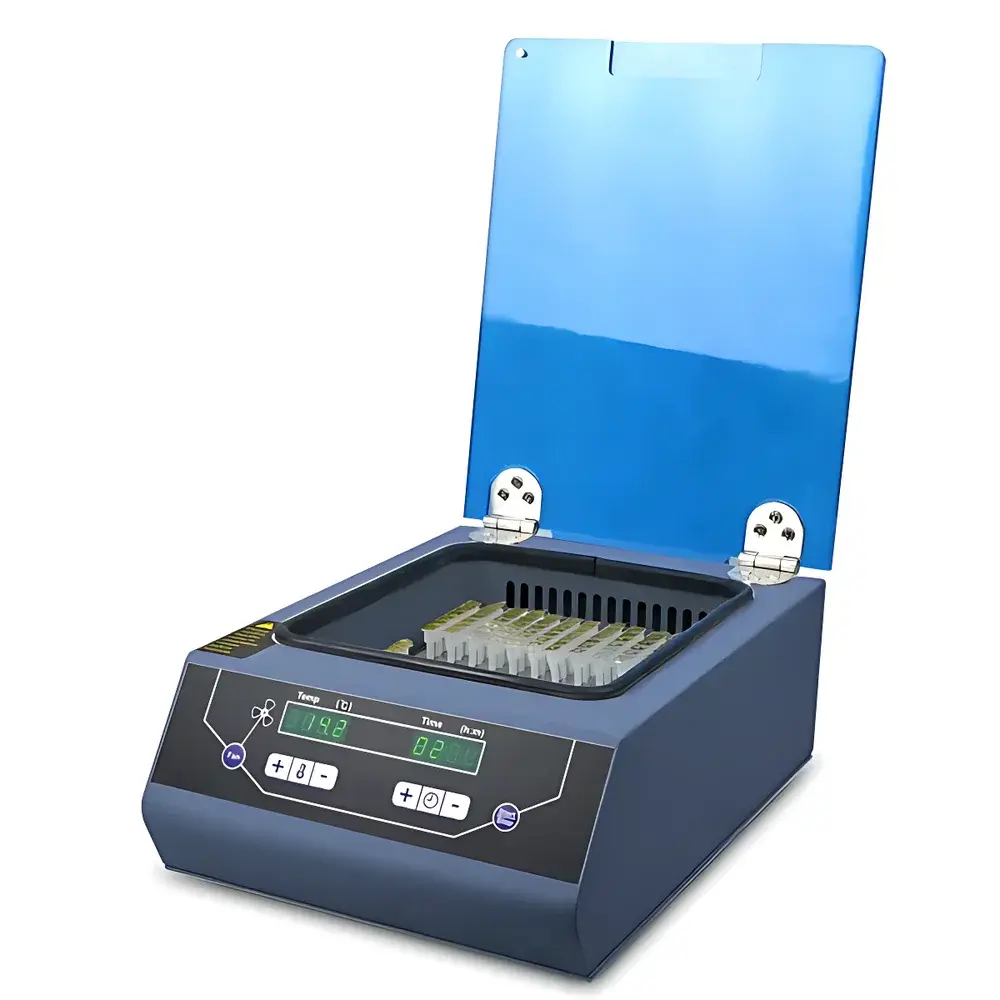
Jiayuan ET-60 Microplate Incubator
| Brand | Jiayuan |
|---|---|
| Model | ET-60 |
| Temperature Range | Ambient +5°C to 60°C |
| Timer Range | 1 min – 99 h 59 min |
| Temperature Uniformity | ±0.5°C |
| Temperature Stability | ±0.2°C |
| Temperature Accuracy | ±0.5°C |
| Power Supply | 220 V, 2.5 A, 200 W |
| Incubation Chamber Dimensions | 245 × 215 × 85 mm |
| External Dimensions | 395 × 275 × 130 mm |
Overview
The Jiayuan ET-60 Microplate Incubator is a compact, microprocessor-controlled benchtop thermal incubation system engineered for precise and reproducible temperature maintenance in life science and clinical laboratory workflows. Designed specifically for standardized microplate-based assays—including ELISA, immunoassays, blood typing, enzymatic reactions, and cell-based screening—the ET-60 employs resistive heating elements combined with PID-driven thermal regulation to achieve stable, uniform chamber conditions. Its operational range spans from ambient +5°C to 60°C, covering the critical temperature window for most serological, biochemical, and molecular diagnostic protocols. Unlike general-purpose heating blocks or dry baths, the ET-60 integrates a transparent polycarbonate lid and an enclosed, insulated chamber that minimizes convective heat loss and ensures consistent thermal exposure across all wells of a 96-well plate—eliminating edge effects commonly observed in open metal baths.
Key Features
- Intuitive LCD interface displaying real-time temperature and countdown timer with adjustable resolution (1 minute minimum, up to 99 hours 59 minutes maximum)
- High-fidelity thermal control architecture delivering ±0.2°C stability over time and ±0.5°C uniformity across the full incubation surface
- Transparent, hinged lid enabling continuous visual monitoring without compromising thermal integrity or introducing contamination risk
- Dedicated chamber geometry optimized for standard SBS-format 96-well microplates, as well as commercial blood typing card carriers, Petri dishes (up to 100 mm), and 15–50 mL conical tubes
- Integrated safety mechanisms including automatic shut-off upon timer completion and audible/visual alarm signaling temperature deviation or power interruption
- Modular compatibility: accepts interchangeable aluminum heating blocks (sold separately) for alternative vessel formats such as PCR strips, 0.2 mL tubes, or custom assay trays
Sample Compatibility & Compliance
The ET-60 accommodates a wide range of sample containers used in routine clinical and research laboratories. Its chamber supports simultaneous incubation of multiple 96-well plates or up to four standard blood typing cards using optional card holders—enabling parallel processing in transfusion medicine workflows. All internal surfaces are constructed from medical-grade stainless steel and anodized aluminum, ensuring chemical resistance to common reagents (e.g., ethanol, sodium hypochlorite, and buffered saline solutions) and facilitating decontamination per CLSI GP26-A4 guidelines. While not certified for ISO 13485 or FDA 510(k) clearance as a Class II medical device, the instrument meets IEC 61010-1:2010 requirements for electrical safety in laboratory equipment and complies with GB 4793.1–2007 (China’s national standard equivalent to IEC 61010-1). It is suitable for use in GLP-compliant environments when operated within documented SOPs and maintained with traceable calibration records.
Software & Data Management
The ET-60 operates as a standalone, embedded-control instrument with no proprietary software dependency. Temperature setpoints, timer values, and operational status are managed exclusively via front-panel controls and the integrated LCD. For laboratories requiring audit-ready documentation, external data loggers (e.g., compliant with FDA 21 CFR Part 11) may be connected via analog output (0–5 V DC proportional to chamber temperature) for continuous recording. The unit does not feature USB, Bluetooth, or Ethernet connectivity; this design prioritizes electromagnetic compatibility, operational simplicity, and long-term reliability in high-throughput clinical settings where network integration introduces unnecessary complexity and cybersecurity overhead.
Applications
- Immunohematology: Controlled incubation of ABO/Rh typing cards and antibody screening panels at 37°C or room temperature per AABB Technical Manual Chapter 7 protocols
- Diagnostic ELISA: Precise thermal conditioning during antigen-antibody binding steps (typically 37°C for 30–60 min) to maximize assay sensitivity and inter-run reproducibility
- Microbiology: Pre-incubation of rapid diagnostic tests (RDTs), lateral flow assays, and culture media activation prior to reading
- Quality control: Standardized thermal challenge testing of reagent stability and kit shelf-life validation under defined time–temperature profiles
- Academic research: Low-cost, reliable incubation platform for undergraduate teaching labs conducting enzyme kinetics, ligand-binding studies, or basic cell adhesion assays
FAQ
Does the ET-60 support programmable multi-step temperature profiles?
No. The ET-60 is designed for single-setpoint incubation only. It does not offer ramp-hold or gradient programming functionality.
Can the incubation chamber accommodate deep-well plates or 384-well formats?
No. Chamber depth (85 mm) and footprint (245 × 215 mm) are optimized for ANSI/SBS-standard 96-well plates (127.76 × 85.48 mm) and flat-bottom blood typing cards. Deep-well or 384-well plates exceed height or spatial constraints.
Is calibration traceable to NIST or other national standards?
The unit ships with a factory calibration certificate referencing internal reference sensors. End users may perform field verification using a NIST-traceable PT100 probe inserted into the chamber center; recalibration requires authorized service personnel.
What is the recommended maintenance schedule?
Clean chamber surfaces weekly with 70% isopropyl alcohol. Inspect heater block contact points quarterly for oxidation or debris. No lubrication or internal servicing is required under normal operating conditions.
Does the ET-60 meet UL or CE marking requirements?
It bears the CCC (China Compulsory Certification) mark per GB 4793.1–2007. UL and CE compliance are not claimed; international users should verify local regulatory acceptance prior to deployment.



