
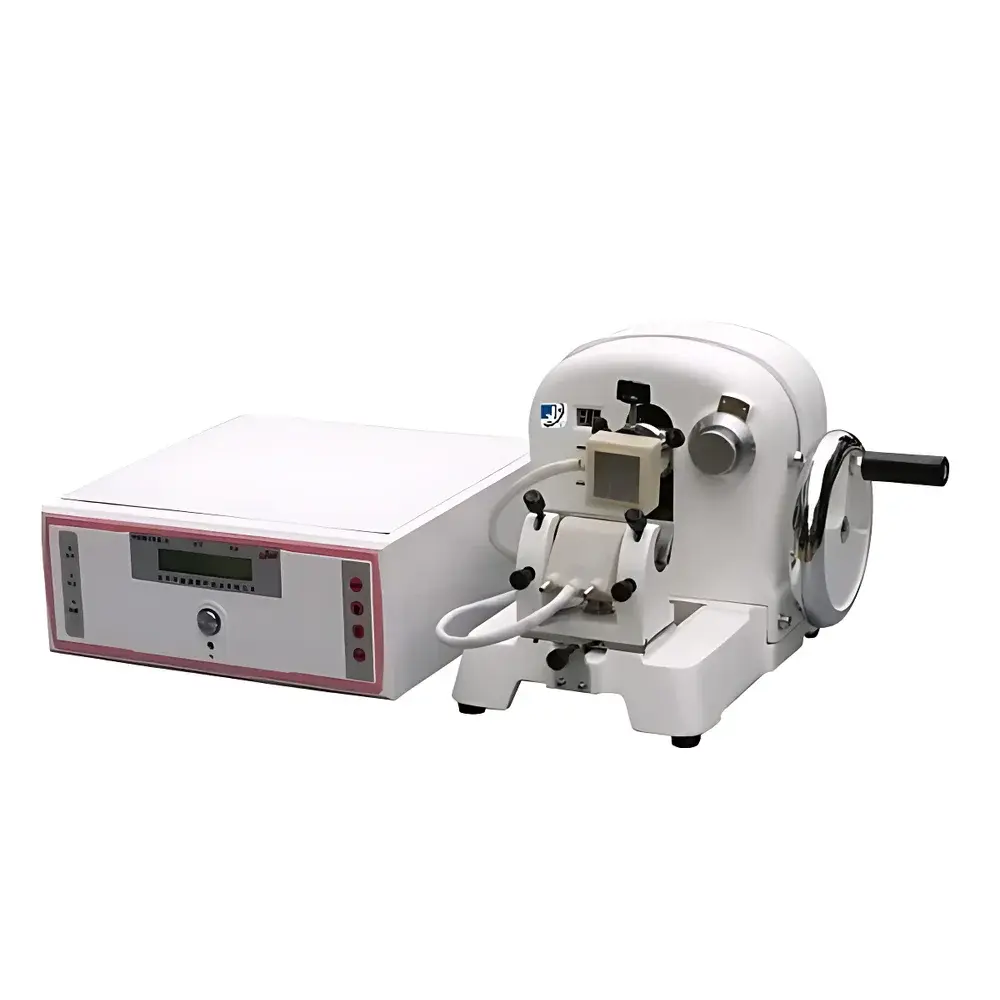
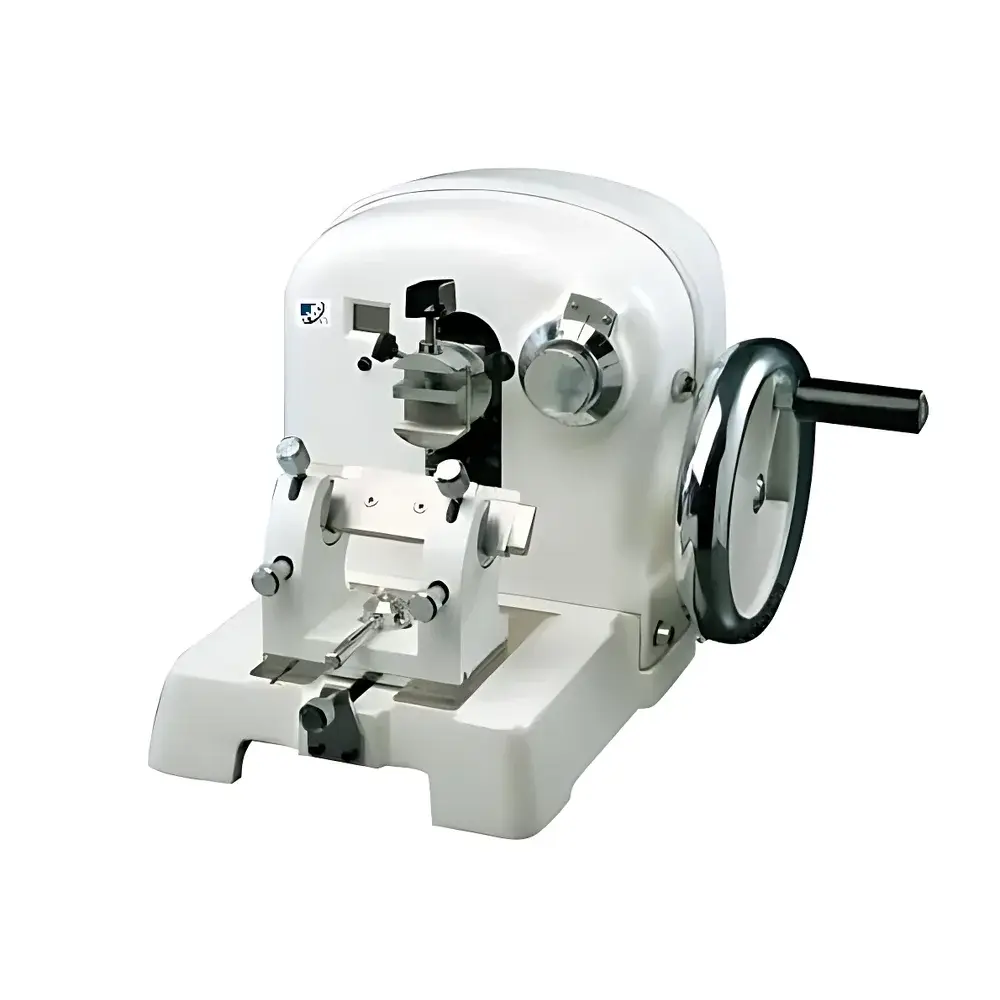
Jiayuan JY-202AIII Cryo-Paraffin Dual-Mode Rotary Microtome
| Brand | Jiayuan |
|---|---|
| Origin | Beijing, China |
| Model | JY-202AIII |
| Max Sample Size | 40 × 30 mm |
| Section Thickness Range | 1–25 µm |
| Minimum Thickness Increment | 1 µm |
| Cryo Stage Max Area | 45 × 40 mm |
| Knife Angle | 45° |
| Precooling Time | 4–8 min to target temperature |
| Dimensions | 335 × 350 × 300 mm |
Overview
The Jiayuan JY-202AIII Cryo-Paraffin Dual-Mode Rotary Microtome is an integrated laboratory instrument engineered for precision sectioning of both frozen and paraffin-embedded biological specimens. It combines a mechanically robust rotary microtome base—derived from the JY-202A platform—with a high-efficiency thermoelectric cooling system based on semiconductor Peltier elements. This dual-function architecture enables seamless transition between cryosectioning (typically at –15 °C to –30 °C) and room-temperature paraffin sectioning without hardware reconfiguration. The system employs a rigid linear feed mechanism with backlash-free micrometer adjustment, ensuring consistent slice geometry across heterogeneous tissue types—including soft parenchymal tissues, fibrous connective structures, calcified bone, and dense neural or vascular specimens. Its design adheres to fundamental microtomy principles: precise specimen advancement, stable knife-sample interaction geometry, and thermal management that minimizes ice crystal artifact formation during cryosectioning.
Key Features
- Thermoelectric cryostage with independent temperature control for both specimen holder and knife—displayed simultaneously on a high-contrast LCD interface
- Automatic temperature stabilization with hysteresis-based PID regulation, maintaining setpoint accuracy within ±0.5 °C under continuous operation
- Dual-mode operational workflow: rapid cooldown (4–8 minutes to operating temperature) followed by reproducible sectioning at user-defined thickness increments
- Micrometer-driven advance mechanism calibrated to 1 µm resolution, with mechanical lock at any handwheel position for procedural pause or alignment verification
- Interchangeable specimen chucks compatible with standard OCT-embedded blocks, metal cryomolds, and paraffin block holders (optional adapters available)
- Motor-assisted rapid trimming mode with adjustable stroke limits and audible/visual end-of-travel alerts
- Integrated section counter with non-volatile memory—retains cumulative count across power cycles and retains user-defined reset points
- Sealed, removable acrylic chamber minimizes airborne particulate contamination and protects blade integrity during extended runs
- Tool-free lateral and longitudinal knife stage translation for fine-tuning clearance angle and cutting plane alignment
Sample Compatibility & Compliance
The JY-202AIII accommodates a broad spectrum of specimen formats and tissue classes. It supports OCT-embedded fresh-frozen sections (e.g., liver, kidney, brain, tumor biopsies), decalcified or methylmethacrylate-infiltrated hard tissues (bone, cartilage), and standard paraffin-embedded archival blocks. The 40 × 30 mm maximum specimen footprint complies with ISO 15195:2019 (Laboratory medicine — Requirements for reference measurement laboratories) dimensional conventions for histological validation studies. While not certified to IEC 61010-1 for in vitro diagnostic use, its mechanical and thermal subsystems conform to general-purpose laboratory equipment safety standards applicable to Class II devices. All electronic controls meet CE electromagnetic compatibility (EMC) Directive 2014/30/EU requirements. The system supports GLP-compliant documentation workflows when paired with external LIMS via timestamped CSV export of section logs.
Software & Data Management
The JY-202AIII operates as a standalone instrument with embedded firmware—no PC dependency required for core functionality. Temperature setpoints, section counts, and operational timestamps are stored in onboard EEPROM with battery-backed retention. A USB-C port enables firmware updates and optional data extraction: session logs (date/time, thickness, temperature, count) export as plain-text CSV files for audit trail reconstruction. Though lacking native network connectivity or FDA 21 CFR Part 11-compliant electronic signatures, the device supports traceability through deterministic parameter logging—enabling retrospective review of critical sectioning conditions during pathology QA/QC investigations or regulatory inspections. Optional Bluetooth-enabled remote monitoring modules (sold separately) provide real-time thermal telemetry for multi-instrument lab coordination.
Applications
This microtome serves core roles across academic research, clinical diagnostics, and preclinical development. In neuroscience labs, it delivers ultra-thin (1–5 µm) serial sections of flash-frozen rodent hippocampus for immunofluorescence mapping. In surgical pathology departments, it facilitates intraoperative frozen section analysis (e.g., margin assessment in breast lumpectomy specimens) with turnaround times under 10 minutes from tissue receipt to slide mounting. For orthopedic research, its hardened specimen stage tolerates methylmethacrylate-embedded bone cores up to 30 mm in diameter, enabling undecalcified histomorphometry. Veterinary diagnostics benefit from its adaptability to avian, reptilian, and marine mammal tissues—particularly those requiring low-temperature preservation to prevent lipid dissolution. The system is routinely deployed in ISO 17025-accredited histology core facilities performing method validation per CLSI EP17-A2 guidelines.
FAQ
Does the JY-202AIII support disposable blade systems?
Yes—optional universal blade holders accept standard 20-mm-wide disposable knives (e.g., Leica 819, Sakura Tissue-Tek blades) as well as reusable tungsten-carbide or stainless-steel profiled knives.
What is the minimum achievable section thickness in cryo mode?
The calibrated minimum is 1 µm; however, practical reproducibility below 3 µm depends on tissue consistency, embedding medium, and knife sharpness—consistent with ASTM E2015-20 standards for microtomy validation.
Can the cryostage temperature be independently controlled from the knife temperature?
Yes—the LCD interface displays and permits separate setpoint configuration for specimen stage and knife, enabling differential thermal gradients to optimize section adhesion and reduce chatter artifacts.
Is routine maintenance documented in the operator manual?
Yes—the English-language manual includes quarterly lubrication schedules, Peltier module cleaning protocols, and calibration verification procedures using NIST-traceable gauge blocks.
What electrical supply is required for stable thermoelectric operation?
A dedicated 220 V AC / 50 Hz circuit with minimum 16 A breaker rating is recommended; voltage fluctuations >±5% may impair temperature stability and shorten Peltier lifespan.



