
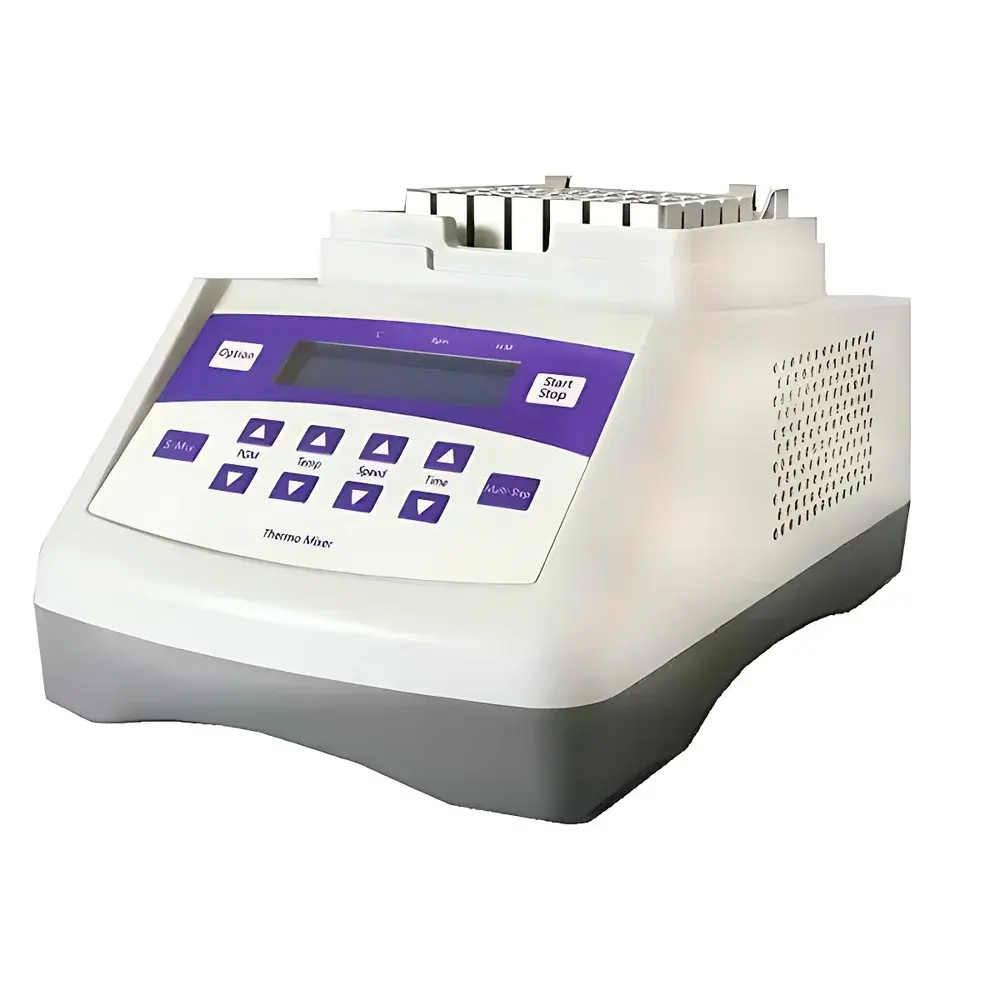
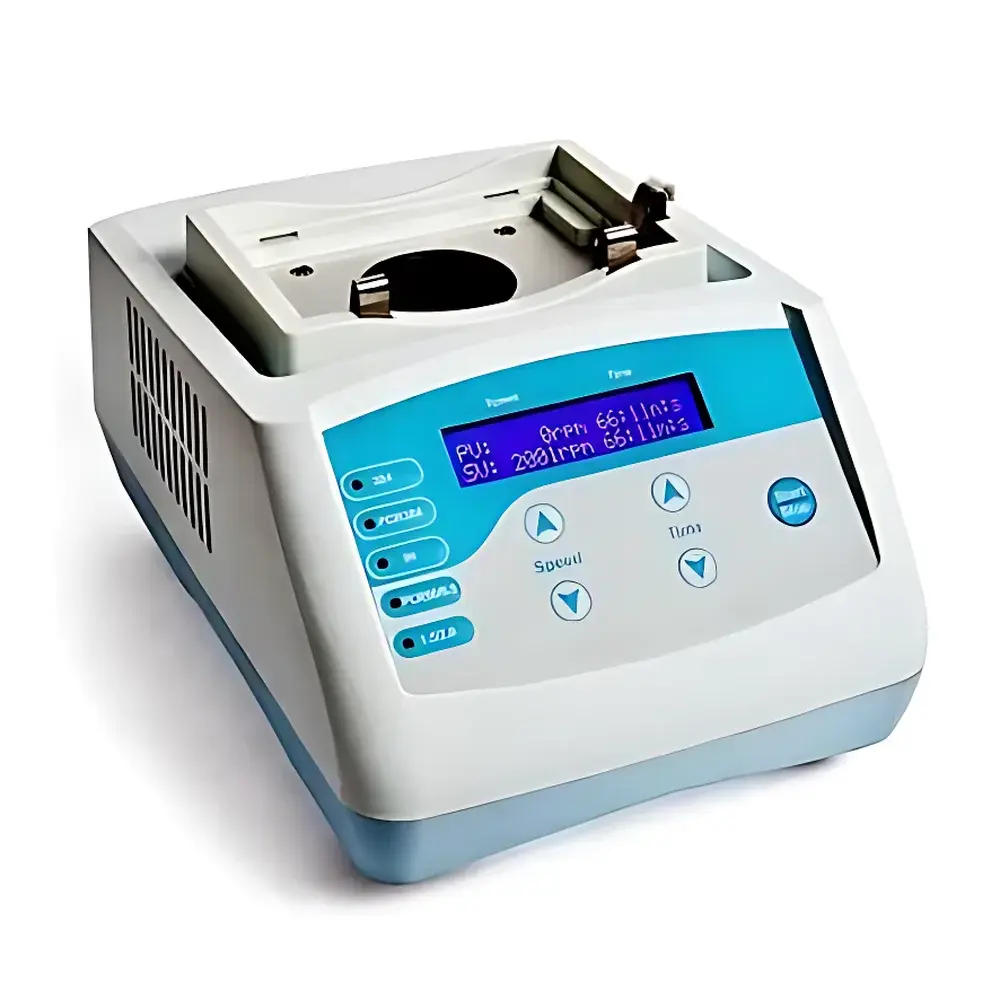
Jiayuan MSC-100 Thermostatic Vortex Mixer
| Brand | Jiayuan |
|---|---|
| Origin | Beijing, China |
| Model | MSC-100 |
| Timer Range | 99 h 59 min |
| Oscillation Speed | 300–1500 rpm |
| Oscillation Amplitude | 3 mm (horizontal rotation) |
| Temperature Control Range | 0°C to 100°C |
| Heating/Cooling Capability | Yes (refrigerated model) |
| Plate Configuration | Single interchangeable heating/cooling block |
| Compliance | CE-certified |
| Power Consumption | 200 W |
| Dimensions (W×D×H) | 270 × 190 × 170 mm |
| Net Weight | 8.3 kg |
| Temperature Uniformity | ≤ ±0.3°C |
| Temperature Stability | ±0.3°C |
| Display Resolution | 0.1°C |
| Heating Rate | <15 min (20°C → 100°C) |
| Cooling Rate | ≥7°C/min (100°C → 20°C), ≥1.2°C/min (RT → RT−20°C at 30°C ambient) |
| Motor Type | Brushless DC |
| Safety Features | Over-temperature protection, auto-restart after power failure, short-cycle pulse mode, built-in calibration function |
Overview
The Jiayuan MSC-100 Thermostatic Vortex Mixer is a precision-engineered benchtop instrument designed for simultaneous temperature-controlled incubation and high-efficiency orbital mixing. Unlike conventional heat blocks or standalone shakers, the MSC-100 integrates Peltier-based thermoelectric heating and cooling with digitally regulated 2D horizontal orbital oscillation (3 mm amplitude), enabling precise thermal management across the full range of 0°C to 100°C—while maintaining tight uniformity (≤ ±0.3°C) and stability (±0.3°C). Its core operating principle relies on closed-loop PID temperature control coupled with brushless DC motor-driven motion, ensuring reproducible mixing kinetics and thermal profiles essential for molecular biology workflows including PCR setup, enzyme reactions, cell lysis, ligand binding assays, and sample homogenization prior to downstream analysis. The device supports programmable multi-step protocols, making it suitable for GLP-compliant laboratories requiring traceable, repeatable thermal-mechanical conditioning of sensitive biological samples.
Key Features
- Integrated thermoelectric (Peltier) module enabling both heating and active cooling—no external chillers or dry ice required.
- Dual-mode operation: independent or concurrent control of temperature and oscillation parameters via intuitive membrane keypad and LED display.
- High-precision microprocessor control with real-time feedback loops for temperature and speed, minimizing drift and overshoot.
- Programmable timer (0–99 h 59 min) with auto-shutdown and power-failure recovery—retains last settings and resumes operation upon power restoration.
- Brushless DC motor ensures low-noise, maintenance-free operation with extended service life (>20,000 hours).
- CE-certified safety architecture including over-temperature cutoff, short-circuit protection, and mechanical lockout during lid opening.
- Onboard temperature calibration function allows user verification and adjustment against NIST-traceable reference standards.
- Short-pulse mixing mode for rapid sample resuspension without thermal disturbance—ideal for viscous or precipitate-prone solutions.
Sample Compatibility & Compliance
The MSC-100 accommodates a broad spectrum of standard laboratory consumables via its modular block system. Interchangeable aluminum blocks support formats including 0.2 mL PCR tubes (96-well), 0.5–2.0 mL microcentrifuge tubes, 96- and 384-well plates (with or without skirts), deep-well plates, MTPs, ELISA plates, and custom-sized vessels up to 50 mL (at reduced speed). All blocks are anodized for chemical resistance and thermal conductivity optimization. The instrument meets CE marking requirements under Directive 2014/30/EU (EMC) and 2014/35/EU (LVD), and its operational design aligns with ISO/IEC 17025:2017 guidelines for equipment qualification in testing laboratories. While not FDA 21 CFR Part 11–enabled out-of-the-box, audit trails can be generated externally via timestamped manual logs or third-party data acquisition systems compliant with GxP documentation standards.
Software & Data Management
The MSC-100 operates via embedded firmware without external PC dependency. All parameters—including target temperature, ramp rate, oscillation speed, duration, and pause intervals—are stored in non-volatile memory. The front-panel interface provides real-time display of current temperature, setpoint, actual rpm, elapsed time, and remaining time. For labs requiring electronic recordkeeping, optional RS-232 or USB-to-serial adapters enable connection to LIMS or ELN platforms using ASCII-based command protocols (e.g., “GET_TEMP”, “SET_SPD 1200”). Raw data export is supported through simple terminal emulation software; no proprietary drivers are needed. Firmware updates are performed via micro-USB port using manufacturer-provided HEX files—a process validated for integrity and rollback safety.
Applications
- Pre-PCR reaction assembly with temperature-sensitive master mixes and primer annealing steps.
- Enzymatic digestions (e.g., restriction enzymes, kinases, phosphatases) requiring strict thermal control during agitation.
- Cell suspension preparation for flow cytometry or viability assays where clumping must be minimized.
- Antibody-antigen binding kinetics studies under controlled thermal and mechanical conditions.
- Standard curve preparation in ELISA and qPCR workflows involving serial dilutions with consistent mixing.
- Thermal denaturation and renaturation experiments for protein folding analysis.
- Sample equilibration prior to HPLC, mass spectrometry, or microplate reader measurements.
FAQ
Does the MSC-100 support remote monitoring or network connectivity?
No—the device lacks Ethernet, Wi-Fi, or Bluetooth interfaces. Remote access requires integration via serial communication using industry-standard terminal emulators.
Can I use the MSC-100 for cryogenic applications below 0°C?
No—the minimum operational temperature is 0°C. It is not designed for sub-zero cooling.
Is validation documentation (IQ/OQ/PQ) available from the manufacturer?
Jiayuan provides basic factory test reports and CE declarations. Full GMP-compliant validation kits—including protocol templates, acceptance criteria, and blank forms—are available upon request for qualified institutional buyers.
What is the maximum load capacity per module?
Maximum recommended load is 1.5 kg distributed evenly across the block surface. Exceeding this may compromise thermal uniformity and mechanical stability.
Are replacement modules calibrated individually?
Yes—each block undergoes thermal mapping at three points (center, left, right) during manufacturing and is labeled with a unique calibration ID traceable to internal QA records.




