
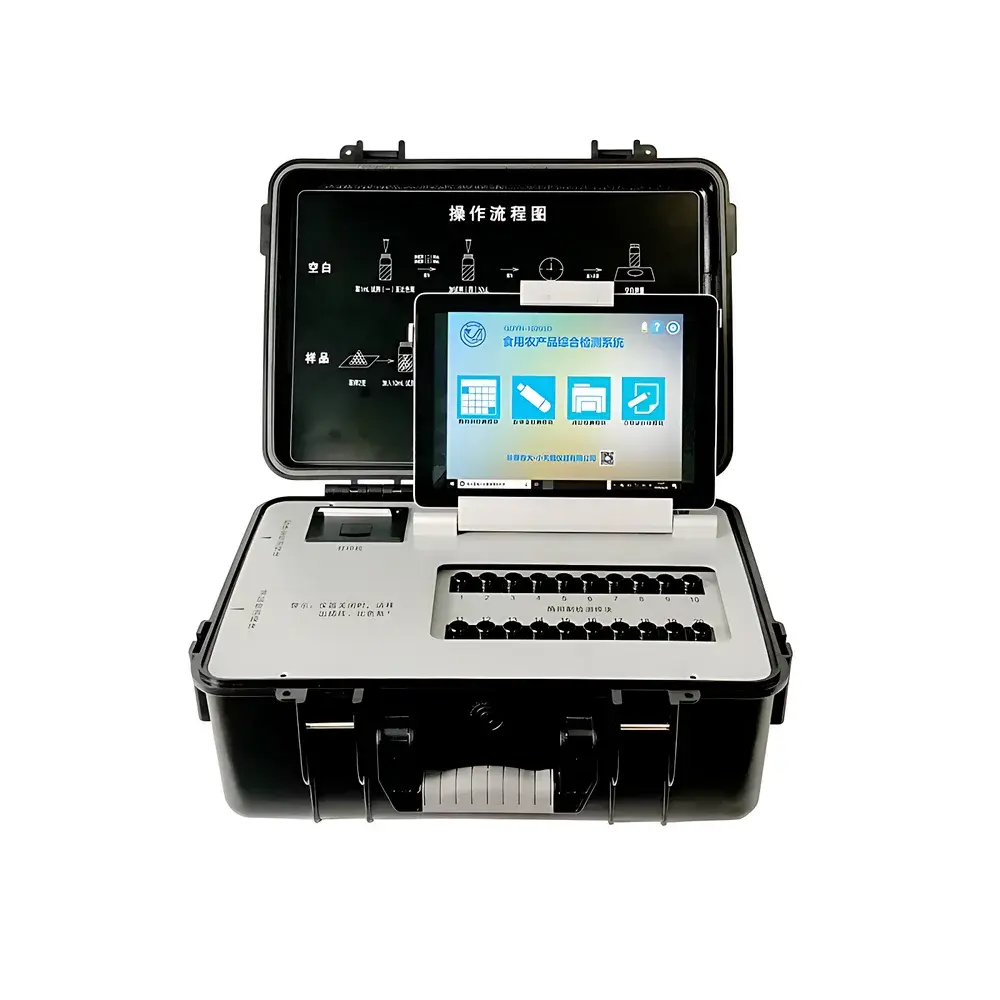
JiDa-Xiaotian’e GDYN-1020SD Multi-Residue Screening System for Agricultural Commodities
| Brand | JiDa-Xiaotian'e |
|---|---|
| Origin | Jilin, China |
| Manufacturer Type | Direct Manufacturer |
| Country of Origin | China |
| Model | GDYN-1020SD |
| Detection Methods | Enzyme Inhibition, Thin-Layer Chromatography (TLC), Colloidal Gold Immunochromatography |
| Measurement Range | 0.0–100.0% (relative inhibition or signal intensity) |
| Number of Channels | 20 |
| Optical Stability | ±0.005 A/20 min |
| Sensitivity | 0.01–3.0 mg/kg (matrix-dependent) |
| Operating Temperature | 5–40 °C |
| Operating Humidity | ≤85% RH |
| Display | 10-inch capacitive touchscreen |
| OS | Windows Embedded |
| Data Output | Dual-printing support (integrated thermal printer + external USB/LAN printer) |
| Power | Rechargeable Li-ion battery + AC adapter |
| Portability | Integrated carry case with detachable control unit and field imaging module |
Overview
The JiDa-Xiaotian’e GDYN-1020SD Multi-Residue Screening System is an integrated, field-deployable analytical platform engineered for rapid, on-site screening of chemical contaminants in agricultural commodities. It operates on three orthogonal detection principles—enzyme inhibition (for acetylcholinesterase- and butyrylcholinesterase-sensitive compounds), thin-layer chromatography (TLC) with visual or densitometric interpretation, and colloidal gold-based lateral flow immunoassay (LFIA)—enabling concurrent assessment of pesticide residues (organophosphates, carbamates, organochlorines, pyrethroids), veterinary drug residues (β-lactams, tetracyclines, sulfonamides), mycotoxins (aflatoxin B1, ochratoxin A, zearalenone), and unauthorized adulterants (e.g., melamine, Sudan dyes). Designed to meet the operational requirements of food safety inspection stations, agro-market laboratories, and regulatory field teams, the system delivers qualitative, semi-quantitative, and quantitative results without requiring centralized laboratory infrastructure. Its architecture complies with foundational principles outlined in ISO/IEC 17025:2017 for method validation in screening contexts and aligns with the tiered testing strategy recommended by Codex Alimentarius for residue surveillance.
Key Features
- Triple-module detection architecture: independent, switchable modules for enzyme inhibition (AOAC 992.11–compatible protocols), TLC (pre-coated silica plates, UV/visible visualization), and colloidal gold LFIA (CE-IVD–level test strips for targeted analytes)
- 20-channel photometric reader with dual-wavelength capability (405 nm and 630 nm), optimized for absorbance-based inhibition assays and colorimetric strip quantification
- 10-inch industrial-grade capacitive touchscreen running Windows Embedded OS, supporting multi-user profiles, audit trail logging, and time-stamped result archiving
- Integrated rechargeable lithium-ion battery (≥4 h continuous operation) and ruggedized portable carry case—certified to IP54 for dust and splash resistance during field deployment
- Detachable main control unit equipped with 5-megapixel autofocus camera and macro lens for real-time sample documentation, strip image capture, and evidentiary chain-of-custody recording
- Dual-printing system: built-in thermal printer for immediate pass/fail certificates (compliant with GB/T 22219–2018 labeling requirements) and configurable USB/LAN interface for external impact or label printers
- Prefabricated, lyophilized reagent kits with lot-specific calibration curves—each kit includes internal controls, blank references, and matrix-matched standards for vegetable, fruit, meat, aquaculture, and supplement matrices
Sample Compatibility & Compliance
The GDYN-1020SD supports homogenized extracts from >95 regulated analyte–matrix combinations, including leafy vegetables (spinach, cabbage), pome fruits (apple, pear), bovine muscle, tilapia fillet, and herbal dietary supplements. Sample preparation follows standardized extraction protocols per GB 2763–2021 (National Food Safety Standard for Maximum Residue Limits of Pesticides in Foods) and GB 31650–2019 (Maximum Residue Limits of Veterinary Drugs in Foods). The system’s detection thresholds are validated against reference methods (e.g., GC-MS/MS, LC-MS/MS) per CNAS-CL01:2018 guidelines. While not a primary quantitative instrument, its semi-quantitative outputs satisfy screening criteria under EU Regulation (EC) No 396/2005 Annex IV and U.S. FDA Red Book Chapter 5.1 for presumptive non-compliance triage.
Software & Data Management
The embedded software suite provides full GLP-compliant data handling: user authentication (role-based access control), electronic signatures, automated result interpretation against preloaded decision thresholds, and export in CSV, PDF, and XML formats. All measurement events—including optical density readings, image timestamps, environmental sensor logs (temperature/humidity), and reagent lot traceability—are stored locally with SHA-256 hashing. Remote connectivity via secure HTTPS enables encrypted data upload to provincial food safety information platforms (e.g., China’s National Food Safety Risk Monitoring System). Audit trails meet 21 CFR Part 11 requirements for electronic records and signatures when deployed in GMP-aligned quality assurance environments.
Applications
- Routine screening at farm gates, wholesale markets, and cold-chain distribution hubs to enforce pre-market clearance
- Emergency response testing during foodborne outbreak investigations involving suspected adulteration or contamination events
- Contract testing labs performing Tier-1 screening prior to confirmatory analysis by accredited methods
- Training and capacity building for county-level food safety officers under China’s “Four Strictest” regulatory framework
- Research applications in agricultural extension services evaluating pesticide application efficacy and post-harvest degradation kinetics
FAQ
Does the GDYN-1020SD require external calibration standards for each test?
No—each prefilled reagent kit contains matrix-matched calibrators and controls; instrument self-calibration occurs automatically before each assay batch.
Can the system quantify residues below the MRL, or is it limited to presence/absence detection?
It delivers semi-quantitative results (0.0–100.0% relative inhibition or signal ratio) correlated to concentration via built-in calibration curves; absolute quantification requires confirmatory LC-MS/MS.
Is the TLC module compatible with custom-developed solvent systems or only factory-validated mobile phases?
The system supports user-defined solvent compositions and development distances; however, only pre-validated TLC protocols (e.g., ethyl acetate:hexane:formic acid for organochlorines) are included in the certified method library.
How is data integrity ensured during offline field use?
All measurements are timestamped, cryptographically signed, and cached locally; synchronization with central servers occurs automatically upon network reconnection, preserving chronological sequence and preventing overwrites.
What maintenance is required for the photometric reader over a 5-year service life?
Annual verification using NIST-traceable neutral density filters is recommended; no lamp replacement is needed—the solid-state LED light source has a rated lifetime exceeding 50,000 hours.
Related Products





