
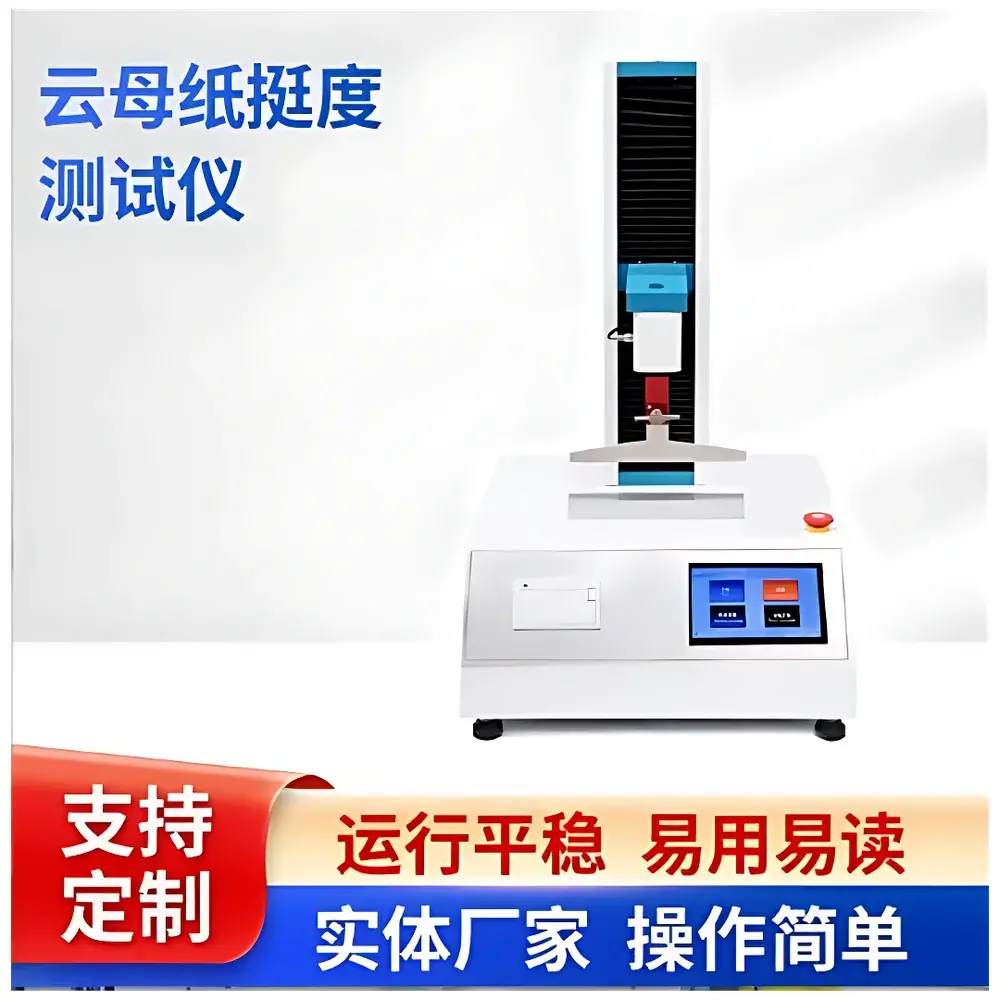
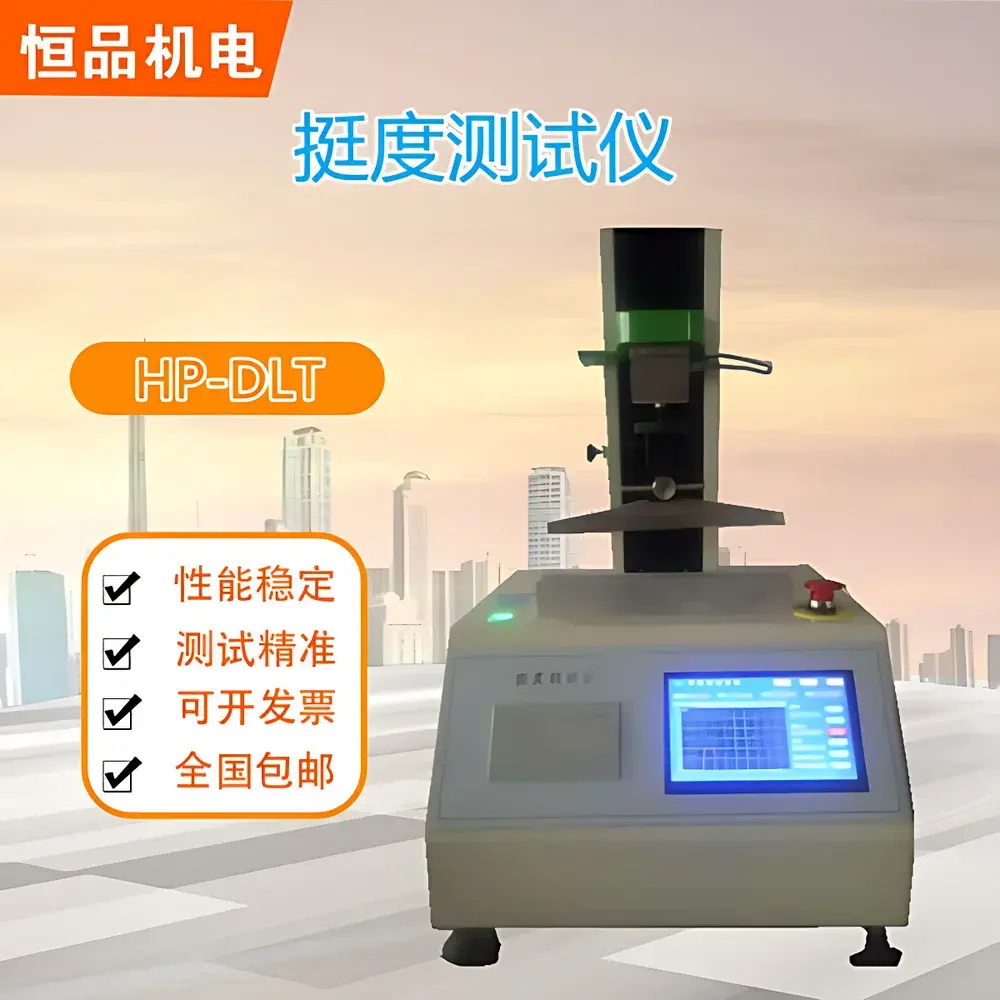
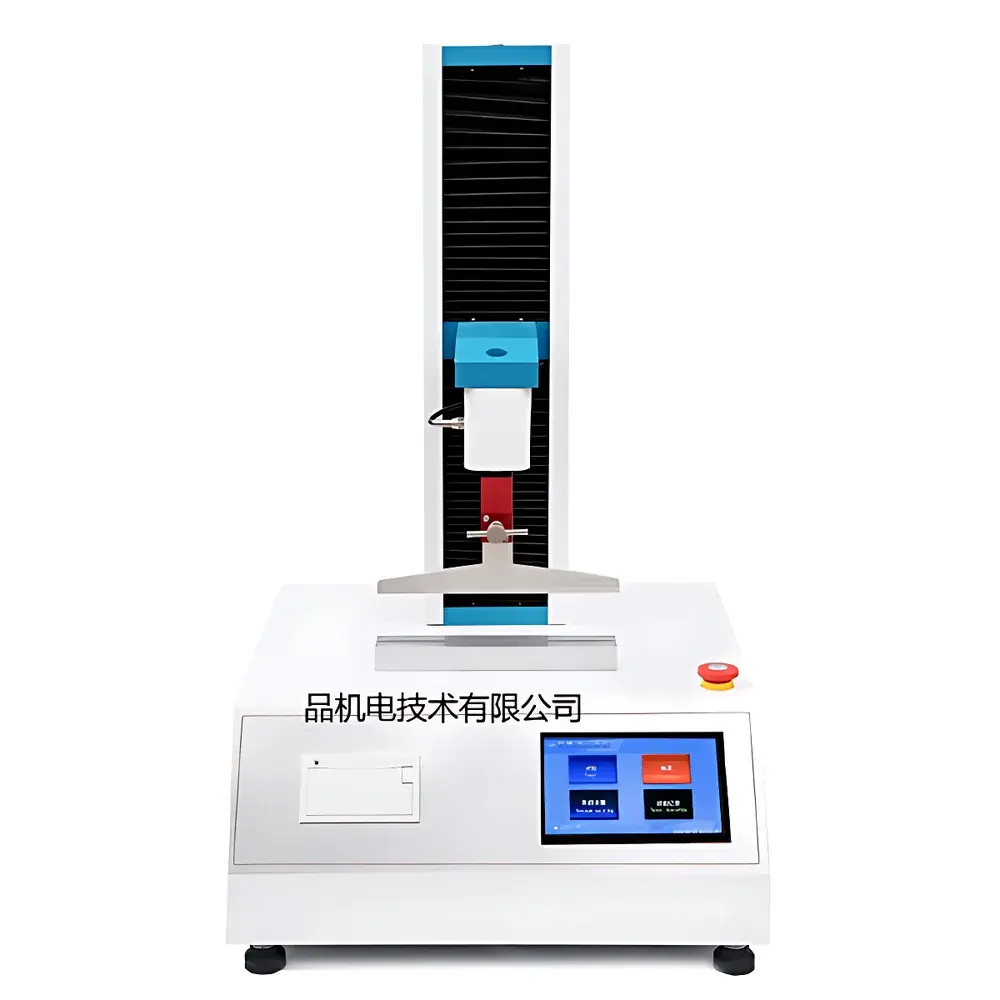
Jihengpin HP-DLT Plastic Film Stiffness Tester
| Brand | Jihengpin |
|---|---|
| Origin | Shandong, China |
| Manufacturer Type | Direct Manufacturer |
| Model | HP-DLT |
| Max. Test Load | 50 N |
| Load Resolution | 0.001 N |
| Force Accuracy | ±1% of reading |
| Displacement Resolution | 0.01 mm |
| Speed Range | 1–600 mm/min |
| Test Space (Compression) | 300 mm |
| Dimensions (W×D×H) | 540 × 280 × 1450 mm |
| Weight | ~70 kg |
| Power Supply | 200 V, 50 Hz |
| Operating Environment | 10–45 °C, 20–80% RH |
| Compliance | GB/T 5019.2–2009 |
| Display | Full Chinese LCD interface |
| Control Mode | Touch-key + optional PC-based software (USB/RS232) |
| Protection | Overload protection, mechanical limit switches |
| Accuracy Class | Class 1 (GB/T 228.1) |
Overview
The Jihengpin HP-DLT Plastic Film Stiffness Tester is a single-arm, microprocessor-controlled bending resistance instrument engineered for precise measurement of flexural rigidity (stiffness) in thin, flexible sheet materials. It operates on the principle of the beam deflection method, where a standardized specimen—clamped at one end and freely supported over a fixed span—is subjected to a controlled downward force applied at a defined distance from the clamp. The resulting angular deflection or bending moment is measured via high-resolution load cell and displacement transducer systems, enabling calculation of stiffness in millinewton-meters (mN·m) per unit width—a critical parameter for evaluating handling, winding, converting, and end-use performance of thin-film substrates.
Key Features
- High-precision electromechanical actuation: Digital DC motor with integrated speed controller delivers smooth, repeatable crosshead motion across a calibrated range of 1–600 mm/min, supporting both quasi-static and dynamic stiffness profiling.
- Robust mechanical architecture: Precision-ground ball screw drive coupled with arc-synchronous timing belt transmission ensures low-noise operation, minimal backlash, and long-term dimensional stability—critical for multi-cycle repeatability in QC labs.
- Optimized sample alignment system: Universal joint fixture with angular constraint limits misalignment-induced torque errors; enables consistent clamping of non-uniform specimens (e.g., embossed films, coated foils) while preserving coaxial loading integrity.
- Real-time embedded control interface: Full Chinese-language LCD display with touch-key navigation shows live values of applied force (N), displacement (mm), peak load (N), test speed (mm/min), and calculated stiffness (mN·m). Eliminates legacy LED-digit reliability issues.
- Automated calibration & validation: Internal auto-calibration routine verifies load cell linearity and zero offset prior to each test sequence, traceable to internal reference standards compliant with GB/T 228.1 requirements.
- Integrated safety architecture: Dual-stage overload protection includes electronic current-limiting circuitry and mechanical limit switches, preventing damage during operator error or abnormal specimen failure modes.
Sample Compatibility & Compliance
The HP-DLT is validated for use with a broad spectrum of thin-sheet dielectric and structural materials—including polyethylene terephthalate (PET), biaxially oriented polypropylene (BOPP), polyimide (PI), aluminum foil, copper foil, separator membranes (e.g., PE/PP microporous films), release liners, backsheet laminates, mica paper, and glass-reinforced composites. Its geometry and force range meet the dimensional and loading specifications defined in GB/T 5019.2–2009 (“Test methods for electrical insulating varnishes — Part 2: Determination of stiffness of insulating papers and films”). While not certified to ISO 2431 or ASTM D747, its mechanical design and metrological traceability align with fundamental principles referenced in those standards. The system supports GLP-aligned documentation when paired with optional PC software, including audit-trail logging, user access control, and electronic signature capability per FDA 21 CFR Part 11 guidelines.
Software & Data Management
An optional Windows-compatible control and analysis package extends functionality beyond standalone operation. This software enables full test method definition (span length, dwell time, ramp rate), automated data acquisition at up to 100 Hz sampling, real-time curve plotting (force vs. displacement), statistical reporting (mean, SD, CV%), and export to CSV, Excel, or PDF formats. All raw datasets include timestamp, operator ID, environmental conditions (if external sensors are connected), and calibration certificate metadata. Data files are digitally signed and version-locked to prevent post-test modification—supporting regulatory readiness for ISO 17025-accredited laboratories and GMP-compliant manufacturing environments.
Applications
- Quality assurance of plastic film batches for packaging converters—ensuring consistency in roll slitting, gravure printing, and lamination processes.
- Evaluation of thermal and mechanical aging effects on battery separator stiffness during accelerated life testing.
- Comparative assessment of surface coating impact (e.g., silicone release agents, anti-static layers) on base film rigidity.
- R&D screening of novel polymer blends or nanocomposite films targeting improved dimensional stability under tension.
- Validation of incoming raw material conformity for photovoltaic backsheet suppliers operating under IEC 61215 or UL 1703 specifications.
- Supporting failure analysis investigations where delamination or edge curl correlates with reduced bending resistance.
FAQ
What standards does the HP-DLT comply with?
The instrument is designed and verified against GB/T 5019.2–2009 for stiffness measurement of insulating films and papers. It is not pre-certified to ISO or ASTM standards but provides measurement traceability suitable for method adaptation under laboratory-developed protocols.
Can the HP-DLT test metallic foils?
Yes—its 50 N maximum load capacity and fine force resolution (0.001 N) support reliable stiffness evaluation of aluminum, copper, and stainless steel foils down to 6 µm thickness, provided specimen width and span adhere to standard test geometry requirements.
Is PC connectivity mandatory for data export?
No. All test results—including peak force, stiffness value, and test date/time—are stored internally and viewable on the LCD. USB or RS232 connection is required only for bulk export, report generation, or advanced statistical analysis.
How often should calibration be performed?
We recommend annual verification using certified reference weights and displacement gauges. Daily zero-point verification is advised before first use, and auto-calibration is executed automatically at system startup or upon operator command.
Does the system support multi-specimen batch testing?
Yes—the embedded controller allows sequential testing of up to 99 specimens per session, with individual result storage and summary statistics (average, min/max, standard deviation) generated automatically upon completion.
What maintenance is required for long-term accuracy?
Routine cleaning of the guideways and periodic lubrication of the ball screw (every 6 months under continuous use) are sufficient. No recalibration of mechanical components is needed unless physical damage occurs. Load cell drift is monitored continuously and flagged if deviation exceeds ±0.5% of full scale.
Related Products





