
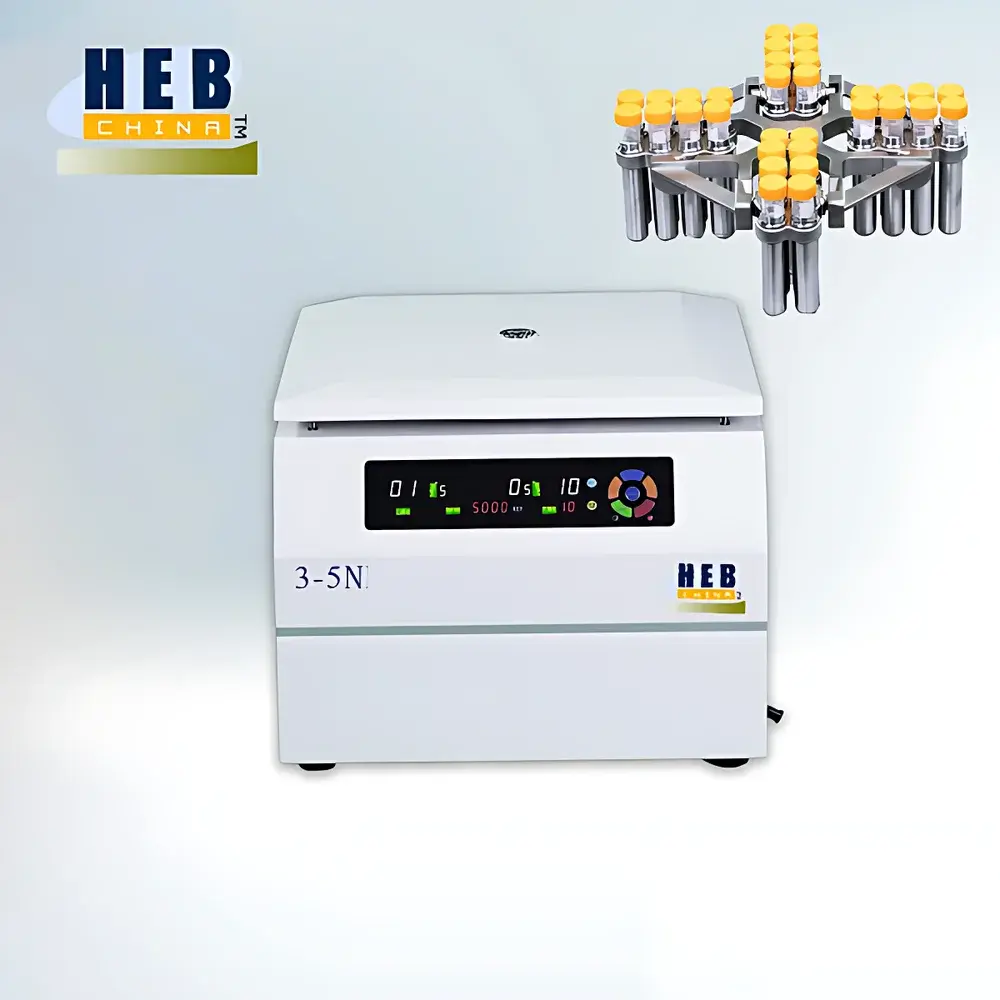
Jihepu 3-5N Urine Sediment Centrifuge
| Brand | Jihepu |
|---|---|
| Origin | Shandong, China |
| Model | 3-5N |
| Instrument Type | Benchtop Centrifuge |
| Speed Range | 0–4000 rpm |
| Max RCF | 2810 × g |
| Max Capacity | 32 × 15 mL |
| Rotor Type | Horizontal Swing-Out Rotor |
| Speed Accuracy | ±20 rpm |
| Timer Range | 1–99 min |
| Power Supply | AC 220 V ±10%, 50 Hz, 10 A |
| Total Power | 450 W |
| Noise Level | ≤65 dB(A) |
| Cavity Diameter | Φ380 mm |
| Dimensions (W×D×H) | 525×430×360 mm |
| Net Weight | 40 kg |
| Safety | Electronic Door Lock, Auto-Balancing Damping System, Momentary Spin Button |
Overview
The Jihepu 3-5N Urine Sediment Centrifuge is a microprocessor-controlled, benchtop horizontal centrifuge engineered specifically for standardized sediment preparation in clinical urinalysis workflows. It operates on the principle of sedimentation-based separation under controlled gravitational force (RCF), enabling reproducible pelleting of urinary cellular elements—including erythrocytes, leukocytes, epithelial cells, casts, and crystalline debris—while preserving morphological integrity. Designed to meet routine diagnostic throughput requirements in hospital laboratories, reference labs, and point-of-care testing environments, the 3-5N delivers consistent performance within the low-speed centrifugation range (up to 4000 rpm / 2810 × g), aligning with CLSI GP16-A3 and ISO 15189 pre-analytical guidelines for urine specimen processing.
Key Features
- Microprocessor-driven control system with variable-frequency motor ensures precise speed regulation and stable rotor acceleration/deceleration profiles.
- High-visibility color LED display provides real-time readouts of speed (rpm), relative centrifugal force (RCF), remaining time, and error codes—enabling intuitive parameter verification without manual conversion tables.
- One-touch RCF/rpm toggle function allows immediate unit switching based on protocol requirements, reducing operator-induced calculation errors.
- Integrated electronic door lock prevents lid opening during operation and enforces interlock compliance per IEC 61010-2-020 safety standards for laboratory centrifuges.
- Patented dual-stage damping mechanism with auto-balancing capability accommodates minor tube weight discrepancies (±0.5 g per position), minimizing vibration and extending bearing service life.
- Dedicated momentary spin (short-run) button supports rapid pellet assessment or supernatant aspiration without timer setup—ideal for QC checks or preliminary sediment evaluation.
- Quick-swap stainless-steel bucket assemblies (including 15 mL conical tube carriers) enable rapid rotor reconfiguration between sample types while maintaining corrosion resistance and cleanability per ISO 13485 medical device manufacturing requirements.
Sample Compatibility & Compliance
The 3-5N accepts standard 15 mL polypropylene conical centrifuge tubes (e.g., Falcon™ 352097 or equivalent) and supports batch processing of up to 32 samples per run. Its horizontal rotor geometry ensures uniform sediment deposition along the tube wall, critical for subsequent microscopic examination per WHO urinalysis protocols. The instrument complies with electromagnetic compatibility (EMC) requirements under EN 61326-1 and meets essential safety criteria outlined in EN 61010-1 and EN 61010-2-020. While not certified for GMP or FDA 21 CFR Part 11 environments out-of-the-box, its audit-ready operational logs (time-stamped start/stop events and error records) support GLP-aligned documentation practices in regulated clinical labs.
Software & Data Management
The 3-5N operates as a standalone instrument with no external software dependency. All operational parameters—including speed, time, and RCF—are stored in non-volatile memory across power cycles. Event logging captures run history (date/time stamp, rotor ID, duration, final speed), accessible via front-panel recall. Though lacking network connectivity or LIMS integration, the device’s deterministic behavior and repeatable mechanical design ensure traceability required for internal quality audits. Optional calibration certificates (traceable to NIM China national metrology standards) are available upon request for metrological verification.
Applications
- Routine urine sediment preparation prior to light microscopy analysis in clinical chemistry and nephrology departments.
- Pre-analytical processing for automated urine analyzers (e.g., Sysmex UF-series, Beckman Coulter Iris iQ200) requiring standardized pellet formation.
- Biochemical isolation of urinary exosomes and microvesicles in research settings where low-shear, low-temperature centrifugation preserves vesicle integrity.
- Supporting CLIA-waived point-of-care testing sites needing CAP-compliant centrifugation for dipstick confirmation workflows.
- Training platforms in biomedical education programs demonstrating principles of sedimentation velocity and particle separation kinetics.
FAQ
What is the maximum recommended sample volume per tube for optimal sediment recovery?
For consistent pellet morphology and minimal resuspension during decanting, use 10–12 mL of well-mixed urine per 15 mL tube.
Can the 3-5N accommodate 50 mL tubes or PCR strips?
No—the rotor is mechanically designed exclusively for 15 mL conical tubes; adapters for other formats are not supplied or validated.
Is rotor imbalance compensation automatic or manual?
The system features passive auto-balancing through elastomeric suspension elements; no user calibration or counterweight adjustment is required.
Does the centrifuge support refrigerated operation?
No—it is a non-refrigerated unit; ambient temperature operation (10–30°C) is specified per IEC 61010 environmental class II.
How often should maintenance be performed?
Routine cleaning of the rotor chamber and inspection of door seal integrity are recommended after every 100 runs; annual professional servicing is advised for bearing and motor health verification.



