
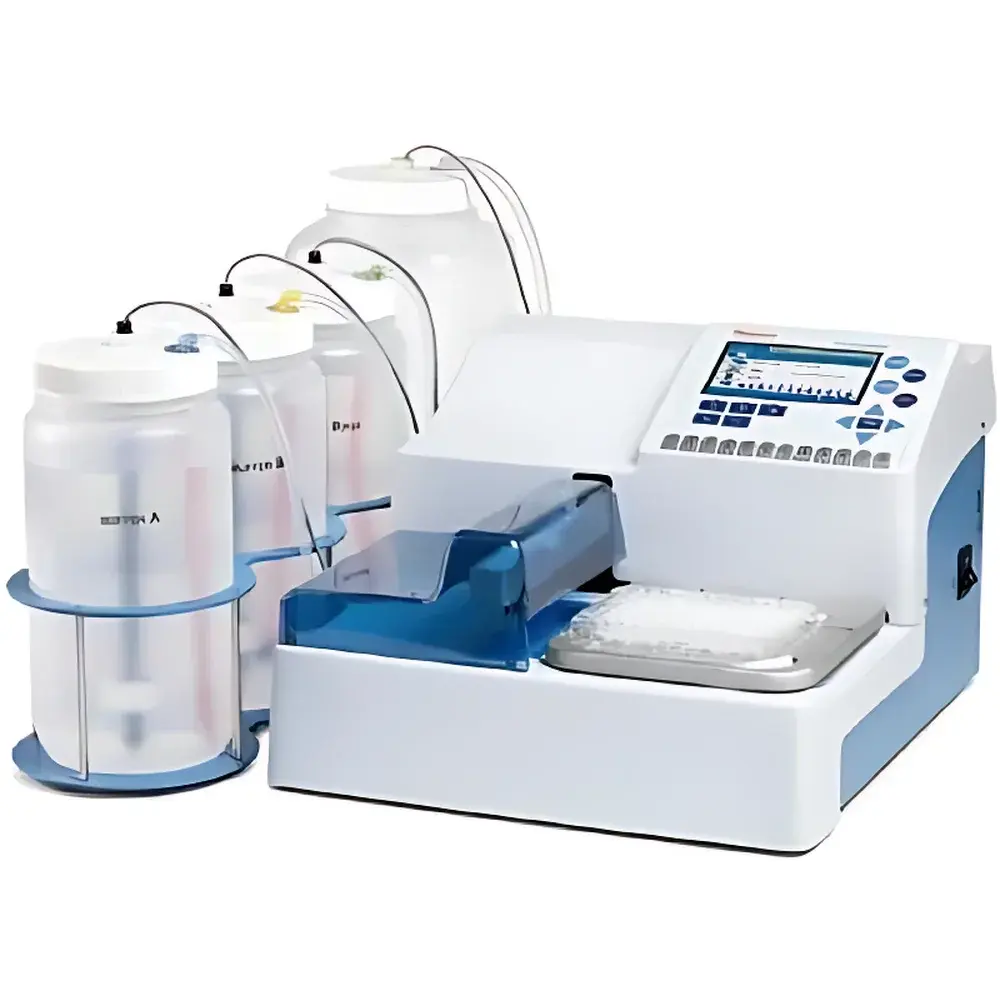
Thermo Fisher Scientific Wellwash Plate Washer
| Brand | Thermo Fisher Scientific |
|---|---|
| Origin | USA |
| Model | Wellwash |
| Voltage/Frequency | 100–240 V, 50/60 Hz |
| Wash Head Options | 1×8 or 1×12 configuration |
| Waste & Wash Bottle Capacity | Standard 2 L (optional 4 L square/cylindrical bottles) |
| Liquid Level Sensors | Integrated for wash/waste bottles and microplate presence |
| Aerosol Cover | Included (N10815) |
| Oscillation | Linear shaking function |
| Software Languages | 8 (English, Chinese, French, German, Spanish, Portuguese, Russian, Japanese) |
| Data Transfer | USB flash drive support for protocol export/import, firmware updates, and log/report download |
| Compliance | Designed for GLP/GMP environments |
Overview
The Thermo Fisher Scientific Wellwash Plate Washer is a benchtop automated plate washer engineered for precision, reproducibility, and operational safety in ELISA, cell-based assays, and other microplate-based immunoassay workflows. Utilizing positive-pressure fluid delivery and gravity-assisted aspiration, the system achieves consistent, low-residual washing across 96-well and 384-well microplates. Its core architecture follows the principle of controlled liquid displacement—where calibrated wash cycles, programmable soak times, and linear plate oscillation synergistically minimize carryover and maximize removal efficiency of unbound reagents. Designed for routine use in academic core facilities, clinical diagnostics labs, and pharmaceutical QC environments, the Wellwash delivers robust performance without requiring specialized engineering oversight.
Key Features
- Intuitive color touchscreen interface with context-sensitive on-screen help and eight-language software localization (including English, German, Spanish, and Japanese) for global lab deployment.
- Color-coded tubing connectors and plug-and-play liquid level sensor cables enable rapid installation and error-free setup—typically completed in under 15 minutes.
- Modular wash head design allows tool-free exchange between 1×8 and 1×12 configurations to accommodate standard flat-bottom, U-bottom, and V-bottom plates.
- Non-pressurized wash and waste bottle system eliminates risk of siphoning, pump backflow, or overpressure-related failure—enhancing long-term reliability and reducing service interventions.
- Integrated plate presence sensor prevents unintended operation and ensures wash cycle initiation only when a microplate is correctly seated.
- Standard aerosol cover (part N10815) mitigates biohazard dispersion during aspiration, supporting biosafety level 2 (BSL-2) compliance in infectious disease research settings.
- Automated post-run maintenance routines—including timed auto-rinse and periodic pre-wash—prevent crystallization, salt buildup, and tubing occlusion between uses.
Sample Compatibility & Compliance
The Wellwash accommodates ANSI/SLAS-standard microplates (96-well and 384-well formats), including polypropylene, polystyrene, and low-binding surfaces. It supports common assay chemistries such as horseradish peroxidase (HRP) and alkaline phosphatase (AP) conjugates without cross-contamination risk. From a regulatory standpoint, the instrument’s event-logged operation—including timestamps for wash cycle start/end, user login, parameter changes, and maintenance alerts—supports adherence to FDA 21 CFR Part 11 requirements when paired with appropriate laboratory information management system (LIMS) integration. Its mechanical design conforms to IEC 61010-1 safety standards for electrical equipment used in laboratory environments. Routine calibration verification can be performed using gravimetric residual volume assessment per ISO 20387:2018 (biobanking) and CLSI EP29-A guidelines.
Software & Data Management
The embedded firmware provides full protocol programming capability—including customizable wash volumes (50–400 µL/well), aspiration speed, soak duration (0–10 min), number of cycles (1–10), and linear oscillation amplitude/frequency. All protocols are stored internally and transferable via USB flash drive—enabling secure, offline synchronization across multiple instruments within a shared lab network. Firmware updates, usage logs, and cycle reports (CSV-formatted) are exportable for internal QA review or external audit preparation. No cloud connectivity or vendor-hosted accounts are required, preserving data sovereignty and simplifying IT validation.
Applications
The Wellwash serves critical roles in high-throughput ELISA development, serological screening, cytokine profiling, receptor-ligand binding assays, and antibody titer quantification. Its low residual volume (<2 µL/well after final aspiration, verified gravimetrically) directly contributes to reduced background noise in colorimetric and chemiluminescent detection systems—thereby improving signal-to-noise ratios and assay Z′-factors. In regulated environments, its repeatable performance supports method validation per ICH Q2(R2) and supports stability-indicating wash steps in release testing of biologics.
FAQ
Does the Wellwash support 384-well plates?
Yes—when equipped with the optional 1×12 wash head (part N10801) and compatible plate carrier, it performs full-plate washing on ANSI/SLAS-compliant 384-well microplates.
Can wash parameters be locked to prevent unauthorized changes?
Yes—user access levels (Operator, Supervisor, Administrator) allow parameter editing restrictions and password-protected protocol modification.
Is the instrument compatible with third-party wash bottles?
Yes—the N10820 User Bottle Bracket enables secure mounting of non-Thermo wash/waste containers, provided they meet dimensional and cap-thread specifications.
What maintenance is required beyond daily rinsing?
Quarterly inspection of tubing elasticity, aspiration tip alignment, and sensor calibration verification is recommended; no scheduled pump replacement is specified in the manufacturer’s service manual.
Does the Wellwash generate electronic records suitable for FDA audit?
Yes—internal event logs include operator ID, timestamp, protocol name, cycle count, and error codes; these may be exported and archived as part of a validated electronic record system per 21 CFR Part 11 Annex 11 guidance.




