
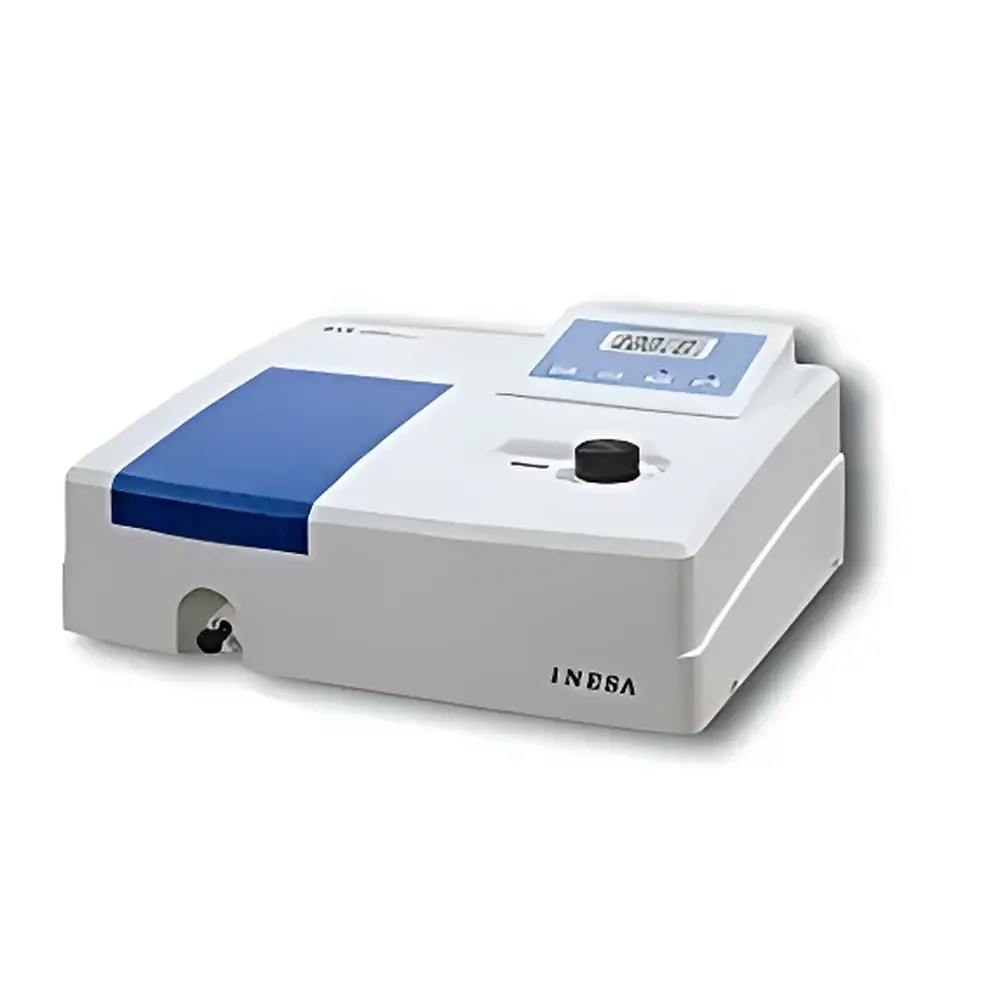
Jihepu 721G-100 Portable Visible-NIR Spectrophotometer
| Brand | Jihepu |
|---|---|
| Origin | Shandong, China |
| Model | 721G-100 |
| Wavelength Range | 340–1000 nm |
| Wavelength Accuracy | ±2 nm |
| Wavelength Repeatability | ≤1 nm |
| Photometric Accuracy (Transmittance) | ±0.5% T |
| Photometric Repeatability | ≤0.2% T |
| Spectral Bandwidth | 5 nm |
| Stray Light | ≤0.5% T (at 360 nm, measured with NaNO₂) |
| Detector | Silicon photodiode |
| Display | Backlit LCD |
| Sample Compartment | Accommodates up to 10 cm pathlength cuvettes |
| Data Output | RS-232 interface (optional serial printer support) |
| Software Compatibility | UVWin7 (sold separately) |
Overview
The Jihepu 721G-100 Portable Visible-NIR Spectrophotometer is a benchtop single-beam instrument engineered for quantitative and qualitative analysis in the visible to near-infrared spectral region (340–1000 nm). It operates on the fundamental principle of molecular absorption spectroscopy: analytes absorb specific wavelengths of electromagnetic radiation in proportion to their concentration and molar absorptivity, as described by the Beer–Lambert law. Designed for routine laboratory use, the 721G-100 delivers reliable absorbance (A) and transmittance (%T) measurements with high photometric linearity and optical stability. Its extended wavelength range—beyond standard visible instruments (typically 350–800 nm)—enables broader application coverage, including low-absorbance measurements in dilute solutions where longer pathlengths (up to 10 cm) are required. The instrument employs a Czerny–Turner monochromator architecture with a holographic blazed grating, ensuring consistent spectral resolution and minimized stray light—critical for accurate low-concentration determinations in industrial process control and environmental monitoring.
Key Features
- Single-beam optical design with high-stability tungsten-halogen lamp source and silicon photodiode detector
- Holographic blazed grating monochromator delivering 5 nm spectral bandwidth and ≤0.5% stray light at 360 nm (measured per NaNO₂ method)
- Backlit LCD display with intuitive menu navigation for direct %T, A, and concentration readouts
- Microprocessor-controlled system supporting automatic zeroing (%0 T) and full-scale calibration (%100 T), eliminating manual alignment drift
- Extended sample compartment accommodating standard 10 mm, 20 mm, 50 mm, and 100 mm pathlength cuvettes—optimized for low-absorbance applications in sugar refining, power plant water chemistry, and municipal wastewater analysis
- RS-232 serial interface for external data logging; compatible with optional dot-matrix or thermal serial printers
- Concentration factor programming and linear calibration curve storage for up to 10 user-defined standards
Sample Compatibility & Compliance
The 721G-100 accepts standard rectangular quartz, glass, or plastic cuvettes with pathlengths from 10 mm to 100 mm, enabling direct measurement of samples with absorbance values as low as 0.02 AU without dilution or signal averaging. Its optical performance meets core requirements outlined in ASTM E275 (Standard Practices for Describing and Measuring Performance of Ultraviolet, Visible, and Near-Infrared Spectrophotometers) and ISO 6223 (Water quality — Determination of nitrate nitrogen — Spectrophotometric method using brucine). While not FDA 21 CFR Part 11–compliant out-of-the-box (as it lacks electronic audit trail and user authentication), the instrument supports GLP/GMP-aligned workflows when paired with UVWin7 software (sold separately), which provides data export in CSV/Excel format, calibration history logs, and user-accessible method templates.
Software & Data Management
The 721G-100 operates autonomously via its onboard microcontroller but integrates with the optional UVWin7 PC-based software suite. UVWin7 enables advanced spectral scanning, kinetic time-course analysis, multi-wavelength quantitation, and generation of calibration curves with regression statistics (linear, quadratic, or polynomial fit). Raw absorbance and transmittance data are timestamped and exportable in ASCII-compatible formats for traceability in regulated environments. All instrument settings—including wavelength, mode (A/%T/C), zero/reference point, and concentration factor—are retained in non-volatile memory across power cycles. No internal data storage is provided; data persistence relies on external logging via serial connection or manual recording.
Applications
- Clinical laboratories: Quantification of hemoglobin derivatives, bilirubin, and enzyme-linked immunoassay (ELISA) endpoints
- Environmental testing: Measurement of nitrate, phosphate, ammonia, and COD in surface and wastewater per APHA Standard Methods
- Industrial QA/QC: Sugar concentration (Brix) in cane/beet processing using 10 cm cells; iron corrosion inhibitor monitoring in boiler feedwater
- Academic teaching: Fundamental spectroscopy experiments, Beer’s law validation, and kinetics studies in undergraduate chemistry curricula
- Petrochemical analysis: Color number determination (ASTM D1500) and oxidation stability assessment of lubricants
FAQ
What is the maximum pathlength supported by the 721G-100 sample chamber?
The instrument accommodates cuvettes up to 100 mm (10 cm) in optical pathlength, enabling high-sensitivity detection of low-concentration analytes without signal amplification.
Does the 721G-100 comply with ISO or ASTM standards for spectrophotometer validation?
Its optical specifications—including wavelength accuracy (±2 nm), photometric repeatability (≤0.2% T), and stray light performance (≤0.5% T)—align with acceptance criteria in ASTM E275 and ISO 6223 for routine verification procedures.
Is UVWin7 software included with the instrument?
No. UVWin7 is an optional, separately licensed software package that must be purchased to enable spectral scanning, data plotting, and advanced calibration functions.
Can the 721G-100 perform kinetic measurements?
Kinetic analysis is only available when used with UVWin7 software; the standalone instrument supports static endpoint measurements only.
What type of lamp does the 721G-100 use?
It utilizes a long-life tungsten-halogen lamp optimized for stable output across the 340–1000 nm range, with no deuterium or LED-based UV extension.





