
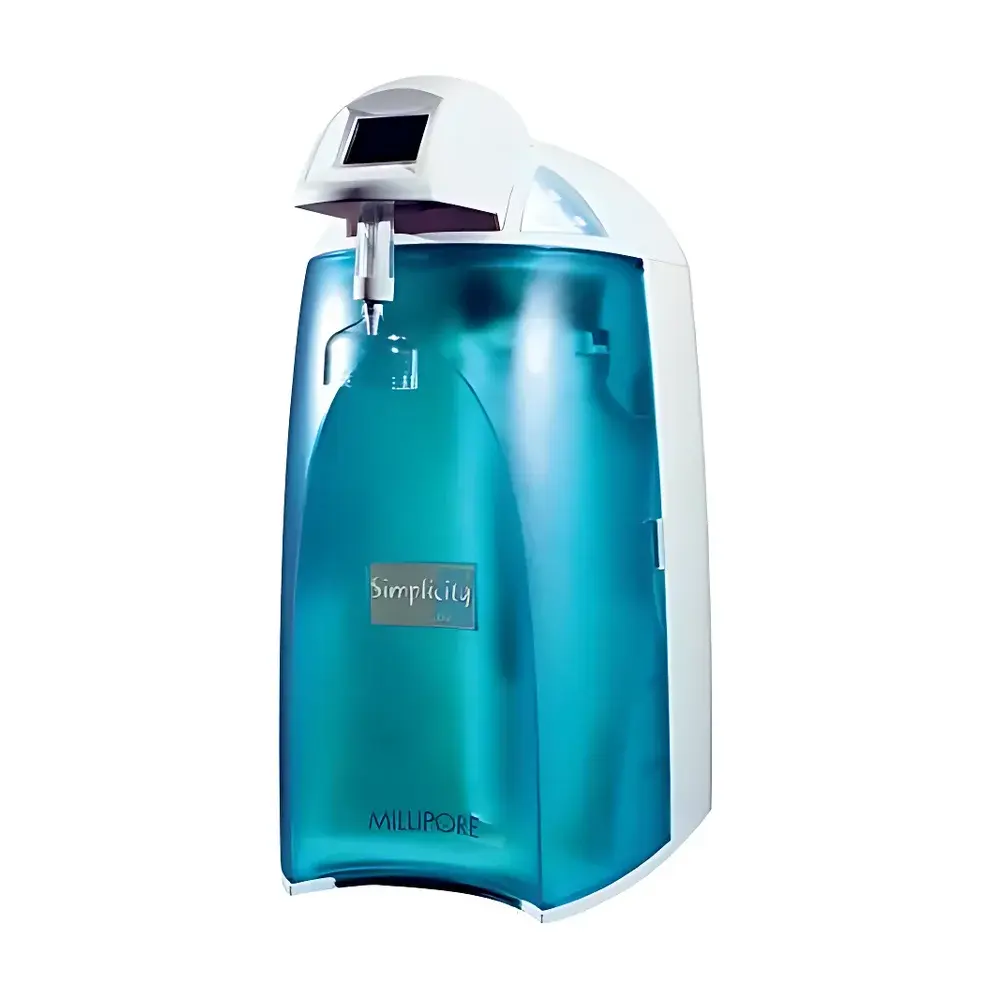
Millipore Simplicity Ultra Pure Water System
| Brand | Millipore |
|---|---|
| Origin | France |
| Model | Simplicity |
| UV Option | Optional dual-wavelength (185 nm & 254 nm) UV lamp |
| Resistivity | 18.2 MΩ·cm @ 25°C |
| TOC | <15 ppb (standard), <5 ppb (with UV) |
| Particles (>0.05 µm) | <1/mL |
| Microbial count | <0.1 CFU/mL |
| Endotoxins | <0.001 EU/mL |
| RNase | <0.01 ng/mL |
| Flow rate | >0.5 L/min |
| Internal reservoir | 2 L |
| Dimensions (L×W×H) | 36 × 29 × 51 cm |
| Weight (dry, no UV) | 4.9 kg |
| Weight (dry, with UV) | 5.4 kg |
| Operating weight (full reservoir, no UV) | 8.4 kg |
| Operating weight (full reservoir, with UV) | 9.0 kg |
| Power supply | 100–230 V, 50–60 Hz |
Overview
The Millipore Simplicity Ultra Pure Water System is a compact, benchtop-grade water purification platform engineered to deliver Type I ultrapure water (ASTM D1193-20 and ISO 3696:1987 Grade 1) from pretreated feed water—such as reverse osmosis (RO), deionized (DI), or distilled water. It employs a multi-stage purification architecture integrating ion exchange, activated carbon adsorption, and optional dual-wavelength ultraviolet oxidation (185 nm + 254 nm) to achieve stringent purity benchmarks required for sensitive analytical and life science applications. Unlike centralized systems, Simplicity operates independently of plumbing infrastructure, drawing from its integrated 2 L reservoir—a design feature that supports flexible placement in confined lab spaces and ensures uninterrupted operation during temporary feed water interruptions. Its core function is not merely water production, but consistent, on-demand delivery of water meeting the electrochemical, chromatographic, and molecular biology performance thresholds defined by USP , CLSI EP21-A, and ISO/IEC 17025-accredited laboratories.
Key Features
- On-demand generation of Type I ultrapure water (18.2 MΩ·cm @ 25°C) without permanent plumbing or dedicated utility lines
- Modular, field-replaceable purification cartridges—including SimFilter and optional BioPak ultrafiltration modules—for end-point removal of endotoxins (<0.001 EU/mL), RNase (<0.01 ng/mL), and microorganisms (<0.1 CFU/mL)
- Optional integrated dual-wavelength UV lamp (185 nm + 254 nm) reducing total organic carbon (TOC) to <5 ppb—critical for HPLC mobile phase preparation, GC carrier gas humidification, and TOC instrument calibration
- Intuitive color graphical display showing real-time resistivity, TOC (when equipped), reservoir level, cartridge status, UV lamp life, and system temperature
- Automated periodic recirculation cycle maintaining water quality stability within the reservoir and distribution path
- Height- and geometry-optimized dispensing spout compatible with standard volumetric flasks, beakers, and narrow-necked glassware
- Self-diagnostic alerts triggered by resistivity deviation, low reservoir level, or cartridge exhaustion—ensuring continuous compliance with water quality specifications
Sample Compatibility & Compliance
The Simplicity system is validated for compatibility with common pretreatment sources: Elix®-grade water, RO permeate, distilled water, and laboratory-grade DI water. Its output meets or exceeds international standards for ultrapure water used in regulated environments, including ASTM D1193-20 (Type I), ISO 3696:1987 (Grade 1), CLSI EP21-A (for analytical reagent water), and USP (Purified Water and Water for Injection specifications). While Simplicity itself is not a GMP-certified manufacturing system, its documented performance metrics—including endotoxin, RNase, and particle counts—support use in GLP-compliant research, QC testing, and pre-analytical sample preparation under FDA 21 CFR Part 11–aligned data management protocols when paired with appropriate audit trail software.
Software & Data Management
Simplicity operates via embedded firmware with no external PC dependency. All operational parameters—including resistivity history, reservoir fill cycles, cartridge usage time, and UV lamp operating hours—are stored locally and displayed in chronological sequence on the color interface. The system logs timestamped events (e.g., “Cartridge replaced”, “UV lamp reset”) with automatic retention for ≥12 months. While it does not include native network connectivity or cloud export, its event log structure is compatible with manual CSV extraction via USB export (optional accessory) and integration into laboratory information management systems (LIMS) via standardized ASCII output protocols. This architecture satisfies basic ALCOA+ principles (Attributable, Legible, Contemporaneous, Original, Accurate) for non-critical water quality documentation.
Applications
- HPLC and UHPLC mobile phase and blank preparation where low TOC and silica leaching are critical
- UV-Vis and fluorescence spectrophotometry requiring minimal background absorbance at 254 nm and 190 nm
- Electrochemical assays sensitive to trace ions (e.g., chloride, sodium) and redox-active organics
- Preparation of cell culture media, PCR reagents, and electrophoresis buffers demanding endotoxin- and RNase-free water
- Calibration of TOC analyzers and trace metal analysis (ICP-MS, AAS) using sub-ppt contamination control
- Routine labware rinsing where residual organics or cations could interfere with subsequent assays
FAQ
What feed water quality is required for optimal Simplicity performance?
Simplicity requires pretreated water with resistivity ≥0.05 MΩ·cm (i.e., ≤20 µS/cm conductivity), typically supplied by RO, Elix®, or distillation systems. Feed water exceeding 50 ppm total dissolved solids (TDS) or containing high chlorine/chloramine levels will reduce cartridge service life.
Can Simplicity be connected to a permanent water line?
No—the system is designed exclusively for reservoir-based operation. Direct line connection voids warranty and compromises safety interlocks governing reservoir overfill and dry-run protection.
How often must the purification cartridge be replaced?
Under typical usage (≤5 L/day), replacement frequency ranges from 6 to 12 months, depending on feed water quality and resistivity decay profile. The system triggers visual and audible alerts when resistivity falls below 17.5 MΩ·cm.
Is the BioPak ultrafilter certified for sterile filtration?
BioPak is rated for 0.22 µm retention and validated for endotoxin and RNase reduction—not for sterility assurance per ISO 11140 or pharmacopeial microbial challenge tests. It is intended for final polishing, not terminal sterilization.
Does Simplicity comply with FDA 21 CFR Part 11 requirements?
The base unit lacks electronic signature capability and audit trail export functionality. However, its deterministic event logging, tamper-resistant timestamps, and parameter lockout features enable alignment with Part 11 Annex 11 expectations when deployed within a validated procedural framework and supported by SOP-controlled manual recordkeeping.



