
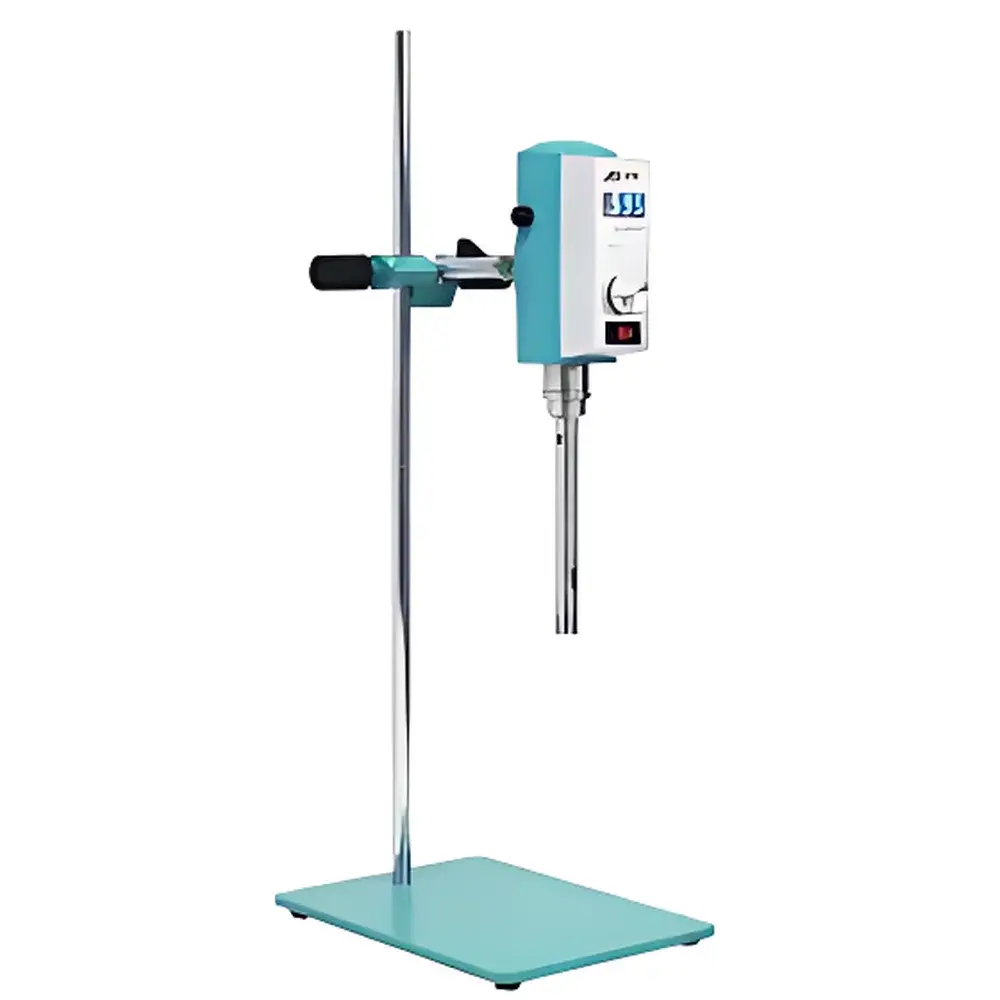
Jihepu AD200L-H Laboratory High-Shear Homogenizer
| Brand | Jihepu |
|---|---|
| Origin | Shandong, China |
| Manufacturer Type | Authorized Distributor |
| Instrument Type | Probe-Type Rotor-Stator Homogenizer |
| Dimensions (W×D×H) | 215 × 310 × 720 mm |
| Speed Range (No-Load) | 2000–21000 rpm |
| Input Power | 280 W |
| Output Power | 200 W |
| Rated Torque | 8.3 N·cm |
| Working Head Material | SS304 Stainless Steel |
| Standard Working Heads | 12G & 18G |
| Max. Viscosity Handling | 1000–2000 mPa·s |
| Max. Operating Temperature | 120 °C |
| Ambient Temperature Limit | ≤40 °C |
| Relative Humidity Limit | ≤80 % |
| Net Weight | 8.3 kg |
| Gross Weight | 10.0 kg |
Overview
The Jihepu AD200L-H Laboratory High-Shear Homogenizer is a precision-engineered rotor-stator system designed for reproducible dispersion, emulsification, homogenization, and particle size reduction in small-to-medium volume samples (30–1500 mL). It operates on the principle of high-frequency mechanical shear generated by the relative motion between a rapidly rotating rotor and a fixed stator within a narrow annular gap. This configuration produces intense hydrodynamic forces—including radial acceleration, turbulent flow, cavitation, and interfacial shear—enabling efficient breakdown of immiscible phases (e.g., oil-in-water or water-in-oil emulsions), disruption of cellular structures, and deagglomeration of suspended particles. Unlike ultrasonic or valve-based systems, the AD200L-H delivers consistent energy input across variable viscosities without thermal runaway or probe erosion, making it suitable for both aqueous and moderately viscous non-Newtonian formulations encountered in formulation development and quality control workflows.
Key Features
- Digitally controlled, stepless speed regulation from 2000 to 21000 rpm with real-time RPM display (resolution: ±10 rpm) and dynamic speed feedback for load compensation.
- Dual-standard interchangeable working heads (12G and 18G) engineered for distinct throughput and shear intensity profiles: the 12G head supports 30–800 mL volumes with up to 1000 mPa·s viscosity and 11 m/s tip speed; the 18G head handles 50–1500 mL at up to 2000 mPa·s and 15 m/s tip speed.
- Robust SS304 stainless steel construction for all wetted parts, including rotor, stator, and shaft—ensuring chemical compatibility with common solvents, surfactants, and pH-adjusted media used in pharmaceutical, cosmetic, and food applications.
- PTFE-coated bearings provide low-friction rotational stability and resistance to moisture ingress, supporting reliable operation under intermittent duty cycles (S2-5 min rating).
- Integrated safety functions include electronic torque overload protection, automatic shutdown upon stall detection, and memory retention of last-used speed and timer settings.
- Programmable digital timer (1–1000 min) enables unattended batch processing while maintaining traceability of operational parameters.
Sample Compatibility & Compliance
The AD200L-H accommodates a broad range of sample types—including suspensions, pastes, gels, and biphasic liquids—with viscosity tolerance up to 2000 mPa·s and thermal stability to 120 °C. Its design aligns with fundamental requirements for laboratory-scale process simulation per ISO 13320 (laser diffraction particle sizing) and ASTM D2794 (coating dispersion testing). While not certified to IEC 61000-6-2/6-4 or CE for full industrial deployment, the unit meets essential electrical safety standards for Class I laboratory equipment (IEC 61010-1) and supports GLP-compliant documentation when paired with external audit-trail-enabled data loggers. All wetted surfaces comply with USP extractables guidance for stainless steel components used in non-sterile pharmaceutical manufacturing environments.
Software & Data Management
The AD200L-H operates as a standalone instrument with no embedded software stack or network interface. However, its analog-compatible speed and timer outputs permit integration with third-party data acquisition systems via 0–10 V or 4–20 mA signal conditioning modules. Users may record operational metadata—including setpoint speed, elapsed time, and activation timestamp—using external LIMS or ELN platforms. For regulatory environments requiring electronic records, the device supports 21 CFR Part 11 compliance when operated under procedural controls that mandate manual entry of run parameters into validated systems, with operator authentication and version-controlled SOPs governing usage protocols.
Applications
- Pharmaceutical R&D: Preparation of topical emulsions (e.g., corticosteroid creams), nanostructured lipid carriers (NLCs), and microemulsion preconcentrates prior to lyophilization or fill-finish validation.
- Personal Care Formulation: Development of stable O/W sunscreens, silicone-free conditioners, and fragrance-loaded microcapsules requiring submicron droplet distribution.
- Food Science: Homogenization of plant-based dairy alternatives, enzymatic hydrolysate suspensions, and heat-sensitive flavor emulsions where minimal thermal degradation is critical.
- Materials Chemistry: Exfoliation of graphene oxide dispersions, carbon nanotube suspension stabilization, and pigment dispersion in solvent-borne coating bases.
- Academic Research: Cell lysis optimization for proteomics, bacterial membrane disruption studies, and rheological benchmarking of shear-thinning model fluids.
FAQ
What is the minimum immersion depth required for the 18G working head?
The 18G head requires a minimum liquid depth of 45 mm and a total immersion height of 150 mm to ensure full engagement of the rotor-stator zone and prevent vortex formation or air entrainment.
Can the AD200L-H be used for sterile processing?
No—the device is not autoclavable or designed for aseptic operation. Wetted components may be cleaned with ethanol or sodium hypochlorite solutions and dried thoroughly, but sterility must be achieved downstream via filtration or terminal sterilization.
Is continuous operation supported?
The motor is rated for intermittent duty (S2-5 min), meaning sustained operation beyond 5 minutes requires ≥10-minute cooldown intervals to prevent thermal derating or bearing fatigue.
Does the unit support external footswitch control?
No native footswitch interface is provided; however, the start/stop function can be externally triggered via dry-contact relay input if integrated with a programmable logic controller (PLC) or custom control panel.
How is calibration verified for speed accuracy?
Speed calibration is performed using a non-contact optical tachometer traceable to NIST standards. Users should verify displayed RPM against measured values annually or after any mechanical service involving the motor encoder assembly.



