
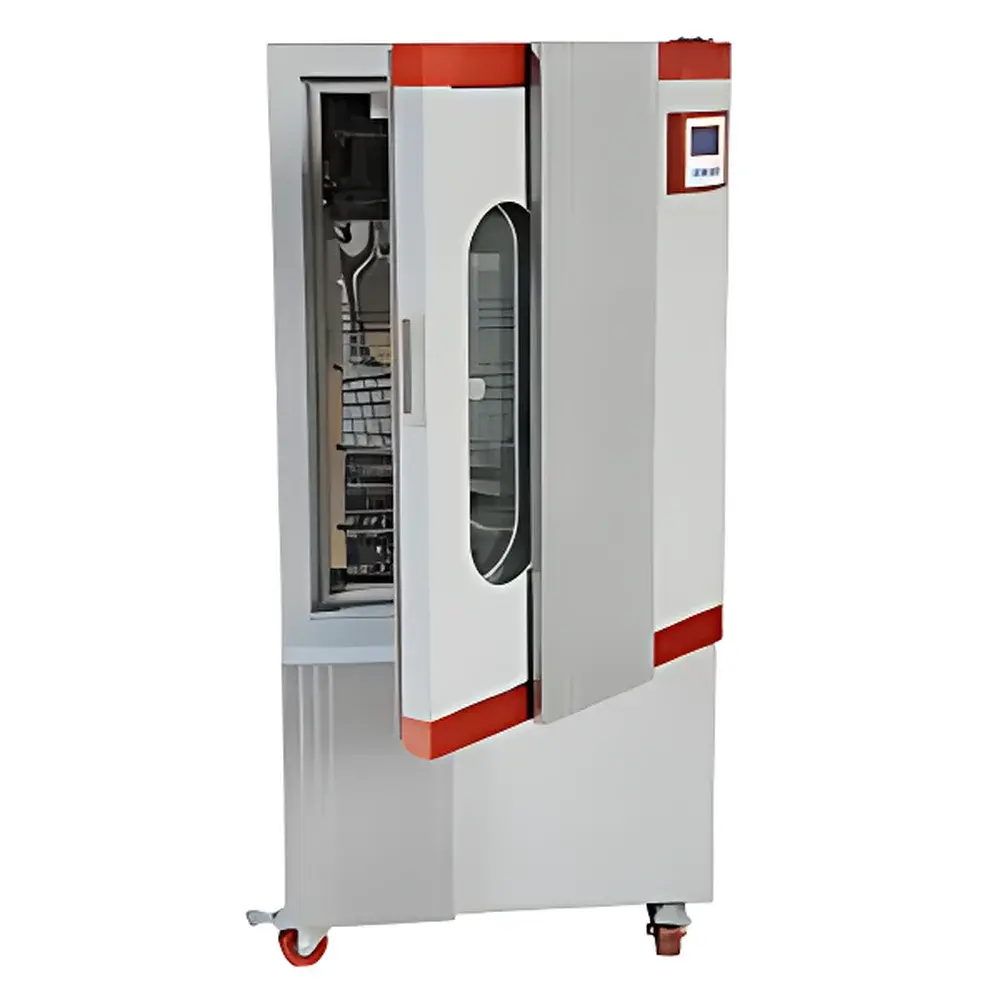
Jihepu BSP-250 Biochemical Incubator
| Brand | Jihepu |
|---|---|
| Model | BSP-250 |
| Temperature Range | 0°C to 60°C |
| Temperature Resolution | 0.1°C |
| Temperature Uniformity | ±1°C |
| Temperature Fluctuation | ±0.5°C |
| Input Power | 1100 W |
| Timer Range | 0–9999 minutes |
| Interior Dimensions (W×D×H) | 510 × 450 × 1090 mm |
| Exterior Dimensions (W×D×H) | 650 × 740 × 1726 mm |
| Shelving | 4 adjustable stainless steel shelves |
| Refrigerant | Eco-friendly non-CFC refrigerant |
| Compressor | Internationally certified hermetic compressor |
| Interface | RS-485 for PC connectivity |
| Programmable Cycles | 10 segments × 99 cycles |
| Power Failure Recovery | Yes, with parameter retention |
Overview
The Jihepu BSP-250 Biochemical Incubator is a precision-engineered, microprocessor-controlled environmental chamber designed for stable, long-term cultivation and preservation of biological samples under tightly regulated thermal conditions. It operates on a forced-air convection principle, utilizing an optimized dual-channel air circulation system with centrifugal blower and patented multi-directional wind duct architecture to ensure rapid thermal equilibration and exceptional temperature homogeneity across the entire working chamber. The unit integrates a hermetically sealed, high-efficiency compressor and environmentally compliant non-CFC refrigerant, enabling reliable sub-ambient operation down to 0°C while maintaining energy efficiency and operational safety. Its fully insulated chamber—constructed with cold-rolled steel exterior and mirror-finish 304 stainless steel interior—supports GLP-compliant workflows in academic, pharmaceutical, environmental, and clinical research laboratories.
Key Features
- Intelligent microcomputer control system with backlit LCD interface for real-time monitoring of temperature, elapsed time, and programmable cycle status
- Dual-door observation window with independent inner and outer seals minimizes thermal disturbance during sample inspection
- Modular shelving system: four corrosion-resistant, height-adjustable stainless steel trays accommodate varied vessel configurations (e.g., Petri dishes, flasks, culture bottles)
- Patented integrated refrigeration module with auto-defrost functionality—designed to eliminate ice buildup without interrupting temperature stability or requiring manual intervention
- Dedicated fresh-air inlet valve (30 mm ID / 60 mm OD) enables controlled ventilation for aerobic cultures or CO₂-sensitive applications
- Comprehensive safety architecture: over-temperature alarm with audible/visual alert, compressor overload protection, and automatic restart after power recovery with full parameter retention
- RS-485 serial interface supports bidirectional communication with laboratory data acquisition systems or centralized monitoring software
Sample Compatibility & Compliance
The BSP-250 accommodates standard microbiological, botanical, and biochemical sample formats—including agar plates, liquid broth cultures, seedlings, and enzymatic assay kits—within its 250 L effective chamber volume. Its temperature stability (±0.5°C fluctuation) and uniformity (±1°C across all shelf levels) meet the performance criteria outlined in ISO 13408-2 (aseptic processing), ASTM E171 (environmental chamber specifications), and USP for stability-indicating incubation environments. The non-CFC refrigerant complies with Montreal Protocol requirements, and the electrical design conforms to IEC 61010-1 for laboratory equipment safety. Optional GPRS alarm modules support 21 CFR Part 11–aligned remote event logging when integrated with validated LIMS platforms.
Software & Data Management
While the BSP-250 operates as a standalone instrument, its RS-485 port enables seamless integration into networked lab infrastructures via Modbus RTU protocol. When connected to compatible data loggers or SCADA systems, users can configure automated temperature profiling, generate time-stamped audit trails, and export CSV-formatted datasets for statistical process control (SPC) analysis. Optional accessories—including thermal printer modules (supporting real-time curve printing), GPRS-enabled SMS alert transceivers, and PC-based supervisory software—extend traceability capabilities for QA/QC documentation. All firmware updates are performed via secure serial upload, preserving configuration integrity and supporting periodic verification per ISO/IEC 17025 calibration management protocols.
Applications
This incubator serves critical roles in BOD₅ testing per EPA Method 405.1, microbial enumeration (ISO 4833-1), fungal growth assessment (ASTM D3273), algal toxicity screening, plant tissue culture initiation, and enzyme activity assays requiring precise thermal control. Its wide operating range (0–60°C) supports both psychrophilic and thermophilic organism studies, while the optional fresh-air modulation allows adaptation for facultative anaerobe maintenance or volatile compound mitigation during extended incubations. Regulatory laboratories use the BSP-250 for method validation studies under GLP conditions, particularly where uninterrupted operation over 72+ hours is required for sterility assurance testing.
FAQ
What is the minimum temperature achievable with the BSP-250?
The unit achieves a stable setpoint as low as 0°C, verified under ambient conditions ≤30°C and 60% RH. Performance at lower ambient temperatures may require additional environmental conditioning.
Can the incubator maintain humidity control?
No—this model is a dry-air biochemical incubator; humidity regulation is not integrated. For humidified applications, consider the companion BSP-H series with steam generator and RH sensor.
Is the RS-485 interface compatible with LabVIEW or Python-based control scripts?
Yes—standard Modbus RTU implementation enables native integration with LabVIEW’s Modbus I/O libraries and Python’s pymodbus package using appropriate USB-to-RS485 adapters.
How often does the auto-defrost cycle activate?
Defrosting occurs only when frost accumulation is detected by internal thermal sensors—typically every 48–120 hours depending on ambient humidity and door-opening frequency—ensuring minimal thermal perturbation.
Does the unit include factory calibration documentation?
Each unit ships with a NIST-traceable temperature verification report (performed at three points: 25°C, 37°C, and 55°C) and a Certificate of Conformance compliant with ISO 9001 manufacturing standards.



