
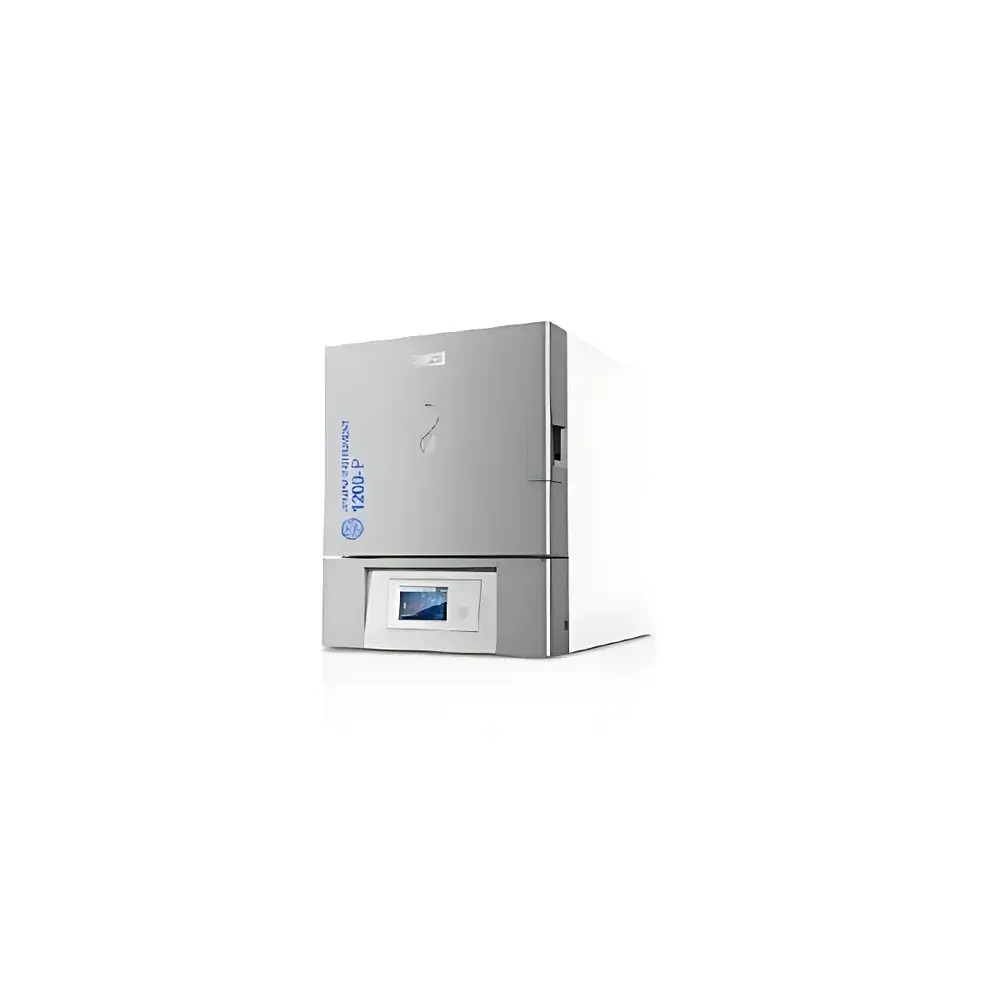
Jihepu GDP Series 1000°C Benchtop Box-Type Resistance Furnace (Muffle Furnace) SX2-2.5-10GDP
| Brand | Jihepu |
|---|---|
| Origin | Shandong, China |
| Model | SX2-2.5-10GDP |
| Instrument Type | Box-Type Muffle Furnace |
| Maximum Design Temperature | 1000°C |
| Recommended Operating Temperature | ≤900°C |
| Chamber Dimensions | 200 × 120 × 80 mm (2 L) |
| Heating Rate | 15°C/min |
| Temperature Control Accuracy | ±1°C |
| Thermocouple Type | K-type |
| Control System | 5-inch color touchscreen with bilingual (English/Chinese) interface |
| Programmable Ramp Segments | 1–40 |
| Power Supply | AC 220 V / 50 Hz |
| Rated Heating Power | 2.5 kW |
| Chamber Lining Material | Al₂O₃ (alumina ceramic) |
| Door Structure | Dual-layer insulated door with automatic power cutoff upon opening |
| Viewing Window | Integrated high-temperature quartz viewport |
| Compliance | Designed for GLP-compliant laboratory environments |
Overview
The Jihepu GDP Series SX2-2.5-10GDP is a benchtop box-type resistance furnace engineered for precise, repeatable high-temperature thermal processing in research and quality control laboratories. Operating on the principle of resistive Joule heating via embedded high-alumina heating elements, it delivers stable thermal profiles up to a design temperature of 1000°C — with recommended continuous operation at ≤900°C to ensure long-term element integrity and measurement reproducibility. Its compact 2-liter chamber (200 × 120 × 80 mm) supports standardized sample crucibles and small-scale thermal treatments including ashing, calcination, sintering, and pre-treatment of inorganic matrices prior to elemental analysis (e.g., AAS, ICP-OES). The furnace conforms to fundamental thermal safety and operational logic expected in ISO/IEC 17025-accredited labs, featuring dual-point temperature sensing, segmented programmable ramp/soak profiles, and hardware-level interlock mechanisms.
Key Features
- Integrated dual-door architecture: outer insulating door + inner high-temperature stainless-steel (304) sealing door, minimizing heat loss and enhancing operator safety.
- Automatic power cutoff circuit triggered by door opening — meets IEC 61000-4-11 immunity requirements for transient voltage tolerance during safety interlock activation.
- Alumina (Al₂O₃) fiber-reinforced refractory chamber lining: low thermal conductivity (<0.2 W/m·K at 800°C), excellent thermal shock resistance, and minimal outgassing under inert or air atmospheres.
- Front-mounted quartz observation window (high-purity fused silica, rated to 1000°C): enables real-time visual monitoring without compromising thermal stability or vacuum compatibility (when optionally equipped with purge fittings).
- 5-inch capacitive touchscreen HMI with configurable English/Chinese language support, password-protected parameter editing, and non-volatile storage of up to 40-segment temperature programs.
- Two independent K-type thermocouples (one for control, one for redundant monitoring): ensures traceable temperature verification and supports internal calibration logging per ASTM E220 protocols.
Sample Compatibility & Compliance
The SX2-2.5-10GDP accommodates standard ceramic crucibles (alumina, quartz, silicon carbide), platinum dishes, and stainless-steel boats — compatible with ASTM D3174 (ash content), ISO 1171 (determination of ash), and USP heavy metals testing workflows. Its uniformity profile (±5°C across chamber volume at 900°C, measured per ASTM C1040) satisfies routine QC validation requirements. While not certified for Class I Div 1 hazardous locations, the unit complies with CE marking directives (2014/35/EU Low Voltage Directive, 2014/30/EU EMC Directive) and incorporates grounding continuity protection per IEC 61000-6-3. For regulated environments, audit trails can be exported manually (CSV) to support FDA 21 CFR Part 11-aligned documentation practices when paired with validated external data loggers.
Software & Data Management
No proprietary PC software is bundled; all configuration and operation occur locally via the embedded touchscreen controller. Temperature programs are stored in non-volatile flash memory with timestamped version history (max. 9 user-defined recipes). Real-time setpoint/actual temperature curves are displayable on-screen with adjustable time scaling (1–60 min/div). Data export requires manual USB transfer of event logs (power-on/off, program start/stop, fault codes) — suitable for inclusion in laboratory notebooks or LIMS-integrated reporting. Optional RS485 Modbus RTU output (available on request) enables integration with SCADA systems for centralized thermal process monitoring in multi-furnace installations.
Applications
- Residue and ash determination in coal, biomass, polymers, and pharmaceutical excipients (per ISO 1171, ASTM D2974).
- Pretreatment of geological samples prior to XRF or fusion bead preparation.
- Thermal gravimetric analysis (TGA) sample conditioning and baseline stabilization.
- Heat treatment of metal powders and ceramic green bodies in materials development labs.
- Calibration of secondary temperature sensors using fixed-point reference materials (e.g., Zn, Al melting points) within defined uncertainty bands.
FAQ
What is the maximum continuous operating temperature?
The furnace is rated for continuous use up to 900°C. Operation at 1000°C is limited to short-duration calibration or qualification procedures only.
Can this furnace be used under inert gas atmosphere?
Yes — optional gas inlet/outlet ports (M6 threaded) can be factory-installed to enable nitrogen or argon purging; consult technical specifications for leak-rate limits and pressure rating.
Is temperature uniformity data available for validation?
A standard uniformity map (measured at 900°C per ASTM C1040 methodology) is provided in the installation qualification (IQ) package upon request.
Does the unit support remote monitoring via Ethernet or Wi-Fi?
No native Ethernet or wireless interface is included; RS485 Modbus RTU is the only digital communication option, requiring external gateway hardware for IP-based integration.
What maintenance intervals are recommended for heating elements and insulation?
Visual inspection every 200 operating hours; replacement of heating elements typically required after ≥5000 h at 900°C, depending on thermal cycling frequency and atmosphere conditions.



