
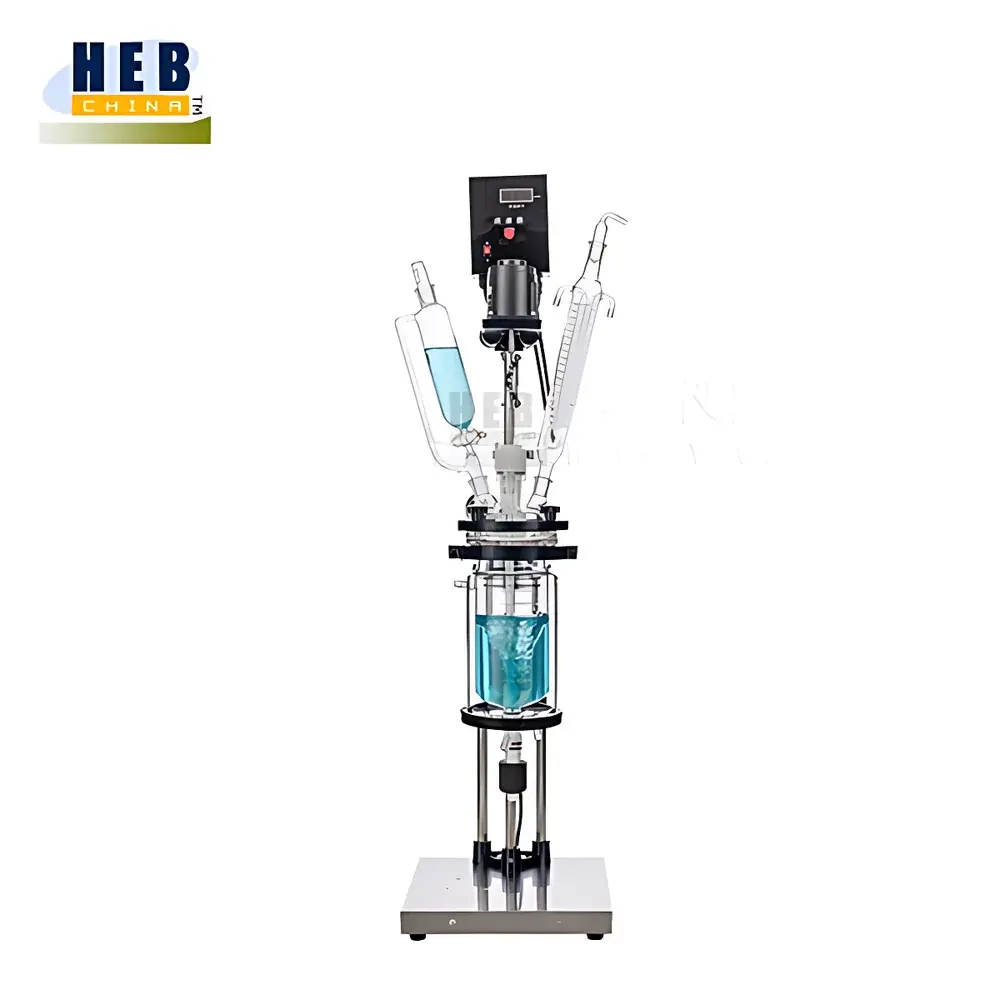
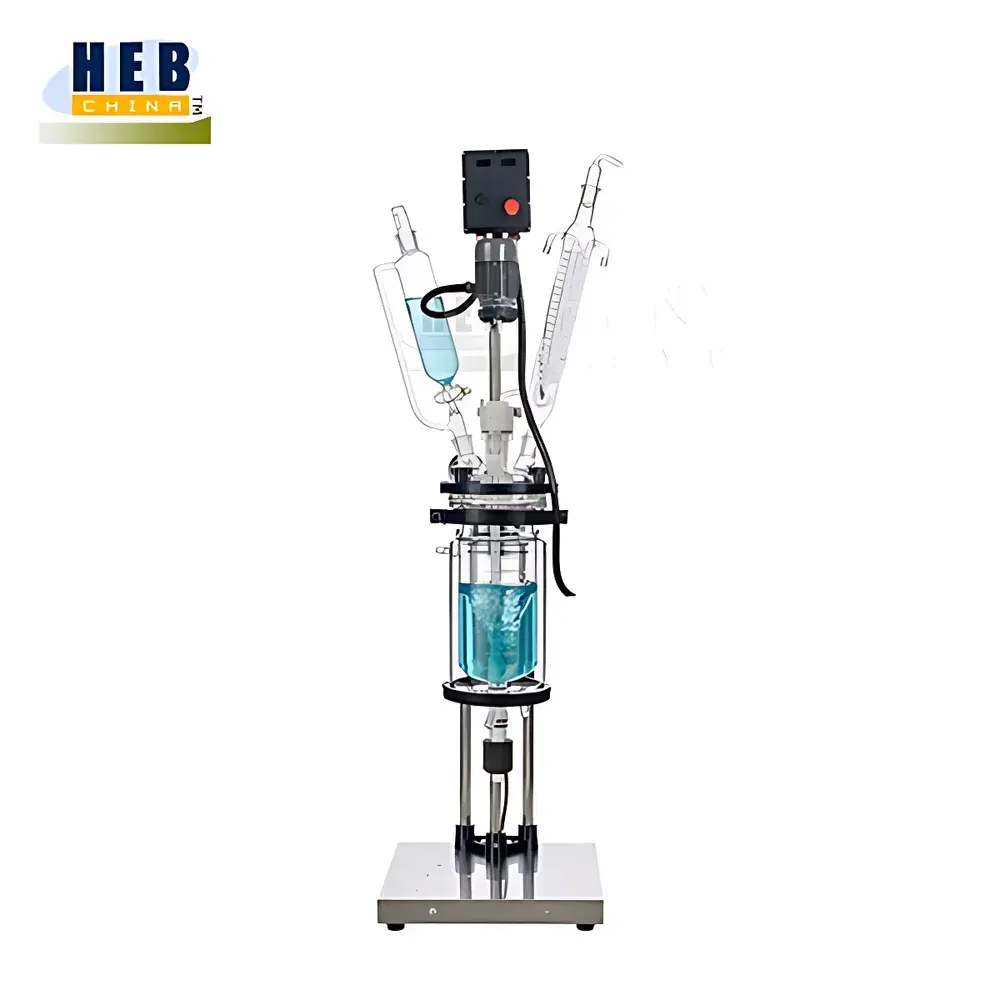
Jihepu HEB-2L Dual-Jacketed Glass Reactor
| Brand | Jihepu |
|---|---|
| Origin | Shandong, China |
| Model | HEB-2L |
| Capacity | 2 L |
| Working Pressure | Low-pressure |
| Vacuum Degree | 0.098 MPa |
| Temperature Range | −80 °C to 250 °C |
| Stirring Speed | 0–1100 rpm |
| Motor Power | 40 W |
| Voltage/Frequency | 220 V / 50 Hz |
| Jacket Volume | 0.5 L |
| Condenser Funnel Capacity | 250 mL |
| Lid Ports | 5-port |
| Stirrer Shaft Diameter | 10 mm |
| Discharge Height | 300 mm |
| Overall Dimensions (L×W×H) | 350 × 345 × 1000 mm |
| Packing Dimensions (L×W×H) | 1200 × 480 × 400 mm |
| Net Weight | 32 kg |
| Construction Material | GG-17 borosilicate glass |
| Sealing System | PTFE components + imported fluororubber gaskets |
| Drive Type | AC motor with digital speed display and stepless electronic speed control |
Overview
The Jihepu HEB-2L Dual-Jacketed Glass Reactor is a precision-engineered laboratory-scale reaction system designed for controlled synthesis, distillation, reflux, concentration, and phase separation under variable thermal and vacuum conditions. It operates on the principle of jacketed heat transfer: a circulating medium—such as silicone oil, glycol-water mixture, or chilled ethanol—is introduced into the annular space between the inner and outer walls of the GG-17 borosilicate glass vessel. This enables precise, uniform temperature regulation of the reaction mass—from cryogenic cooling at −80 °C to high-temperature heating up to 250 °C—while maintaining optical clarity for real-time visual monitoring. The reactor integrates a centrally mounted mechanical stirrer driven by a brushless AC motor, delivering stable torque output across its full 0–1100 rpm range without sparking or electromagnetic interference. Its low-pressure design supports operation under reduced pressure (down to 0.098 MPa absolute), facilitating solvent removal, azeotropic drying, and high-boiling-point compound handling. As a modular platform, it interfaces seamlessly with auxiliary equipment—including condensers, vacuum pumps, chiller units, and heating circulators—via standardized 10 mm and 12 mm push-fit ports.
Key Features
- GG-17 high-borosilicate glass vessel (DIN ISO 3585 compliant) ensures exceptional thermal shock resistance (ΔT ≥ 120 °C), chemical inertness against most organic solvents and mild acids/bases, and UV-transparent observation capability.
- Robust support frame fabricated from corrosion-resistant stainless steel (AISI 304) and anodized aluminum, engineered for long-term stability and vibration damping during extended stirring cycles.
- PTFE-coated stainless steel stirring shaft and impeller eliminate metal leaching; compatible with halogenated, acidic, and strongly coordinating media without cross-contamination.
- Imported fluororubber (FKM) O-rings and molded PTFE sealing components provide reliable vacuum integrity and extended service life under cyclic thermal and pressure stress.
- Digital electronic speed controller with LED rpm readout enables reproducible agitation profiles; fine-tuned adjustment via front-panel rotary encoder ensures consistent shear input across experiments.
- Five-port ground-glass lid accommodates simultaneous insertion of thermometer, addition funnel, condenser, nitrogen inlet, and vacuum line—supporting Schlenk-line-compatible inert-atmosphere protocols.
- Zero-dead-volume PTFE discharge valve with inclined seat geometry ensures complete, residue-free material evacuation—critical for quantitative yield determination and multi-step cascade reactions.
Sample Compatibility & Compliance
The HEB-2L is routinely deployed in synthetic organic chemistry, pharmaceutical process development, polymerization kinetics studies, and catalyst screening where transparency, thermal fidelity, and chemical compatibility are paramount. Its GG-17 construction meets ASTM E438 Type I, Class A specifications for laboratory glassware. Vacuum performance aligns with ISO 2859-1 sampling plans for leak integrity verification. While not certified for ASME BPVC Section VIII or PED 2014/68/EU compliance (as a non-pressurized Class I device per EN 13445-1), it conforms to general laboratory safety guidelines (e.g., ANSI Z9.5, ISO 15190) when operated within its rated temperature and vacuum envelope. Users performing GLP- or GMP-aligned workflows may integrate optional data loggers for temperature, pressure, and rpm traceability—supporting audit readiness under FDA 21 CFR Part 11 when paired with validated software.
Software & Data Management
The base unit operates as a stand-alone analog-digital hybrid system with no embedded firmware or network interface. For automated data acquisition, third-party DAQ systems (e.g., LabVIEW, MATLAB Data Acquisition Toolbox, or Omega iSeries loggers) can be connected via analog 0–10 V or 4–20 mA outputs (optional add-on). Real-time monitoring of jacket inlet/outlet temperatures, internal bath temperature (via Pt100 probe), and vacuum level (via analog-capable digital vacuum gauge) is feasible using external controllers. All mechanical adjustments—including speed setpoint, valve actuation, and port cap tightening—are manual and operator-verified, ensuring full procedural transparency and eliminating black-box algorithmic dependencies common in fully integrated reactors.
Applications
- Controlled exothermic/endothermic reaction monitoring in academic and industrial R&D labs.
- Solvent-free or low-solvent green synthesis under reduced pressure (e.g., esterifications, amidations, Suzuki couplings).
- Distillation and fractional reflux of heat-sensitive natural product extracts.
- Photochemical reactions requiring visible-light access through transparent walls.
- Small-batch crystallization trials with in situ cooling ramp control.
- Preparative-scale hydrolysis or saponification with continuous pH or conductivity monitoring via optional electrode ports.
FAQ
What is the maximum allowable operating pressure for the HEB-2L reactor?
The HEB-2L is rated for low-pressure operation only, with a maximum positive gauge pressure of 0.1 MPa (1 bar) and a minimum absolute vacuum of 0.098 MPa (≈20 mbar). It is not designed for pressurized hydrogenation or supercritical fluid applications.
Can the reactor be used with aggressive reagents such as bromine or fuming nitric acid?
While GG-17 glass exhibits broad chemical resistance, prolonged exposure to hot concentrated oxidizers (e.g., >70% HNO₃, Br₂ vapor, molten alkalis) may cause surface etching or stress cracking. Consult the Corning PYREX® Chemical Resistance Guide (Rev. 2022) before deployment.
Is the stirring system suitable for viscous polymer solutions?
Yes—the 40 W AC motor delivers sufficient torque for viscosities up to ~50,000 mPa·s at lower speeds (≤300 rpm); however, paddle or anchor impellers (not included) are recommended over standard propellers for non-Newtonian media.
How is temperature calibration performed?
Calibration requires external reference thermometers (e.g., NIST-traceable Pt100 probes) immersed directly in the reaction medium and jacket fluid; the reactor itself does not include built-in calibrated sensors.
What maintenance intervals are recommended for the PTFE/FKM seals?
Inspect seals visually before each use; replace fluororubber gaskets annually or after 200 thermal cycles (−40 °C to +200 °C), whichever occurs first. PTFE components show negligible aging under typical lab conditions.



