
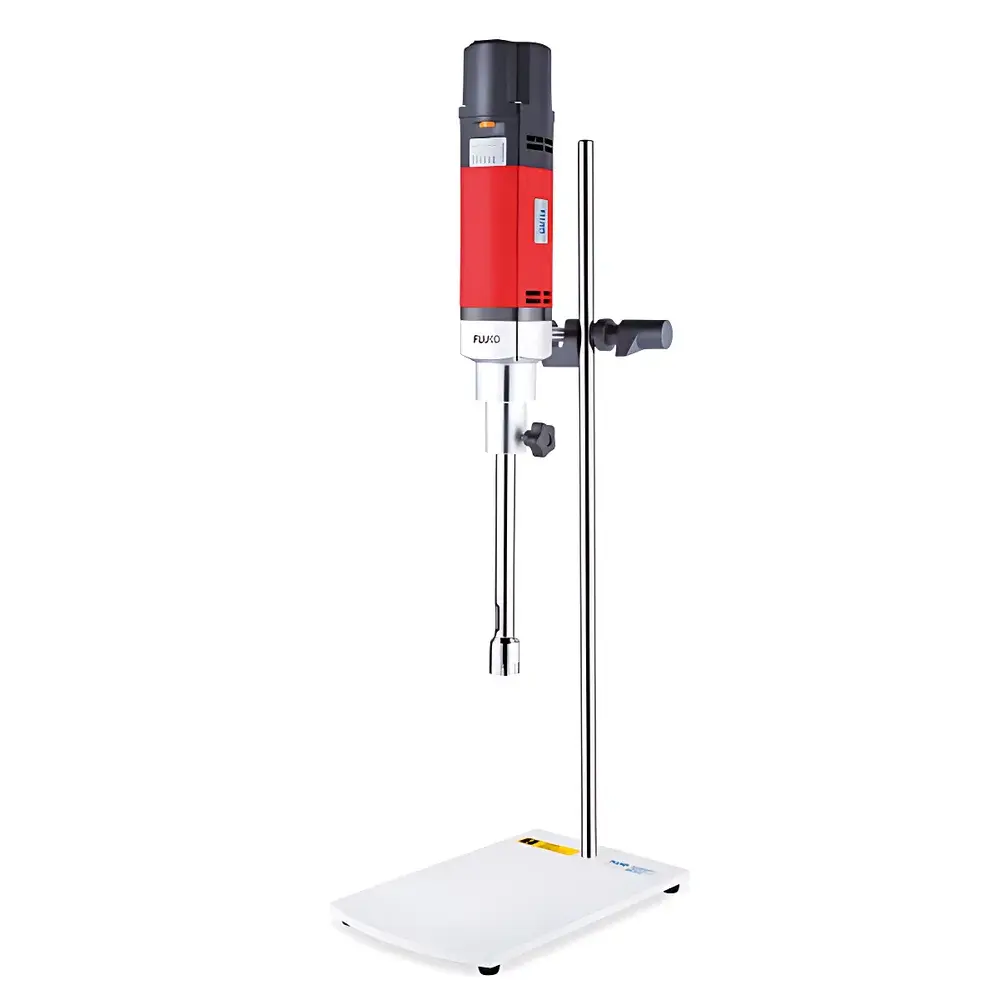
FLUKO FA30 High-Shear Disperser and Homogenizer
| Brand | FLUKO |
|---|---|
| Origin | Shanghai, China |
| Manufacturer Type | Authorized Distributor |
| Product Category | Domestic |
| Model | FA30-111-S |
| Instrument Type | Probe-type Rotor-Stator Homogenizer |
| Dimensions (W×D×H) | 215 × 310 × 730 mm |
| Processing Volume | 0.2–10,000 mL |
| Power | 1050 W |
| Voltage/Frequency | 220 V, 50/60 Hz |
| Speed Range | 3500–25,000 rpm |
| Max. Tip Speed | 35 m/s |
| Max. Viscosity | 8000 cP |
| Display | Analog Tachometer Scale |
| Speed Control | Continuous Variable (Analog) |
| Wetted Materials | SS316L |
| Shaft Sleeve Material | PTFE |
| Standard Generator | 30G |
| Ambient Temperature Range | 5–40 °C |
| Relative Humidity Limit | ≤80% |
| Protection Rating | IP20 |
| Weight | ~9.8 kg |
Overview
The FLUKO FA30 High-Shear Disperser and Homogenizer is an engineered laboratory-scale rotor-stator system designed for reproducible, scalable processing of heterogeneous liquid-phase formulations. Operating on the principle of controlled hydrodynamic cavitation and intense shear generation within a narrow annular gap between rotating and stationary elements, the FA30 delivers consistent particle size reduction, emulsification, dispersion, and homogenization across a broad viscosity and volume range. Its high-speed motor—capable of up to 25,000 rpm and generating tip speeds of 35 m/s—enables efficient energy transfer into the sample, facilitating rapid breakdown of agglomerates, stabilization of oil-in-water or water-in-oil emulsions, and uniform suspension of nanoparticles or pigments. The system is intended for use in research and development laboratories engaged in formulation science, pharmaceutical preformulation, cosmetic product development, polymer nanocomposite synthesis, and food-grade colloidal systems.
Key Features
- Robust 1050 W brushless motor with continuous variable speed control (3500–25,000 rpm), calibrated via analog tachometer scale for stable operation under load
- Modular rotor-stator architecture supporting interchangeable generator heads—including full backward compatibility with FLUKO FA25 series components—for flexible process optimization
- Standard 30G generator head fabricated from electropolished SS316L stainless steel, ensuring corrosion resistance and compliance with ISO 8504-2 surface finish requirements for pharmaceutical and biotech applications
- PTFE-coated shaft sleeve providing low-friction rotational stability and chemical resistance to organic solvents, acids, and bases
- Integrated support stand and heavy-duty base plate included as standard, enabling secure clamping and vibration-dampened operation during extended processing cycles
- IP20-rated motor housing suitable for controlled laboratory environments (5–40 °C, ≤80% RH); no internal cooling fan required due to thermal management via aluminum heat sink design
Sample Compatibility & Compliance
The FA30 accommodates aqueous, solvent-based, and semi-viscous media with viscosities up to 8000 cP, including suspensions containing micronized APIs, lipid nanoparticles, ceramic slurries, and polymer melts. Its SS316L wetted surfaces meet ASTM F899 specifications for surgical-grade stainless steel and are compatible with cleaning validation protocols per FDA Guidance for Industry: Process Validation (2011). While not certified for GMP manufacturing, the unit supports GLP-aligned documentation workflows when paired with external electronic lab notebooks (ELNs) or LIMS-integrated data capture systems. It conforms to IEC 61000-6-3 (EMC emission limits) and IEC 61000-6-2 (immunity standards) for laboratory instrumentation.
Software & Data Management
The FA30 operates as a standalone analog instrument without embedded digital control or software interface. Speed settings are manually adjusted via front-panel potentiometer; real-time rotational speed is indicated by mechanical tachometer scale (±5% accuracy at full scale). For traceable process documentation, users may integrate external USB or Bluetooth-enabled tachometers (e.g., Extech RPM300) or pair the unit with time-stamped video recording synchronized to batch logs. When used in regulated environments, operators are advised to record speed, duration, generator type, sample mass/volume, and ambient conditions in audit-ready format compliant with 21 CFR Part 11 principles—particularly when supporting formulation transfer to pilot-scale FLUKO FHS or production-grade FM series systems.
Applications
- Preparation of nanoemulsions and microemulsions for topical drug delivery and nutraceutical encapsulation
- Dispersion of carbon nanotubes, graphene oxide, and metal oxide nanoparticles in polymer matrices
- Rapid homogenization of tissue lysates and cell suspensions prior to centrifugation or chromatographic analysis
- Stabilization of pigment dispersions in architectural coatings and inkjet inks
- High-shear mixing of thermosetting resins with fillers for composite material R&D
- Emulsification of silicone oils and fluorosurfactants in personal care formulations
FAQ
Is the FA30 suitable for sterile processing?
No—the FA30 is not autoclavable or SIP-capable. Sterile applications require post-processing filtration or integration with aseptic glovebox workflows.
Can the FA30 be used with corrosive solvents such as chloroform or THF?
Yes, provided the generator head and shaft sleeve remain intact and are thoroughly rinsed post-use; PTFE and SS316L exhibit broad chemical compatibility, though prolonged exposure to strong oxidizers (e.g., nitric acid) is not recommended.
Does FLUKO provide IQ/OQ documentation for the FA30?
No—qualification documentation is not supplied as standard. Users must develop and execute their own installation and operational qualification protocols aligned with internal SOPs and regulatory expectations.
What is the expected service life of the 30G generator head under routine laboratory use?
With proper cleaning and avoidance of abrasive particulates, the 30G head typically maintains dimensional integrity and performance consistency for ≥1,500 operating hours before requiring inspection or replacement.
Is speed calibration traceable to NIST or other national standards?
The analog tachometer is factory-calibrated against reference optical tachometers; however, no NIST-traceable certificate is issued unless requested as a paid add-on service during order placement.



