
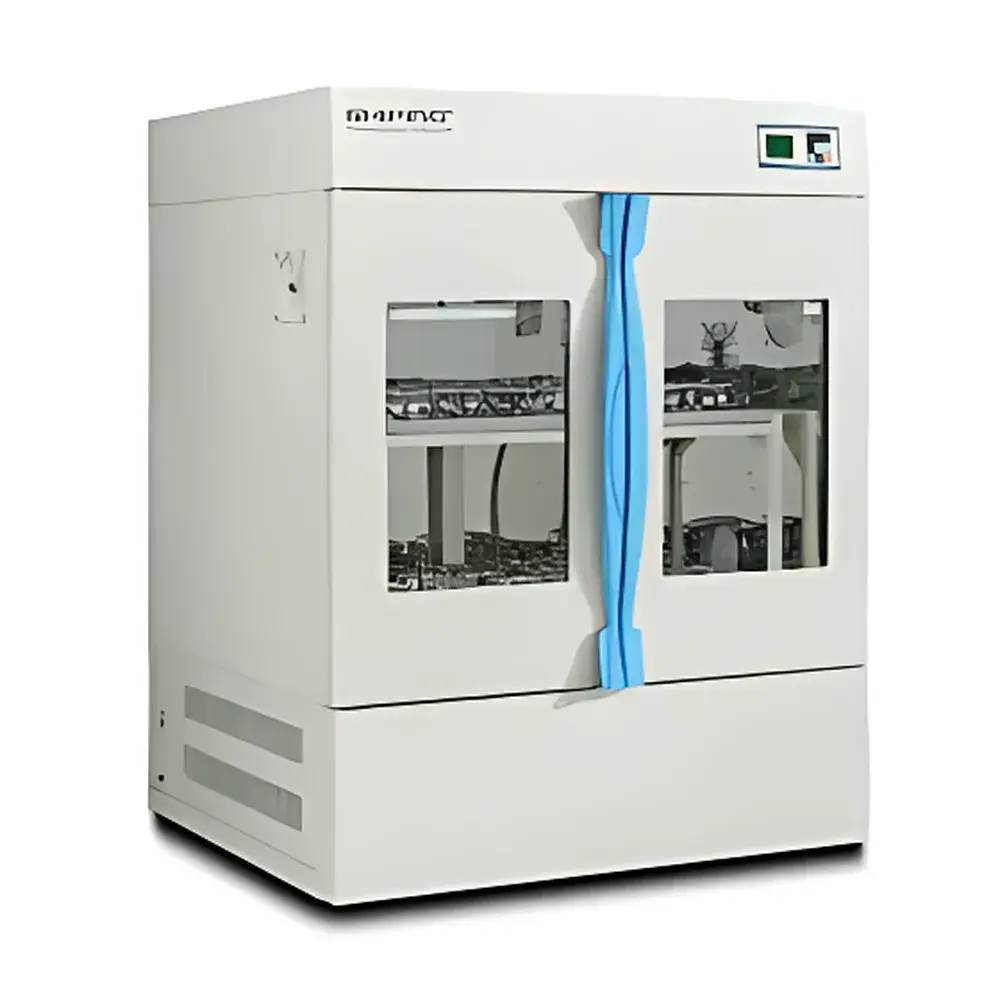
Jihepu SPH-1112F Reciprocating Dual-Door, Dual-Shelf Incubated Shaker
| Brand | Jihepu |
|---|---|
| Origin | Shandong, China |
| Model | SPH-1112F |
| Temperature Range | Ambient +5°C to 60°C |
| Oscillation Frequency | 50–280 rpm |
| Amplitude | Φ25 mm |
| Timer Range | 0–500 hours (continuous mode) |
| Shelf Quantity | 2 |
| Power Supply | AC 200–240 V, 50–60 Hz |
| Rated Power | 1100 W |
| Net Weight | 325 kg |
| External Dimensions (W×D×H) | 1200 × 850 × 1600 mm |
| Internal Chamber Dimensions (W×D×H) | 1100 × 700 × 830 mm |
| Chamber Material | Mirror-finish imported stainless steel |
| Control System | PID microprocessor with LCD dual-display |
| Cooling System | CFC-free R134a refrigerant |
| Heating Capacity | 800 W |
| Compressor Power | 230 W |
| Safety Features | Over-temperature, over-speed, motor overheat, and current leakage protection |
| Compliance | RoHS-compliant design, non-CFC refrigeration per EU Regulation (EC) No 1005/2009 |
Overview
The Jihepu SPH-1112F Reciprocating Dual-Door, Dual-Shelf Incubated Shaker is engineered for high-throughput, temperature-controlled orbital agitation in life science laboratories and bioprocess development environments. Unlike standard rotary or linear shakers, the SPH-1112F employs a reciprocating motion profile—characterized by controlled back-and-forth horizontal displacement—optimized for uniform suspension of microbial cultures, mammalian cells, and particulate-based assays where shear-sensitive viability or consistent mass transfer is critical. Its dual-shelf architecture supports parallel processing across two independently accessible, vibration-isolated platforms, each accommodating up to 90 × 250 mL flasks or 36 × 1000 mL vessels. The unit integrates a high-efficiency, brushless AC induction motor with single-axis balanced drive and suspended damping rails to minimize mechanical resonance and acoustic emission (<55 dB at 1 m), ensuring stable operation during extended incubation cycles. Temperature control utilizes a dual-mode PID algorithm coupled with forced-air circulation and a non-ozone-depleting R134a refrigeration system, enabling precise thermal regulation from ambient +5°C to 60°C with ±0.1°C setpoint accuracy and ±1–2°C intra-chamber uniformity (per ISO 17025 traceable validation protocols).
Key Features
- Dual independent access doors with magnetic safety interlocks and tempered glass viewing windows—enabling rapid sample insertion/removal without disturbing adjacent shelf conditions
- Two-tier stainless steel shelves (970 × 560 mm each), load-rated for ≥70 kg per shelf, with removable silicone-coated clamps compatible with Erlenmeyer flasks, culture bottles, and multi-well plates
- Reciprocating oscillation mechanism delivering consistent 25 mm amplitude (Φ25 mm) across full frequency range (50–280 rpm), calibrated to ±1 rpm repeatability per ASTM E2500-13
- Microprocessor-based PID controller with backlit LCD dual-display showing real-time temperature, speed, elapsed time, and remaining timer duration
- Integrated safety architecture: over-temperature cutoff (hardware + software redundancy), motor thermal shutdown, ground-fault circuit interruption (GFCI), and automatic power recovery after grid interruption
- Energy-optimized thermal management: 800 W heater and 230 W compressor operate dynamically under load-sensing logic to maintain setpoint with ≤15% power variance across operating range
Sample Compatibility & Compliance
The SPH-1112F accommodates diverse vessel formats including glass and polycarbonate flasks (50–1000 mL), roller bottles, deep-well plates, and custom bioreactor sleeves. Its chamber geometry (1100 × 700 × 830 mm internal volume) and low-profile airflow path support homogeneous gas exchange for aerobic cultures. The unit conforms to IEC 61010-1:2010 for laboratory equipment safety and incorporates RoHS-compliant materials throughout. Refrigerant use complies with EU Regulation (EC) No 1005/2009 and U.S. EPA SNAP program requirements for non-ozone-depleting alternatives. Optional UV germicidal lamps (254 nm) and humidity sensors (±3% RH accuracy) are available as field-installable modules for GLP/GMP-aligned workflows requiring environmental documentation per 21 CFR Part 11 Annex 11 audit trails.
Software & Data Management
While the SPH-1112F operates autonomously via its embedded PID controller, optional RS-485/Modbus RTU interface enables integration into centralized lab automation systems (e.g., LabVantage, STARLIMS). All operational parameters—including temperature setpoint, oscillation speed, timer value, and alarm events—are stored in non-volatile memory with timestamped logging capacity for ≥10,000 entries. Data export is supported via USB flash drive (FAT32 formatted) in CSV format for post-hoc analysis in MATLAB, Python Pandas, or Excel. The controller firmware supports firmware updates via secure signed binary packages and includes configurable password-protected parameter lockout for SOP enforcement.
Applications
- High-yield bacterial and yeast fermentation pre-screening under controlled aeration and thermal profiles
- Protein expression optimization in E. coli and Pichia pastoris using gradient temperature/time matrices
- Plasmid DNA purification workflows requiring gentle mixing during alkaline lysis and neutralization steps
- Antibody-antigen binding kinetics studies in 96-well plates under constant agitation
- Tissue dissociation and primary cell suspension preparation with minimized shear-induced apoptosis
- Environmental microbiology assays involving soil slurry homogenization and pollutant biodegradation monitoring
FAQ
What is the maximum flask loading capacity per shelf?
Each shelf supports up to 36 × 1000 mL Erlenmeyer flasks, 70 × 500 mL flasks, or 90 × 250 mL flasks—configured using factory-supplied universal clamps.
Does the unit support programmable ramping of temperature or speed?
No—the SPH-1112F maintains fixed setpoints for temperature and oscillation frequency during runtime; multi-step protocols require external scheduling via integrated Modbus control.
Is the interior chamber certified for autoclave compatibility?
The stainless steel chamber is corrosion-resistant and cleanable with 70% ethanol or 0.5% sodium hypochlorite, but it is not rated for steam sterilization or autoclaving.
Can the shaker be operated in cold rooms or walk-in incubators?
Ambient operating conditions must remain between 5°C and 25°C with relative humidity ≤90% non-condensing; operation below 5°C may impair refrigerant cycle efficiency and sensor calibration.
What documentation is provided for IQ/OQ validation?
Factory test reports include temperature mapping (9-point grid), speed calibration certificates, and electrical safety verification—sufficient for initial qualification per ASTM E2500-13 and EU GMP Annex 15 guidelines.





