
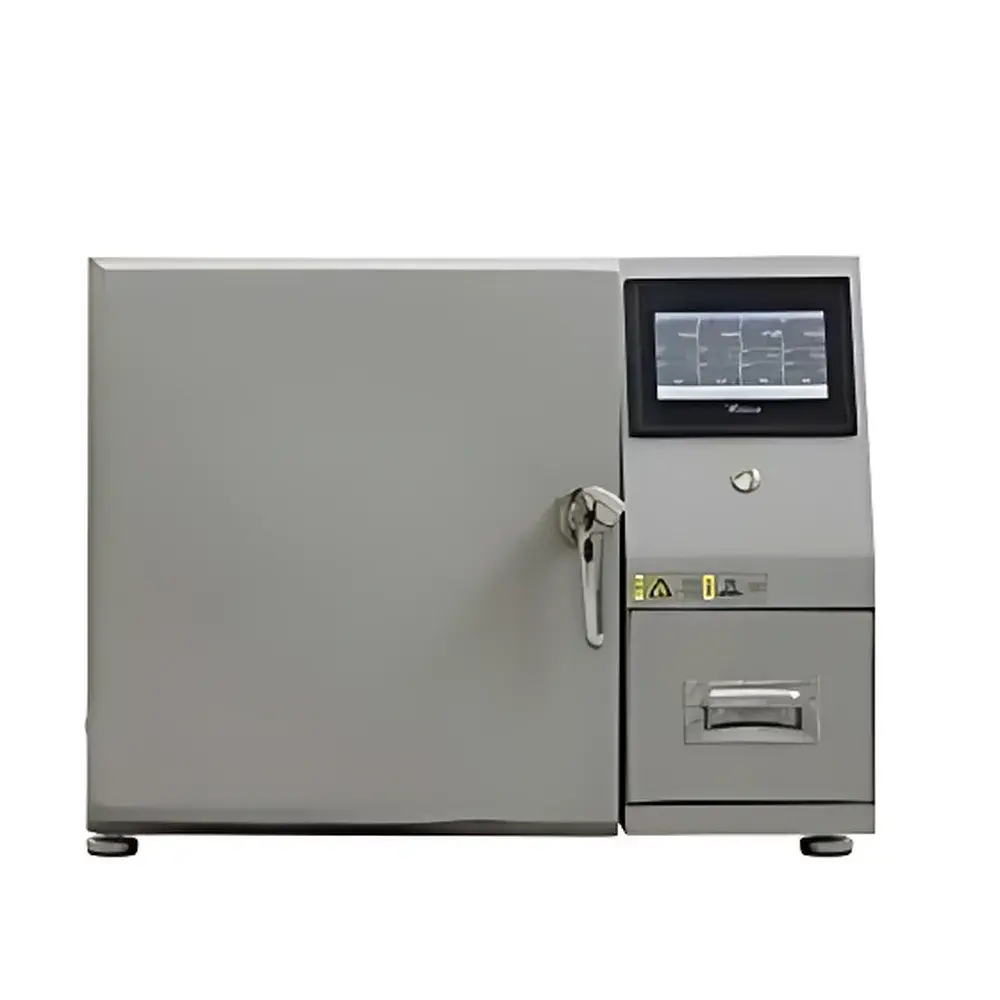
Jihepu SXL-1200 Precision Box-Type Laboratory Muffle Furnace
| Brand | Jihepu |
|---|---|
| Origin | Shandong, China |
| Model | SXL-1200 |
| Maximum Temperature | 1200 °C (continuous operation ≤1150 °C) |
| Temperature Control Accuracy | ±1 °C |
| Chamber Dimensions | 300 × 200 × 200 mm (D×W×H) |
| Heating Elements | Kanthal® A1 alloy wire (3-sided embedded: left, right, top) |
| Power Supply | AC 220 V, 50/60 Hz / 4 kW (standard) |
| Ramp Rate | ≤10 °C/min (recommended), up to 30 °C/min (max) |
| Cooling Rate | ≤10 °C/min above 700 °C |
| Insulation Material | Vacuum-formed high-purity alumina polycrystalline fiber (Japan-sourced technology) |
| Temperature Sensor | N-type thermocouple (Omega, USA), rear-mounted for representative chamber measurement |
| Compliance | CE certified (GB/1067/4189/12 Issue 1), GB/T 10066.1–2004, GB/T 10067.4–2005 |
Overview
The Jihepu SXL-1200 Precision Box-Type Laboratory Muffle Furnace is a rigorously engineered thermal processing instrument designed for reproducible high-temperature applications in academic research, materials science laboratories, and industrial quality assurance environments. Operating on the principle of resistive heating via embedded Kanthal® A1 alloy elements, the furnace delivers uniform thermal distribution across its insulated chamber—critical for sintering, annealing, ashing, calcination, and thermal stability testing of metals, ceramics, composites, and advanced functional materials. Its muffle architecture isolates the sample from direct contact with heating elements and combustion byproducts, ensuring contamination-free thermal treatment under controlled atmospheric conditions (ambient air or inert gas-compatible with optional purge ports). The furnace is rated for continuous operation up to 1150 °C and peak excursions to 1200 °C, with thermal stability maintained within ±1 °C—meeting stringent requirements for ISO/IEC 17025-accredited testing labs and GLP-compliant material qualification protocols.
Key Features
- Triple-zone resistive heating configuration: Kanthal® A1 alloy wire embedded on left, right, and top furnace walls ensures radial and axial temperature homogeneity (±3 °C across working zone at 1100 °C).
- 7-inch capacitive touchscreen HMI with intuitive graphical interface supports multi-language operation, real-time parameter visualization, and one-touch program execution.
- Programmable 30-segment temperature ramp-soak-cool profiles, each independently assignable to specific material classes—enabling rapid protocol switching without parameter re-entry or cross-contamination risk.
- Vacuum-formed alumina polycrystalline fiber insulation (≤0.15 W/m·K thermal conductivity at 1000 °C) minimizes heat loss, reduces energy consumption, and maintains low external surface temperatures (<50 °C at 1100 °C ambient).
- Integrated safety architecture includes door-interlocked power cutoff, over-temperature cutout (hardware-based independent limit controller), thermocouple break detection, earth leakage protection, and active forced-air cooling driven by thermal feedback sensors.
- Front-facing quartz viewport enables non-intrusive visual monitoring of sample morphology, color transition, and sintering behavior during dynamic thermal cycles.
- Dual-cabinet configuration options (low cabinet: 730 × 600 × 550 mm; high cabinet: 730 × 600 × 1400 mm) accommodate diverse lab ergonomics and space constraints while maintaining structural rigidity and vibration damping.
Sample Compatibility & Compliance
The SXL-1200 accommodates standard crucibles—including high-purity alumina, fused quartz, and silicon carbide—with maximum sample volume of 12 L (300 × 200 × 200 mm chamber). Its muffle design eliminates chemical interaction between samples and heating elements, supporting ASTM C1171 (ceramic sintering), ISO 5660-1 (fire reaction testing), and USP heavy metal residue analysis workflows. The furnace complies with GB/T 10066.1–2004 (general safety requirements for industrial furnaces) and GB/T 10067.4–2005 (safety specifications for laboratory electric resistance furnaces). CE marking (Certificate No. GB/1067/4189/12 Issue 1) confirms conformity with EU Machinery Directive 2006/42/EC and Low Voltage Directive 2014/35/EU. Optional inert gas inlet ports support nitrogen or argon purging for oxide-sensitive processes per ISO 8501-1 surface preparation standards.
Software & Data Management
All thermal profiles, real-time temperature logs, and event timestamps are stored internally and exportable via USB flash drive in CSV format—compatible with Excel, MATLAB, and LabVIEW for post-processing and statistical analysis. The system records audit-trail metadata including operator ID (user-defined), program name, start/end times, and deviation alerts—supporting traceability requirements under FDA 21 CFR Part 11 when paired with user-access-controlled login (optional firmware upgrade). No proprietary software installation is required; data files are human-readable and interoperable with LIMS platforms compliant with ASTM E1578–22 (laboratory information management systems).
Applications
- High-temperature sintering of powder metallurgy compacts and ceramic green bodies
- Thermal gravimetric analysis (TGA) pre-conditioning and residue quantification
- Heat treatment of tool steels, superalloys, and shape-memory alloys
- Ash content determination per AOAC 942.05 and EPA Method 200.7
- Calibration of thermocouples and RTDs using fixed-point reference materials
- Pre-firing of catalyst supports and battery electrode precursors
- Quality control of refractory linings and insulating ceramics
FAQ
What is the recommended maintenance interval for the furnace insulation and heating elements?
Routine visual inspection is advised before each use. Full replacement of the alumina fiber lining is recommended after 2,000 cumulative hours at ≥1000 °C or upon visible cracking/shrinkage. Kanthal® A1 elements typically exceed 5,000 h service life under controlled ramp rates and proper ventilation.
Can the SXL-1200 operate under vacuum or controlled atmosphere?
The base model is configured for ambient air operation. Optional flanged ports (M20 × 1.5) enable connection to vacuum pumps or gas manifolds; however, vacuum-rated seals and reinforced chamber construction require custom configuration and separate validation.
Is the temperature calibration traceable to national standards?
Yes—factory calibration uses NIST-traceable reference thermocouples. Users may perform on-site verification using secondary-standard thermocouples accredited per ISO/IEC 17025; calibration certificates are available upon request.
Does the furnace support remote monitoring or Ethernet connectivity?
Standard configuration includes USB data export only. RS-485 Modbus RTU interface is available as an optional hardware module for integration into building management systems (BMS) or centralized lab monitoring networks.
What safety certifications apply to the electrical subsystem?
The power supply, relay drivers, and thermal cutoff circuits conform to IEC 61000-6-3 (EMC emission limits) and IEC 61000-6-2 (immunity requirements), verified during CE certification testing. Ground-fault circuit interrupter (GFCI) functionality is integrated per IEC 61008-1.



