
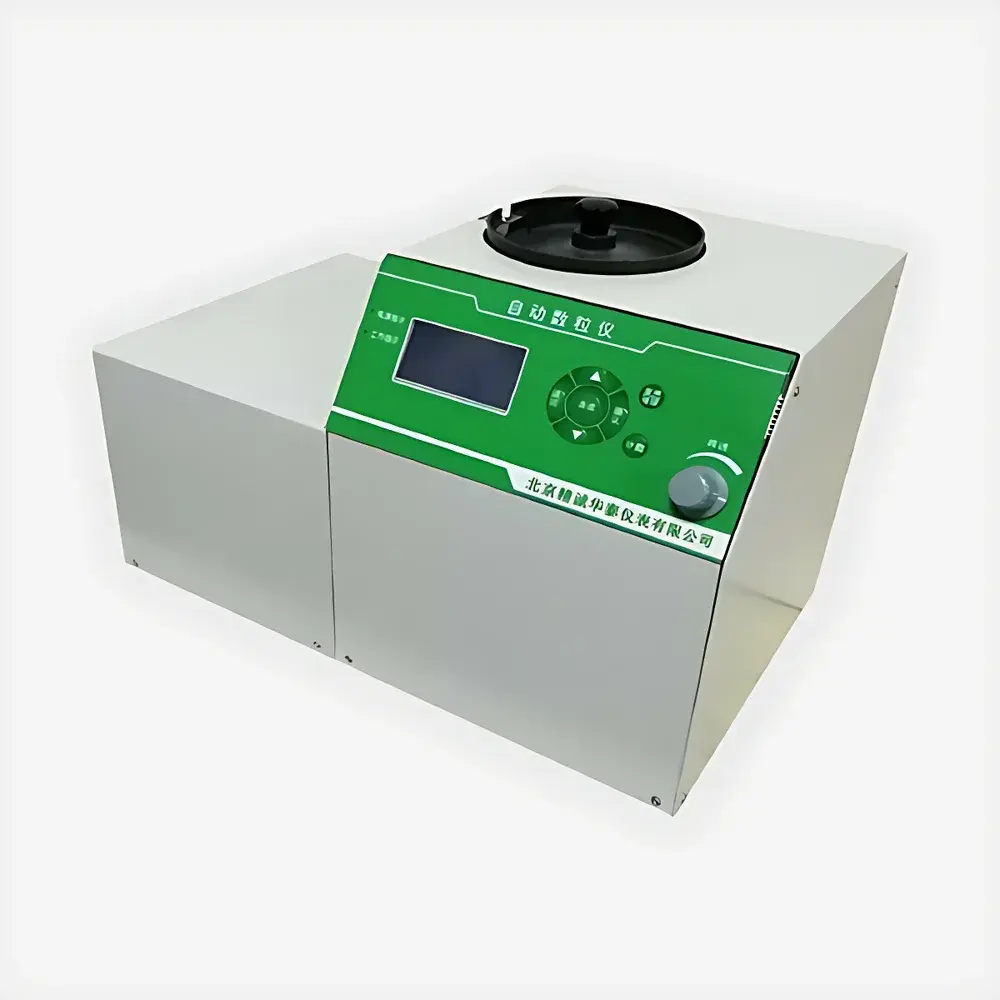
Jingcheng Huatai SLY-5 Gravimetric Seed Counter
| Brand | Jingcheng Huatai |
|---|---|
| Origin | Beijing, China |
| Manufacturer Type | Authorized Distributor |
| Country of Origin | China |
| Model | SLY-5 |
| Price Range | USD 980–1,820 |
| Counting Principle | Gravimetric + Optical Vibration Discrimination |
| Counting Range (Dimensions) | ≤12×4 mm (small seeds), ≤12×10 mm (large seeds) |
| Counting Accuracy | ±5/1000 (small), ±3/1000 (large) |
| Counting Speed | 1000 seeds / 3 min |
| Max Count Capacity | 1–99,999 |
| Preset Stop Range | 1–99,999 (00000 = continuous mode) |
| Weighing Range | 0–2000 g |
| Power Supply | AC 220 V ±20 V, 50 Hz |
| Data Storage | 8 GB SD card (internal) |
| Display | Full Chinese LCD with touch interface |
| Connectivity | USB data export, optional cloud platform integration |
| Optional | Thermal printer module |
Overview
The Jingcheng Huatai SLY-5 Gravimetric Seed Counter is an integrated precision instrument engineered for high-throughput, repeatable seed enumeration in agricultural research, seed certification, quality control, and breeding programs. Unlike optical-only counters that rely solely on image segmentation or mechanical aperture-based detection, the SLY-5 employs a dual-mode counting methodology: real-time gravimetric mass monitoring combined with vibration-driven seed separation and optical event triggering. This hybrid architecture significantly reduces miscounts caused by clumping, static adhesion, or irregular seed morphology—common challenges when handling heterogeneous batches of maize, soybean, rice, wheat, sunflower, and other agronomic species. The system operates under controlled vibratory feed dynamics, where seed flow rate is actively regulated via adjustable amplitude and frequency parameters, enabling consistent single-layer dispersion across the sensing zone. All operational logic—including weight-to-count calibration, sensitivity thresholding, and stop logic—is managed by an embedded ARM-based microcontroller with deterministic real-time response.
Key Features
- Gravimetric-optical hybrid counting engine delivering traceable, ISO-aligned repeatability for GLP-compliant seed lot documentation
- Full-touch Chinese LCD interface with intuitive menu navigation; supports date/time stamping, user-defined presets (500/1000/1500/2000), and custom count thresholds (1–99,999)
- Adjustable sensitivity tuning to suppress interference from chaff, dust, broken kernels, or inert debris—critical for field-collected or uncleaned seed samples
- Dual operating modes: “Free Count” (auto-shutdown after 2 min idle) and “Auto-Stop Count” (halts precisely at preset value)
- Integrated high-resolution load cell (0–2000 g, resolution ≤0.01 g) enabling concurrent mass recording and count normalization (e.g., seeds per gram)
- Onboard 8 GB SD card with timestamped logging: records date, time, count value, elapsed time, gross weight, and operator ID (if configured)
- USB 2.0 interface for direct data export to Windows/macOS systems; CSV-formatted logs include full metadata for audit trail compliance
- Optional thermal printer module (external accessory) supports on-demand hardcopy of count reports with header fields for lab ID, sample code, and analyst signature line
- Cloud-ready firmware architecture (optional subscription service) enables encrypted HTTPS upload to centralized dashboards for multi-site aggregation and statistical process control (SPC)
Sample Compatibility & Compliance
The SLY-5 accommodates a broad morphological spectrum: spherical (e.g., soybean), oblong (e.g., rice), flattened (e.g., sunflower), and irregularly shaped seeds—with dimensional limits of ≤12 × 4 mm (fine grains) and ≤12 × 10 mm (coarse seeds). Its vibration plate design minimizes jamming while maintaining laminar flow characteristics required for statistical validity. The instrument meets general requirements of ISO 6647 (rice grain counting), ASTM D7052 (seed purity testing), and GB/T 3543.4–1995 (Chinese national standard for seed testing methods). While not FDA 21 CFR Part 11–certified out-of-box, its audit-trail-capable data log structure—including immutable timestamps and sequential record IDs—supports validation protocols under GxP frameworks when deployed with documented SOPs and periodic performance verification.
Software & Data Management
Data integrity is maintained through structured local storage: each count session generates a uniquely named .CSV file containing six mandatory fields (Session_ID, Date_UTC, Time_UTC, Count_Value, Elapsed_Seconds, Gross_Weight_g) plus optional user-defined tags. No proprietary binary formats are used—raw files open natively in Excel, LibreOffice Calc, or R/Python analysis environments. The included PC utility software provides batch import, filtering by date range or count threshold, and export to PDF report templates compliant with ISO/IEC 17025 documentation standards. For laboratories requiring electronic signatures and role-based access control, integration with validated LIMS platforms is supported via RESTful API endpoints (available under enterprise licensing).
Applications
- Seed quality assurance in certified seed production facilities (germination testing preparation, purity assessment)
- Field trial plot management: rapid seed allocation for randomized block designs and replication setup
- Plant breeding programs: tracking progeny counts per cross, calculating segregation ratios, and validating Mendelian inheritance models
- Phytosanitary inspection labs: verifying declared seed quantities in import/export documentation
- Agronomy education: hands-on demonstration of sampling statistics, coefficient of variation (CV) calculation, and measurement uncertainty propagation
- Seed coating R&D: correlating particle count with active ingredient loading per unit mass
FAQ
What types of seeds are compatible with the SLY-5?
The instrument is validated for cereals (wheat, rice, barley), legumes (soybean, pea), oilseeds (sunflower, rapeseed), and maize. Seeds must fall within the dimensional envelope of ≤12 × 10 mm and exhibit sufficient density contrast against background debris.
Does the SLY-5 require calibration before each use?
No daily calibration is required. A one-time factory calibration of the load cell and sensitivity baseline is performed prior to shipment. Users may execute a quick self-check (“Quick Self-Calibration”) using supplied reference weights to verify drift—recommended every 30 days or after transport.
Can count data be exported in machine-readable format for statistical analysis?
Yes. All stored records are plain-text CSV files with UTF-8 encoding and comma delimiters, fully compatible with JMP, Minitab, SAS, Python pandas, and R data.frame ingestion pipelines.
Is the cloud platform mandatory or optional?
Cloud connectivity is strictly optional. Local SD card storage and USB export constitute the primary, offline-capable data workflow. Cloud features require separate subscription and network configuration.
What power source does the SLY-5 require?
It operates on standard AC 220 V ±20 V, 50 Hz mains supply. An internal switching power supply ensures stable operation across voltage fluctuations typical in rural agricultural stations and mobile field labs.






