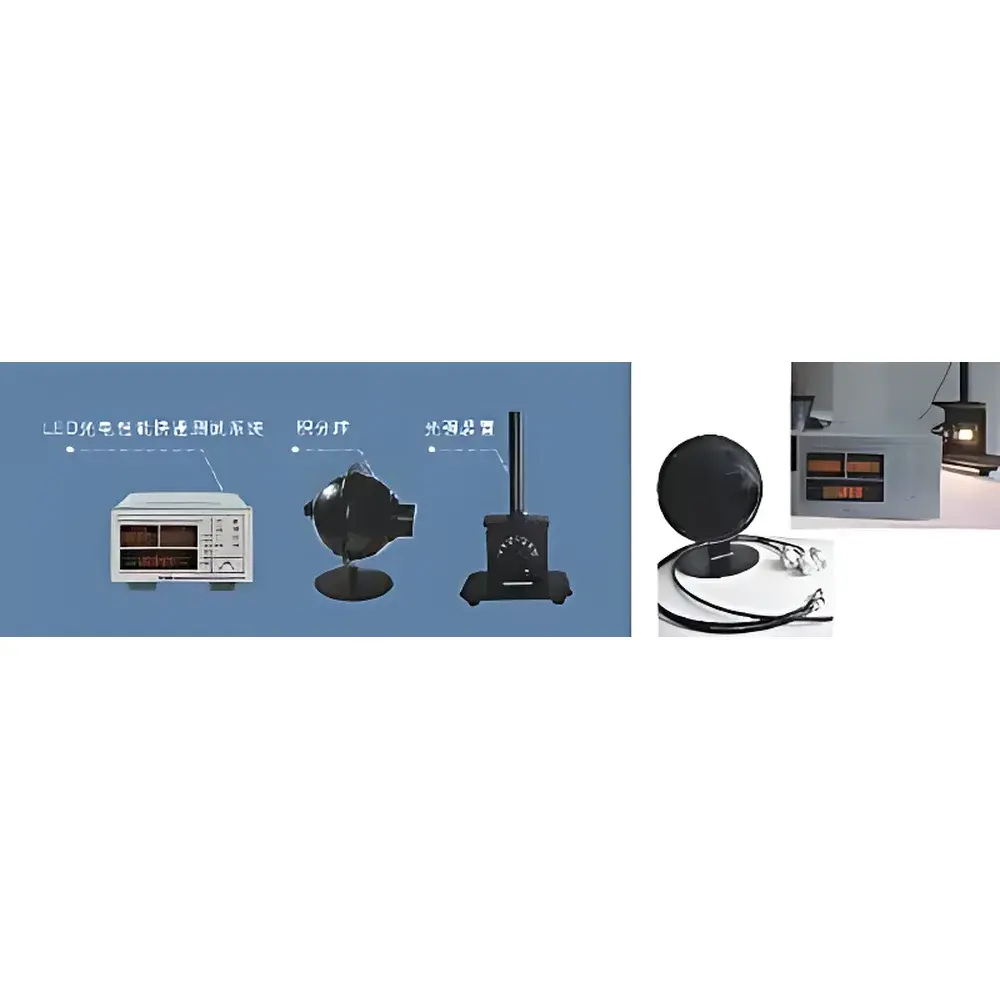
Jingfei FLA7260 LED and High-Power LED Photometric & Electrical Parameter Sorting Tester
| Brand | Jingfei Technology |
|---|---|
| Origin | Zhejiang, China |
| Manufacturer Type | Direct Manufacturer |
| Country of Origin | China |
| Model | FLA7260 |
| Pricing | Available Upon Request |
| Luminous Flux Range | 0.01 lm to 1.9999 × 10⁵ lm |
| Programmable Constant-Current Source Output | 1.0 mA to 1.0 A |
| Programmable Constant-Voltage Source Output | 0.1 V to 10.0 V |
| Forward Current (IF) Measurement Range | 1.0 mA to 1.0 A |
| Forward Voltage (VF) Measurement Range | 0.1 V to 10.0 V |
| Reverse Leakage Current (IR) Measurement Range | 0.01 µA to 100.0 µA |
| Reverse Breakdown Voltage (VZ) Measurement Range | 0.1 V to 38.0 V |
| Measurement Accuracy | ±0.5% of Full Scale |
Overview
The Jingfei FLA7260 LED and High-Power LED Photometric & Electrical Parameter Sorting Tester is a dedicated integrated test platform engineered for high-throughput, repeatable characterization of light-emitting diodes across R&D laboratories, quality control departments, and front-line manufacturing environments. It operates on a dual-domain measurement architecture—simultaneously acquiring photometric (luminous flux, spectral distribution via optional integration with calibrated spectroradiometers) and electrical parameters (IF, VF, IR, VZ) under controlled DC bias conditions. The system implements precision source-measure unit (SMU) topology with four-quadrant operation capability, enabling accurate forward conduction analysis as well as reverse-bias leakage and breakdown evaluation. Its design conforms to the functional requirements of IEC 62031 (LED modules for general lighting), CIE S 025/E:2015 (test methods for LED lamps and luminaires), and supports traceable calibration paths aligned with ISO/IEC 17025-accredited practices.
Key Features
- Integrated photometric-electrical synchronized testing: Simultaneous acquisition of luminous flux (lm) and electrical operating points eliminates sequential test delays and inter-test variability.
- High-dynamic-range SMU architecture: Programmable constant-current source (1.0 mA–1.0 A) and constant-voltage source (0.1 V–10.0 V) with auto-ranging and low-noise feedback loops ensure stable biasing across low-power indicator LEDs and high-power COB modules.
- Reverse-characterization capability: Precision microampere-level IR measurement (0.01 µA–100.0 µA) and controlled VZ sweep up to 38.0 V support reliability screening for ESD robustness and junction integrity assessment.
- Full-scale accuracy of ±0.5%: Achieved through factory-trimmed analog front-end circuits, temperature-compensated shunt resistors, and digital offset/gain calibration stored in non-volatile memory.
- Modular hardware interface: Standard GPIB, USB-TMC, and Ethernet (LXI-compliant) connectivity enable seamless integration into automated test systems and MES-linked production lines.
- Thermal management-aware design: Optional thermal chuck interface (not included) allows mounting under active temperature control (–10 °C to +85 °C) to evaluate thermal derating behavior per JEDEC JESD51 standards.
Sample Compatibility & Compliance
The FLA7260 accommodates standard LED packages including 3535, 5050, 7070 SMDs, TO-18/TO-46 through-hole devices, and high-power MCPCBs up to 50 mm × 50 mm. Fixture adaptability supports both probe-based contact testing and socketed module evaluation. All electrical measurements comply with the uncertainty budget requirements defined in ANSI C78.377-2020 for chromaticity and luminous flux verification. Photometric calibration is performed using NIST-traceable integrating sphere systems (e.g., Labsphere Ulbricht spheres), and electrical channels are verified against Fluke 8508A reference multimeters. The instrument meets CE marking requirements (EMC Directive 2014/30/EU and Low Voltage Directive 2014/35/EU) and supports audit-ready documentation for ISO 9001 and IATF 16949 quality management systems.
Software & Data Management
Bundled with Jingfei TestSuite v4.x, the system provides configurable test sequences, pass/fail binning logic (up to 32 user-defined bins), and real-time statistical process control (SPC) charts (X-bar/R, Cp/Cpk). Raw data export is supported in CSV, XML, and industry-standard STDF (Semiconductor Test Data Format) for downstream analytics. Audit trails record operator ID, timestamp, calibration status, and parameter modifications—fully compliant with FDA 21 CFR Part 11 requirements when deployed with optional electronic signature modules and network-based user authentication. Data archival follows GLP/GMP retention guidelines, with automatic backup to NAS or cloud storage via configurable SMB/FTP protocols.
Applications
- LED wafer-level probing and binning prior to packaging
- Final acceptance testing of automotive lighting modules (AEC-Q102 qualified components)
- Accelerated life testing correlation studies (measuring VF drift and IR increase over time)
- Supplier qualification audits requiring full photometric-electrical correlation reports
- Development of luminous efficacy maps for tunable white and RGBW arrays
- Failure analysis root-cause determination (e.g., identifying early-stage junction degradation via anomalous VZ hysteresis)
FAQ
Does the FLA7260 support pulsed current testing for thermal transient analysis?
Yes—the instrument offers programmable pulse width (100 µs to 10 s) and duty cycle (0.1% to 100%) modes, compatible with external thermal imaging synchronization triggers.
Can it be used with integrating spheres from other manufacturers?
Yes—via analog voltage output (0–10 V) or digital RS-485 interface, provided the sphere’s photometer output adheres to standard signal conditioning protocols.
Is firmware upgrade capability available remotely?
Firmware updates are delivered via secure HTTPS download and validated using SHA-256 checksums; no physical access is required post-initial installation.
What calibration interval is recommended for ISO/IEC 17025 compliance?
Annual calibration is recommended, with intermediate verification checks every 90 days using certified reference LEDs (e.g., Optronic OL 770-LED).
Does the system include safety interlocks for high-current operation?
Yes—hardware-enforced current limit clamping, open-circuit detection, and emergency stop relay outputs meet IEC 61010-1 Class II safety requirements.
Related Products