
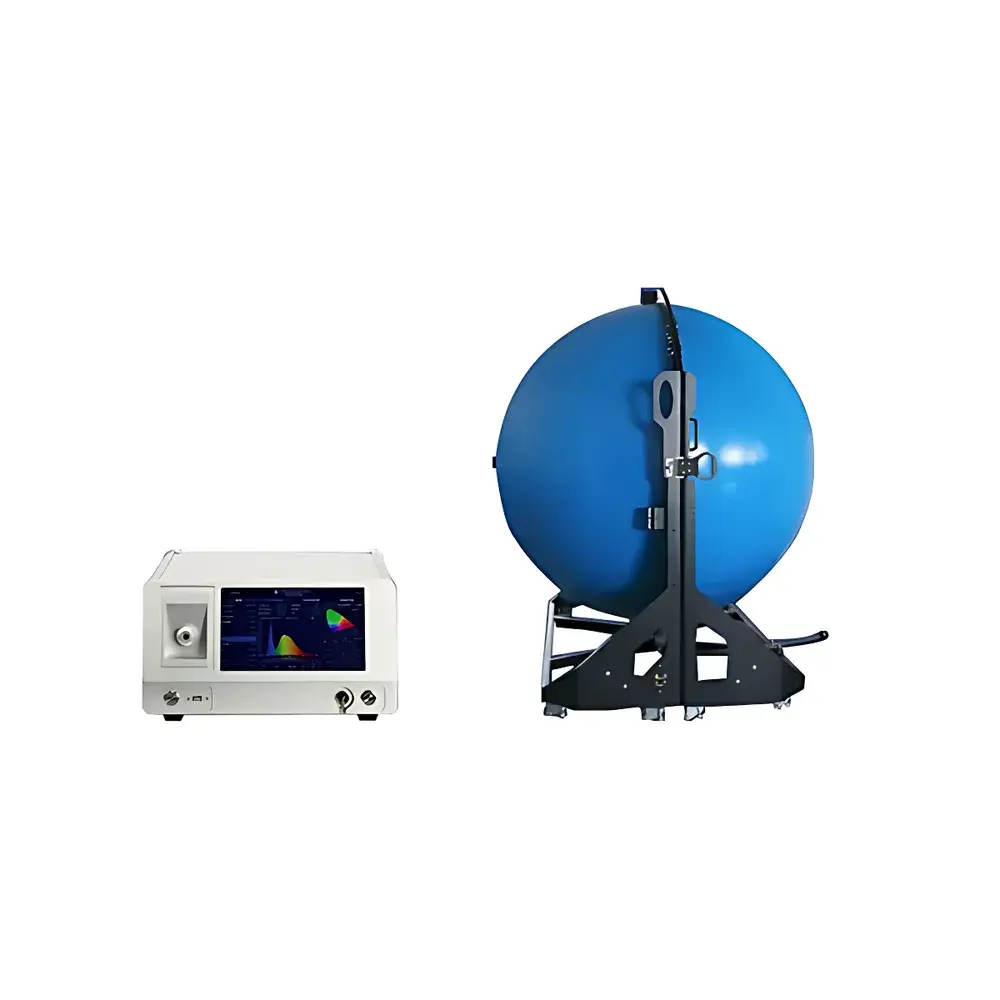
Jingpu Technology JP-ASD8500 High-Precision LED Photometric, Colorimetric & Electrical Integrated Testing System
| Brand | Jingpu Technology |
|---|---|
| Origin | Henan, China |
| Manufacturer Type | Authorized Distributor |
| Country of Origin | China |
| Model | JP-ASD8500 |
| Pricing | Upon Request |
| Spectrometer | Hamamatsu Back-Illuminated CCD Array |
| Grating | Precision Concave Holographic Diffraction Grating |
| Wavelength Range | 380–780 nm |
| Wavelength Accuracy | ±0.3 nm |
| Optical Bandwidth (FWHM) | 2 nm |
| Stray Light | <0.1% |
| Chromaticity Accuracy | ±0.0015 (Standard Illuminant), ±0.0003 (CIE Standard Illuminant A) |
| Chromaticity Repeatability | ±0.0002x / ±0.0003y (Stabilized Blue LED) |
| Luminous Flux Range | 0.01–200,000 lm (with interchangeable integrating spheres) |
| Photometric Class | Class I (per CIE S 023/E:2016 and GB/T 3978–2008) |
| ADC Resolution | 16-bit @ 1.25 MHz |
| Integration Time | 10 µs – 10 s |
| DC Power Supply | 0–60.000 V / 0–5.000 A, 300 W max, current accuracy ±(0.02% rdg + 0.01% range + 1 digit), resolution 0.1 mA |
| AC Programmable Source | 1 kVA, 0–150 V / 0–300 V, 45–65 Hz, THD ≤2% (resistive load), frequency stability ≤0.03% |
| Electrical Analyzer | Voltage accuracy ±(0.4% rdg + 0.1% range + 1 digit), current accuracy ±(0.4% rdg + 0.1% range + 1 digit), power accuracy ±[0.4% rdg + (0.1/PF)% range + 1 digit], PF resolution 0.001 |
Overview
The Jingpu Technology JP-ASD8500 High-Precision LED Photometric, Colorimetric & Electrical Integrated Testing System is an engineered solution for comprehensive characterization of solid-state lighting (SSL) products—including LED lamps, modules, luminaires, and drivers—under controlled electrical and thermal conditions. Built upon CIE-recommended measurement geometry and traceable calibration protocols, the system implements spectroradiometric analysis based on high-resolution diffraction spectroscopy to determine photometric, colorimetric, and electrical parameters in a single platform. Its core optical engine integrates a back-illuminated Hamamatsu CCD array with a precision concave holographic grating, enabling high signal-to-noise ratio spectral acquisition across the visible spectrum (380–780 nm). The system supports full spectral reconstruction per CIE 15:2018 and ISO/CIE 13370:2022, delivering metrologically valid outputs including chromaticity coordinates (CIE 1931 x,y), correlated color temperature (CCT), Duv, general and extended color rendering indices (CRI, Rf, Rg per IES TM-30), spectral radiant flux, luminous efficacy (lm/W), and spectral power distribution (SPD). Electrical subsystems comply with IEC 62384 and EN 61000-3-2 requirements for harmonic and flicker assessment when operated in conjunction with optional accessories.
Key Features
- Triple-source synchronized measurement architecture: simultaneous acquisition of spectral, photometric, and electrical data under stable bias conditions.
- CIE-compliant optical design with NIST-traceable calibration options; includes built-in reference lamp and automated self-check routines for wavelength and photometric linearity verification.
- Modular integrating sphere configuration (optional 0.3 m, 0.6 m, 1.0 m diameters) enabling luminous flux measurement from 0.01 lm to 200,000 lm with Class I photometric accuracy per CIE S 023/E:2016.
- Dual-mode power supply subsystem: precision DC source (0–60 V / 0–5 A, 300 W) with 0.1 mA current resolution and programmable ramp/sweep profiles; plus programmable AC source (1 kVA, 45–65 Hz, dual-range voltage output) supporting dynamic testing of dimmable and driver-integrated luminaires.
- High-fidelity electrical parameter analyzer with real-time power factor, harmonic content (up to 50th order), and flicker metrics (Pst, Plt per IEC TR 61000-4-15) calculation capability.
- Thermal stabilization interface for external temperature-controlled chambers or heatsink mounts, ensuring repeatable thermal management during long-duration aging or binning tests.
Sample Compatibility & Compliance
The JP-ASD8500 accommodates a broad range of SSL devices—from bare COB packages and mid-power SMD LEDs to complete architectural luminaires and smart lighting systems with integrated controls. Fixture mounting is facilitated via standardized mechanical interfaces (M6 threaded posts, adjustable tilt/swivel arms) compatible with industry-standard test benches. All photometric measurements adhere to CIE Publication 84, CIE S 023/E:2016, and GB/T 3978–2008. Electrical testing complies with IEC 62384 (DC/AC LED drivers), IEC 61000-3-2 (harmonics), and IEC 61000-3-3 (voltage fluctuations/flicker). Software-generated reports include audit trails compliant with GLP and ISO/IEC 17025 documentation requirements. Optional factory calibration certificates are issued with uncertainty budgets referenced to NIM (China National Institute of Metrology) standards.
Software & Data Management
The system operates under Jingpu’s proprietary LightLab Pro v4.x software suite, a Windows-based application supporting multi-language UI (English, Chinese, German, Japanese). It provides real-time spectral visualization, batch test sequencing, pass/fail limit scripting, and customizable report generation (PDF, Excel, XML). Raw spectral data is stored in industry-standard JIS X 0211-compliant .spc format, fully interoperable with third-party analysis tools such as MATLAB, Python (via PySpectra), and Lighting Analysts AGi32. Audit trail functionality logs all user actions, parameter changes, calibration events, and instrument status flags—meeting FDA 21 CFR Part 11 electronic record requirements when configured with digital signature and role-based access control. Data export supports CSV, JSON, and IES LM-63 formats for downstream photometric modeling.
Applications
- LED product development labs requiring traceable SPD, CCT, and CRI validation prior to IEC/EN certification.
- Quality control departments performing incoming inspection of LED chips, packages, and driver boards against manufacturer specifications.
- Third-party testing laboratories accredited to ISO/IEC 17025 conducting type testing per ENERGY STAR, DLC, and CE marking directives.
- Research institutions studying spectral tuning, human-centric lighting (HCL), and circadian-effective irradiance (EML, melanopic lux).
- Luminaire manufacturers validating lumen maintenance (LM-80/LM-84), thermal derating curves, and driver compatibility under variable line conditions.
FAQ
Does the JP-ASD8500 support automated compliance reporting for ENERGY STAR or DLC submissions?
Yes—LightLab Pro includes preconfigured templates aligned with ENERGY STAR Lamps V2.1 and DLC Qualified Products List (QPL) requirements, generating validated PDF reports with embedded calibration metadata and uncertainty statements.
Can the system measure pulsed or PWM-driven LEDs?
Yes—the spectrometer’s 10 µs minimum integration time and trigger-synchronized acquisition mode enable accurate spectral capture of modulated sources up to 10 kHz, provided duty cycle and frequency are specified in the test plan.
Is NIST-traceable calibration available as a factory option?
Yes—Jingpu offers optional factory calibration services with full uncertainty budgets issued by CNAS-accredited labs, traceable to NIM primary standards for spectral irradiance and luminous intensity.
What is the recommended recalibration interval for routine QC use?
Annual recalibration is recommended for photometric and spectral channels; biannual verification of electrical subsystems is advised under continuous operation (>2,000 hours/year).
Does the system support remote operation and integration into automated production lines?
Yes—LightLab Pro exposes a COM/ActiveX API and TCP/IP command set for integration with MES, PLC, or LabVIEW environments; hardware I/O ports support external trigger, interlock, and status signaling.





