
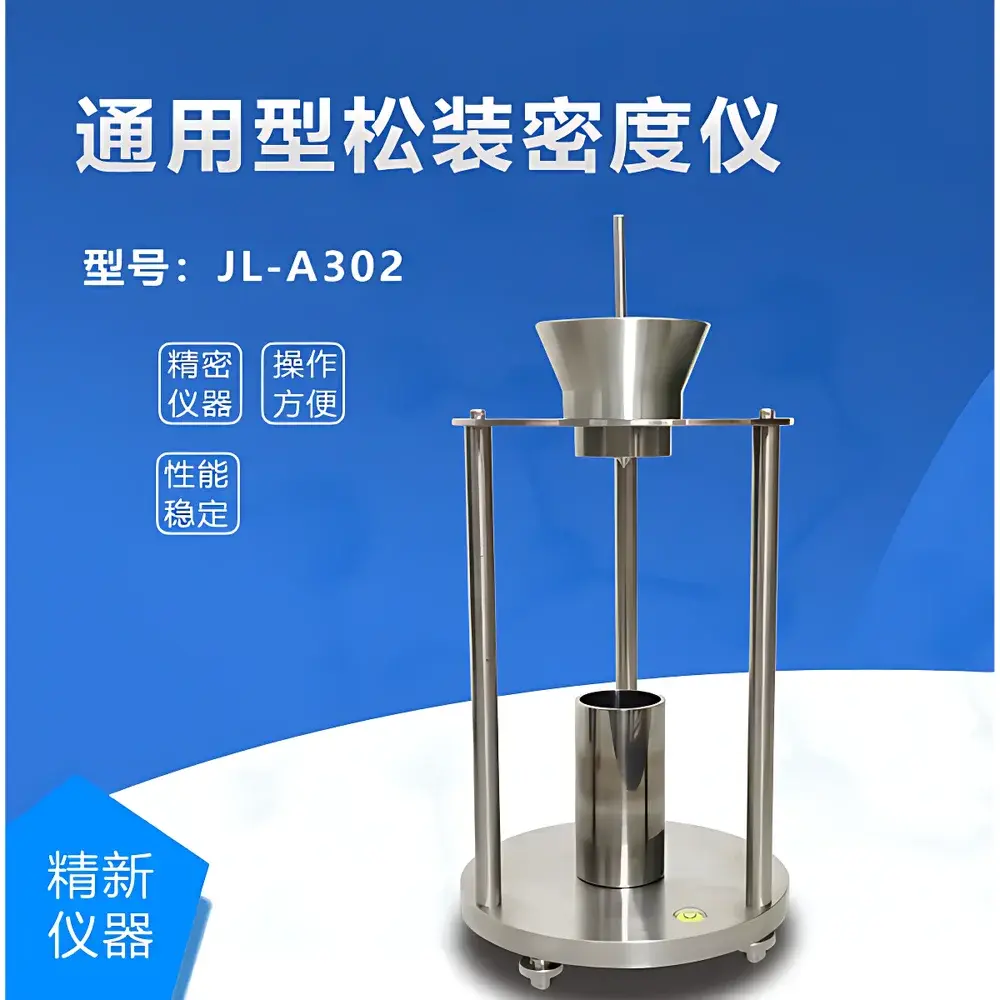
Jingxin JL-A302 Bulk Density Tester for Powders and Granular Materials
| Brand | Chengdu Jingxin (CDJX) |
|---|---|
| Origin | Sichuan, China |
| Manufacturer | Yes |
| Type | Bulk Density Tester |
| Design | Portable |
| Sample Form | Dry Solid Powders & Granules |
| Standard Compliance | GB/T 16913–2008 (Natural Pile Method) |
| Funnel Orifice Diameter | 12.7 mm |
| Cylinder Volume | 100 mL |
| Funnel-to-Cylinder Height | 115 mm ± 2 mm |
| Funnel Cone Angle | 60° |
| Cylinder Material | AISI 304 Stainless Steel |
| Scraper & Plug Rod | AISI 304 Stainless Steel, 25 mm Width |
| Dimensions | ≈ 160 × 160 × 300 mm |
| Weight | 3.7 kg |
| Required Balance | 1 kg capacity, 0.02 g readability |
Overview
The Jingxin JL-A302 Bulk Density Tester is a precision-engineered, manually operated instrument designed to determine the bulk (loose) density of free-flowing powders and granular solids in accordance with the standardized natural pile method. It operates on the principle of gravitational deposition: powder flows freely from a calibrated stainless-steel funnel under controlled geometric conditions—fixed orifice diameter (12.7 mm), fixed vertical drop height (115 mm ± 2 mm), and defined funnel cone angle (60°)—into a standardized 100 mL cylindrical receiver. The resulting mass per unit volume—calculated as sample mass (g) divided by cylinder volume (100 mL)—yields the bulk density in g/mL (equivalent to g/cm³). This method reflects the material’s packing behavior under minimal external compaction, making it critical for characterizing flowability, storage volume requirements, dosing consistency, and process scalability across R&D and QC environments.
Key Features
- Compliant architecture: Fully aligned with GB/T 16913–2008 “Test Methods for Dust Properties – Natural Pile Method”, ensuring regulatory traceability for domestic and export-oriented quality control labs.
- High-reproducibility mechanical design: All wetted components—including funnel, cylinder, scraper, and plug rod—are fabricated from AISI 304 stainless steel, offering corrosion resistance, dimensional stability, and ease of cleaning between samples.
- Optimized funnel geometry: 60° conical angle and 12.7 mm orifice diameter minimize particle bridging and wall adhesion while maintaining laminar flow initiation—critical for consistent fill dynamics across diverse particle size distributions (typically 10 µm to 2 mm).
- Calibrated drop configuration: Fixed 115 mm vertical distance between funnel outlet and cylinder rim ensures repeatable kinetic energy input during powder fall, reducing inter-operator variability.
- Portable benchtop form factor: Compact footprint (160 × 160 × 300 mm) and lightweight construction (3.7 kg) enable deployment in shared lab spaces, production floors, or mobile QA units without dedicated infrastructure.
- Modular operation: Designed for integration with user-supplied analytical balances (1 kg capacity, 0.02 g readability), supporting flexible calibration and audit-ready weight recording workflows.
Sample Compatibility & Compliance
The JL-A302 is validated for dry, non-cohesive to moderately cohesive powders and granules exhibiting free-flow characteristics—commonly encountered in pharmaceutical excipients (e.g., lactose, microcrystalline cellulose), food ingredients (e.g., flour, sugar, milk powder), battery cathode/anode materials (e.g., LiCoO₂, graphite), catalysts, pigments, and ceramic precursors. It excludes hygroscopic, electrostatic-prone, or highly cohesive materials requiring vibration-assisted or tapped density protocols. While GB/T 16913–2008 is its primary reference, the test setup is functionally compatible with analogous international methods including ASTM D1895–18 (Type A), ISO 697–1985, and USP for bulk density assessment. No electrical power, compressed air, or software dependency is required—ensuring operational robustness in GMP/GLP-aligned environments where equipment qualification must exclude firmware variables.
Software & Data Management
The JL-A302 is a purely mechanical, manual-testing device with no embedded electronics or digital interface. Data acquisition and calculation are performed externally using laboratory balance output and standard spreadsheet or LIMS platforms. This analog design eliminates validation overhead associated with electronic records (e.g., FDA 21 CFR Part 11 compliance), simplifying IQ/OQ documentation and facilitating straightforward audit trails: raw mass values, operator ID, date/time stamps, and calculated bulk density (g/mL) are recorded manually or via balance printout. For laboratories requiring automated reporting, the instrument integrates seamlessly with balance-compatible data capture systems (e.g., Mettler Toledo LabX, Sartorius Cubis II) through RS232/USB output—enabling direct transfer of mass readings into validated calculation templates.
Applications
- Pharmaceutical development: Screening excipient compatibility, evaluating granule flow prior to tablet compression, and supporting QbD-based process understanding per ICH Q5C and Q8(R2).
- Food manufacturing: Assessing volumetric dosing accuracy for dry blends, optimizing silo design, and verifying consistency of milled or spray-dried ingredients.
- Battery materials R&D: Quantifying electrode slurry powder loading efficiency and correlating bulk density with tap density and compressibility indices (Hausner ratio, Carr index).
- Chemical & catalyst production: Monitoring batch-to-batch uniformity of supported catalysts and fine chemical intermediates subject to pneumatic conveying or fluidized-bed processing.
- Academic research: Teaching fundamental powder mechanics principles, calibrating DEM (Discrete Element Method) simulations, and benchmarking against advanced techniques like dynamic powder rheometry.
FAQ
What standards does the JL-A302 comply with?
It is engineered and verified for strict adherence to GB/T 16913–2008. Its geometry and procedure also align with ASTM D1895–18 (Type A), ISO 697–1985, and USP .
Is a balance included with the instrument?
No—the JL-A302 requires an external analytical balance (1 kg capacity, 0.02 g readability), which must be qualified and calibrated per ISO/IEC 17025.
Can it measure tapped density?
No—this model implements only the natural pile (loose) density method. Tapped density requires a separate apparatus complying with GB/T 5162 or ASTM D5965.
What maintenance is required?
Routine cleaning of stainless-steel surfaces with ethanol or isopropanol; periodic visual inspection for funnel orifice deformation or cylinder denting; no lubrication or recalibration needed.
How many replicate measurements are recommended?
Per GB/T 16913–2008, a minimum of three independent determinations are required; the arithmetic mean is reported as the final bulk density value.



