
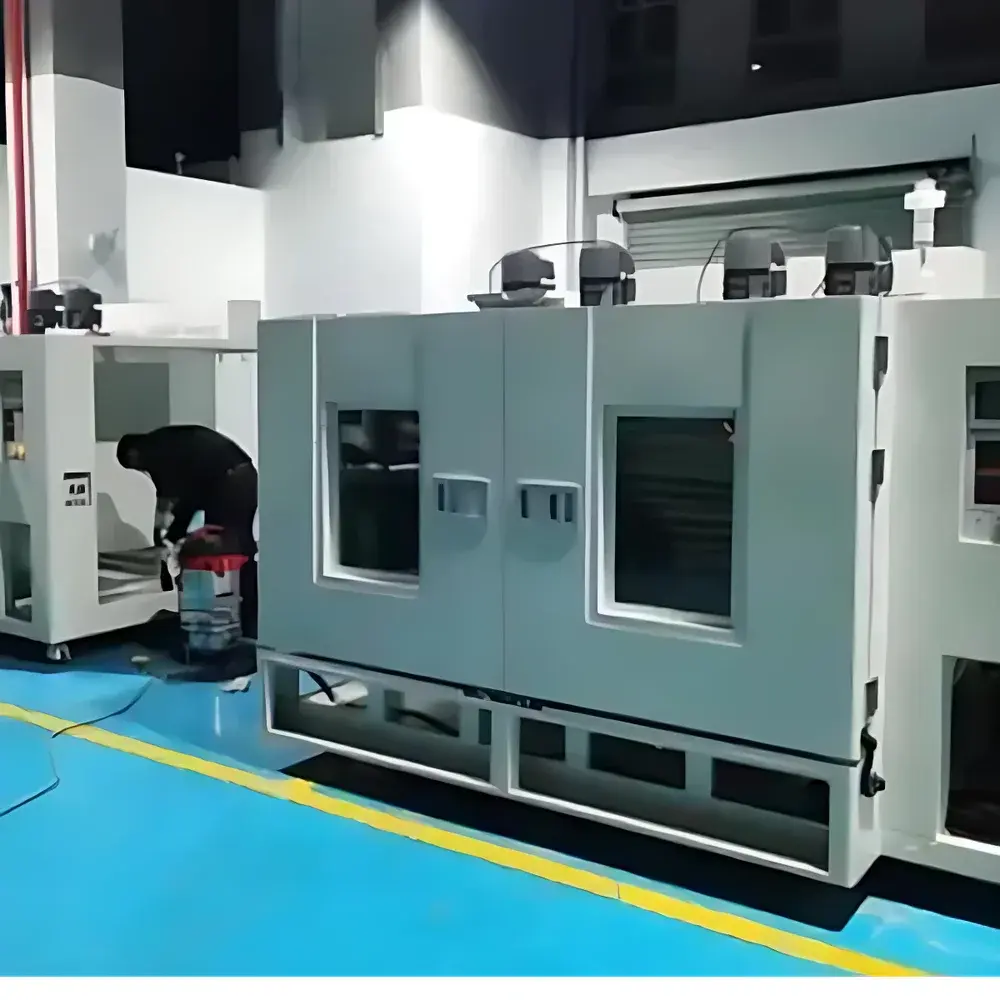
Jinhoo JH-Series Explosion-Proof Battery Environmental Test Chamber for EV & Energy Storage Systems
| Brand | Jinhoo |
|---|---|
| Origin | Shanghai, China |
| Model | JH-Series Explosion-Proof Battery Environmental Test Chamber |
| Temperature Range | −70 °C to +150 °C |
| Cooling Method | Dual-Compressor Refrigeration System (R23/R404A) |
| Explosion Protection | ATEX & IECEx Certified |
| Temperature Uniformity | ±2.0 °C |
| Temperature Stability | ±0.5 °C |
| Temperature Deviation | ±2.0 °C |
| Ramp-Up Time (25 °C → +150 °C) | ≤60 min |
| Ramp-Down Time (25 °C → −70 °C) | ≤45–80 min (model-dependent) |
| Chamber Dimensions | Customizable (Small / Medium / Large Internal Volumes) |
| Gas Monitoring | Real-time H₂ & CH₄ Detection with Auto-Alarm, Power Cut-off, and Forced Ventilation Interlock |
| Construction | 304 Stainless Steel with Explosion-Resistant Coating, Pressure Relief Valve, and Flame Arrestor Mesh |
| Compliance | Designed per IEC 62660-2, UN 38.3, GB/T 31467.3, ISO 12405-2, and GLP-aligned data integrity requirements |
Overview
The Jinhoo JH-Series Explosion-Proof Battery Environmental Test Chamber is an engineered solution for rigorous thermal and safety validation of lithium-ion and next-generation electrochemical energy storage systems under extreme ambient conditions. Built on Couette-flow–informed thermal chamber architecture and intrinsically safe enclosure design, it enables controlled exposure of battery cells, modules, and packs to temperature extremes—from cryogenic −70 °C to high-temperature +150 °C—while continuously monitoring for hydrogen (H₂), methane (CH₄), and other flammable gas species generated during thermal runaway events. Its dual-compressor refrigeration system ensures rapid, stable, and repeatable thermal transitions essential for evaluating low-temperature charge acceptance, high-temperature cycle life degradation, and transient thermal propagation behavior. This chamber is not a general-purpose environmental simulator; it is purpose-built for compliance-driven battery qualification in accordance with UN 38.3, IEC 62660-2, GB/T 31467.3, and automotive OEM-specific thermal abuse protocols.
Key Features
- ATEX/IECEx-Certified Explosion-Proof Enclosure: Constructed from 304 stainless steel with reinforced anti-spark coating, integrated pressure-relief valve, and certified flame-arrestor mesh—validated to Category 2G (gas) and Zone 1 hazardous area classification.
- Real-Time Flammable Gas Monitoring & Safety Interlock: Dual-sensor array (electrochemical H₂ + catalytic bead CH₄) with configurable alarm thresholds (ppm-level detection); triggers immediate audible/visual alert, mains power disconnection, and activation of high-capacity exhaust ventilation.
- Dual-Compressor Refrigeration Architecture: Independent R23 (low-temp stage) and R404A (medium-temp stage) circuits enable stable sub-zero operation down to −70 °C without oil migration or freeze-up risks; achieves ≤45 min ramp-down from 25 °C to −70 °C in standard configuration.
- High-Fidelity Thermal Control: PID-controlled air circulation system with platinum RTD feedback; maintains temperature uniformity within ±2.0 °C across the working volume and stability within ±0.5 °C at setpoint—critical for reproducible capacity fade and impedance spectroscopy correlation studies.
- Modular, Customizable Chamber Configurations: Internal dimensions scalable from 150 L (small cell/module testing) to 1000+ L (large-format pack evaluation); optional integration points for voltage/current logging, IR thermography ports, and vent-gas sampling manifolds.
Sample Compatibility & Compliance
The JH-Series accommodates cylindrical (18650, 21700, 4680), prismatic, and pouch-format cells up to 150 mm × 150 mm × 200 mm; module-level testing supports up to 12S4P configurations with integrated busbar access. All chambers are designed to meet mechanical and thermal boundary conditions specified in UN 38.3 Section 38.3.4 (thermal cycling), IEC 62660-2 Clause 7.3 (high/low temperature operation), and GB/T 31467.3 Annex C (abuse testing). The gas monitoring subsystem complies with EN 50104 (gas detectors) and supports audit-ready event logging aligned with FDA 21 CFR Part 11 and EU Annex 11 requirements when paired with validated software. Structural integrity has been verified per ISO 14644-1 Class 8 cleanroom-compatible mounting and seismic anchoring provisions.
Software & Data Management
The chamber operates via a dedicated industrial-grade controller with embedded Ethernet interface and OPC UA server support. Temperature profiles, gas concentration logs, alarm timestamps, and power cut-off events are recorded at 1 Hz resolution with SHA-256 hash-secured binary export. Optional PC-based software provides GLP-compliant electronic lab notebook (ELN) integration, user role-based access control (admin/operator/auditor), and automatic report generation per ISO/IEC 17025 templates. Audit trails include operator ID, parameter changes, calibration history, and firmware revision metadata—fully traceable for regulatory submissions to NHTSA, CATL, or TÜV SÜD certification bodies.
Applications
- EV Battery Development: Validation of cold-start performance at −40 °C, high-temperature calendar aging at 60 °C/80% RH, and combined thermal-electrical stress cycling per U.S. DOE AVTA protocols.
- Energy Storage System (ESS) Qualification: Long-duration thermal soak testing under IEEE 1679.2-defined conditions; salt-fog + temperature cycling per IEC 62477-1 for grid-scale battery enclosures.
- Aerospace & Defense Batteries: Altitude-simulated thermal shock (−55 °C to +120 °C in <90 s) compliant with MIL-STD-810H Method 502.7.
- Academic & Standards Laboratories: Reference-grade platform for inter-laboratory comparison studies supporting revisions to ISO 12405-2 and UL 1642 Annex B test matrices.
FAQ
Does this chamber support automated test sequencing with external battery cyclers?
Yes—via Modbus TCP or analog I/O interface; programmable trigger outputs synchronize temperature ramps with charge/discharge commands from Keysight, Bitrode, or Arbin systems.
Is third-party calibration documentation provided upon delivery?
Each unit ships with NIST-traceable calibration certificates for temperature sensors and gas detectors, plus as-found/as-left reports per ISO/IEC 17025.
Can the chamber be integrated into a centralized facility monitoring network?
Standard Ethernet/IP and optional MQTT support enable seamless integration with Siemens Desigo CC, Honeywell Experion, or custom SCADA platforms.
What maintenance intervals are recommended for the dual-refrigeration system?
Compressor oil analysis and filter replacement every 2,000 operational hours; full refrigerant purity verification annually per ASHRAE Standard 110.
Are custom safety interlocks available for integration with fume hoods or fire suppression systems?
Yes—dry-contact relay outputs and configurable logic inputs allow hardwired integration with Halon-free suppression systems and HVAC shutdown protocols per NFPA 850.



