
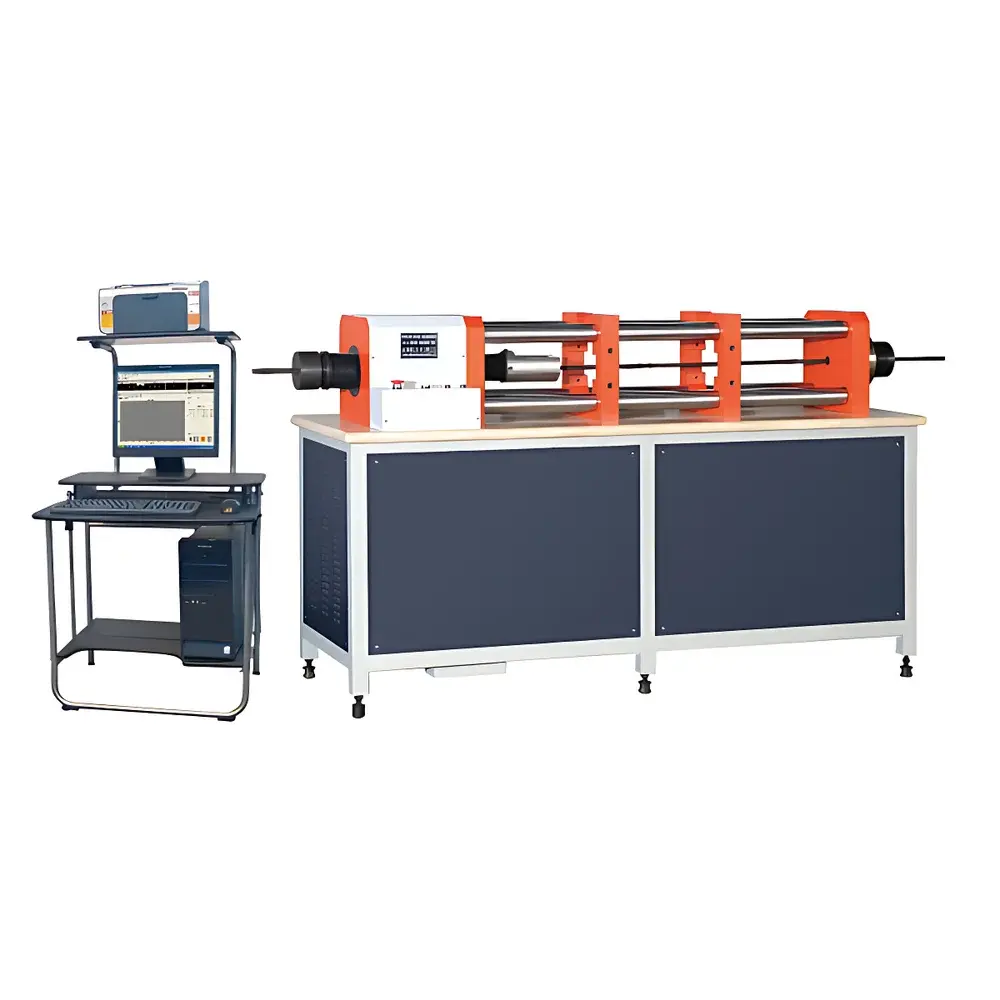
Jiubin GJX-300 Computer-Controlled Steel Strand Stress Relaxation Testing Machine
| Brand | Jiubin |
|---|---|
| Origin | Shanghai, China |
| Manufacturer Type | Authorized Distributor |
| Country of Origin | China |
| Model | GJX-300 |
| Price | Upon Request |
| Test Load Capacity | 300 kN |
| Effective Load Range | 6–300 kN |
| Load Indication Relative Error | ±1% |
| Load Resolution | 5 N |
| Displacement Indication Relative Error | ±1% |
| Loading Rate | 100–5000 N/s (adjustable) |
| Screw Travel | 100 mm |
| Test Zone Height | 2050 mm |
| Power Supply | 1.5 kW, AC 200 V ±10% |
| Dimensions (L×W×H) | 2000×1100×600 mm |
| Weight | 1250 kg |
Overview
The Jiubin GJX-300 Computer-Controlled Steel Strand Stress Relaxation Testing Machine is an electromechanical testing system engineered for the precise evaluation of time-dependent stress relaxation behavior in prestressed steel products—including steel wires, steel rods, seven-wire steel strands, and high-strength prestressing tendons—under constant elongation conditions at ambient temperature. Based on the fundamental principle of uniaxial tensile stress relaxation (per ASTM E328 and ISO 6934-4), the system applies and maintains a controlled initial load while continuously monitoring the decay of axial force over extended durations. Designed for compliance with structural material qualification protocols used in bridge infrastructure, precast concrete manufacturing, and civil engineering R&D, the GJX-300 delivers high reproducibility in long-term relaxation measurements up to 1000 hours, enabling extrapolation of relaxation loss according to logarithmic or power-law models defined in EN 10138 and GB/T 5224.
Key Features
- High-stability electro-mechanical loading train with servo-controlled hydraulic or electromechanical actuation (configurable per regional specification), ensuring minimal thermal drift and mechanical hysteresis during multi-day tests.
- Digital load and displacement transducer calibration traceable to national metrology institutes; load resolution of 5 N within a 300 kN full-scale range supports detection of sub-0.01% relaxation increments.
- Real-time dual-curve acquisition: simultaneous plotting of residual load (or % relaxation) vs. time and ambient temperature vs. time—both synchronized to a common timestamp with millisecond-level precision.
- Automated 1000-hour extrapolation algorithm compliant with ISO 6934-4 Annex B, using least-squares fitting of log(time) vs. log(stress) data to estimate long-term relaxation trends under standardized initial stress levels (e.g., 0.7σu, 0.8σu).
- Full digital control interface with programmable test profiles: users define initial load, hold duration, sampling interval (1 s to 3600 s), and auto-stop criteria (e.g., ΔF < 0.1% F0/hr).
- Integrated environmental monitoring: built-in Class II temperature sensor (±0.5 °C accuracy) mounted adjacent to specimen gauge section ensures thermal condition reporting aligned with ASTM E177 practice.
Sample Compatibility & Compliance
The GJX-300 accommodates standard steel strand specimens per ASTM A416, EN 10138-3, and GB/T 5224, including 1×7, 1×19, and 1×37 configurations with nominal diameters from 9.3 mm to 15.2 mm. Specimen gripping utilizes wedge-type self-tightening jaws with hardened alloy inserts to prevent slippage during prolonged relaxation phases. The system meets mechanical safety requirements per ISO 12100 and electrical safety per IEC 61000-6-2/6-4. Test reports generated include metadata required for GLP-compliant laboratories: operator ID, calibration certificate IDs, environmental logs, raw data timestamps, and audit-trail-enabled parameter change history.
Software & Data Management
The embedded Windows-based control software supports bilingual (English/Chinese) UI and provides full 21 CFR Part 11 readiness via optional electronic signature module, role-based access control, and immutable audit trails for all test setup modifications and result exports. Raw data are stored in .CSV and proprietary binary formats with embedded CRC-32 checksums. Curve visualization includes dynamic axis scaling, cursor-based data point extraction, overlay comparison of multiple tests, and export to PDF/Excel with customizable header templates. All test parameters—including initial load, target strain, sampling rate, and temperature threshold alarms—are saved as reusable templates with versioned revision tracking.
Applications
- Validation of relaxation class (RC1, RC2, RC3) per EN 10138 for post-tensioning strand suppliers.
- Third-party certification testing for highway bridge tendons under JTG/T F50 and AASHTO M203 specifications.
- Quality assurance in precast plant laboratories verifying batch-to-batch consistency of stress relaxation performance.
- Fundamental research on viscoelastic mechanisms in high-carbon steel microstructures under sustained load.
- Calibration support for national metrology institutes conducting inter-laboratory round-robin studies on relaxation measurement uncertainty.
FAQ
What standards does the GJX-300 comply with for stress relaxation testing?
It supports test execution and reporting per ASTM E328, ISO 6934-4, EN 10138-3, GB/T 5224, and JTG/T F50, with configurable calculation methods for relaxation rate and extrapolated 1000-h values.
Can the system perform tests beyond 1000 hours?
Yes—the hardware and firmware support continuous operation up to 4000 hours; however, extrapolation algorithms are validated only up to 1000 h per ISO 6934-4 Annex B.
Is temperature control integrated into the machine?
The base configuration includes ambient temperature monitoring; active chamber temperature control (±0.1 °C) is available as an optional add-on module.
How is data integrity ensured during long-duration tests?
All acquired data are written redundantly to internal SSD and external USB storage with periodic SHA-256 hash verification; unexpected power loss triggers automatic recovery from last stable checkpoint.
Does the system support remote monitoring?
Via optional Ethernet/Wi-Fi module, real-time curve streaming and alarm notifications (email/SMS) are enabled through secure TLS 1.2 API endpoints compatible with enterprise LIMS integration.



